Los KPI que definirán el éxito de los restaurantes en 2026 y cómo adelantarse con la IA
Escrito por: Sai Alluri y Andrew Liu, cofundadores

⟦embed:keyTakeaways⟧
The restaurant industry just wrapped up a transformative year.
In 2025, operators learned that the secret to growth isn’t a new menu item or marketing gimmick — it’s customer satisfaction, powered by AI. Across thousands of restaurant locations, brands that invested in intelligent guest insights outperformed those that didn’t — not just in service ratings, but in measurable revenue.
As we look to 2026, one theme stands out:
The QSRs that win will be the ones that connect guest satisfaction, operational efficiency, and personalized marketing — all through AI.
2025 in a Nutshell: What the Data Revealed
Drawing from insights across 20,000+ restaurant locations and 600+ brands, the data tells a clear story:
When guest experience improves, customers come back, and revenue follows.
Takeaway 1: Repeat Guests = Revenue Growth
A review of restaurant customer retention statistics indicates that quick-service restaurants generate roughly 71% of sales from repeat customers. And a recent industry research points out that repeat guests spend 67% more on average than first-time customers.
We’ve seen the same trends from our customers across 20,00 locations: that a small lift in return rate — even +8.4 percentage points — translated to tens of thousands in new annual revenue per location.
Takeaway 2: The Satisfaction Gap Is Closing
Brands that improved CSAT scores by 2–3% saw up to 119% more revenue uplift, proving satisfaction isn’t just a soft metric — it’s a financial engine.
Takeaway 3: AI Turned Feedback into Action
Operators that used AI-driven incident reporting and survey automation reduced guest issues by 45% and doubled their review response rate.
The result? Faster recovery, more loyal guests, and stronger brand reputation.
Takeaway 4: Unified Systems Outperformed Fragmented Ones
Restaurants running service, marketing, and operations on disconnected tools saw slower response times and inconsistent results.
Those that adopted AI-powered, unified guest intelligence platforms gained real-time visibility — and acted on insights instantly.
In short: 2025 proved that intelligence, not intuition, drives loyalty and growth.
2026: The Year of Predictive KPIs
If 2025 was about discovering the link between satisfaction and revenue, 2026 is about scaling it.
AI is enabling restaurant leaders to move beyond hindsight metrics and focus on predictive, revenue-linked KPIs. Here are the five that will matter most — and how AI helps you master them.
Key Metrics 1: Customer Satisfaction (CSAT / OSAT)
Why it matters: Guest satisfaction remains the single strongest predictor of revenue and repeat visits.
How AI helps:
Analyzes reviews, survey responses, and order feedback in real time.
Flags trending issues before they affect performance.
Benchmarks every location’s satisfaction score systemwide.
With AI copilots, operators can fix what matters most — faster than ever.
Key Metrics 2: Repeat Visit Rate
Why it matters: Returning guests spend more, promote the brand, and stabilize revenue.
How AI helps:
Predicts which guests are most likely to return.
Automates targeted marketing and loyalty offers.
Tracks the ROI of satisfaction-driven retention campaigns.
For growing QSRs, improving repeat visits by even 5% can boost profitability by up to 95%.
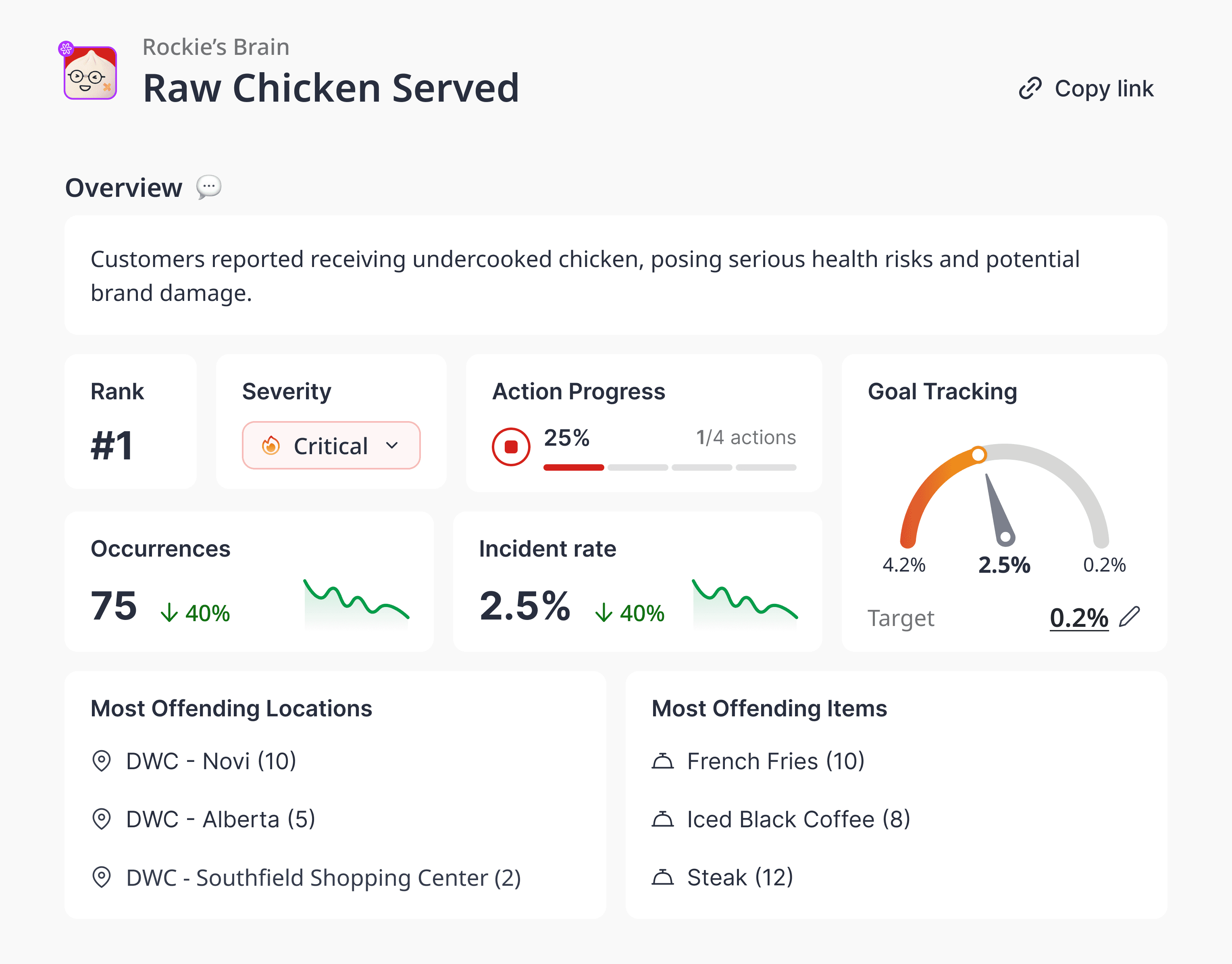
Key Metrics 3: Incident Rate & Recovery Speed
Why it matters: A high incident rate signals operational breakdowns and lost loyalty opportunities.
How AI helps:
Detects recurring service and order issues.
Triggers automated recovery workflows (like rewards or follow-ups).
Tracks time-to-resolution per store.
In the Papa Murphy’s case, this approach led to a 45% drop in incidents and $2M in recovered revenue.
Key Metrics 4: Revenue per Location
Why it matters: It’s the ultimate indicator of systemwide efficiency.
How AI helps:
Links CSAT and operational data directly to sales outcomes.
Reveals how each improvement — faster replies, fewer incidents — translates to dollars.
Provides predictive models for growth forecasting.
This is where the “CSAT to revenue” equation becomes tangible — satisfaction becomes measurable ROI.
How to Get There: The 2026 Operator’s Playbook
The path forward is clear — but execution requires alignment between people, data, and AI.
Transform your data into insights — Bring reviews, surveys, and ops insights into one platform.
Automate intelligently — Use AI to close the feedback loop and detect issues faster.
Coach with context — Give field ops teams the insights to act daily, not quarterly.
Measure what matters — Focus on KPIs that correlate directly with guest experience and revenue.
With these systems in place, every operator, marketer, and frontline employee can see — and improve — the metrics that truly drive growth.
Looking Ahead: From Satisfaction to Prediction
2026 won’t be about guessing what guests want — it’ll be about knowing it first. Restaurants that leverage AI to turn satisfaction data into predictive insights will outperform those that react too late. They’ll deliver faster service, happier guests, and stronger unit economics — all by focusing on the right KPIs. Because in the AI era of hospitality, the best restaurants don’t wait for feedback — they act on foresight.
Restaurant KPIs: FAQ
Which KPIs matter most for restaurants?
The KPIs that matter most link guest experience to revenue: guest satisfaction, repeat visits, incident rate and how each of these flows through to sales. Satisfaction is the strongest predictor of repeat visits and revenue. Tracking them together shows you which improvements actually pay off.
How does guest satisfaction affect restaurant revenue?
When guest experience improves, customers come back more often, and returning guests tend to spend more than first-time ones. That makes satisfaction a financial metric in its own right. Brands that raised their satisfaction scores saw clear revenue gains across their locations.
What is an incident rate for a restaurant?
Your incident rate measures how often guests report problems with service or orders. A high rate points to operational breakdowns and lost chances to build loyalty. AI can spot recurring issues, trigger recovery steps like rewards or follow-ups and track how long each store takes to resolve them.
How can AI help restaurants improve their KPIs?
AI analyzes reviews, surveys and order feedback in real time, flags trending issues and benchmarks every location. It can also predict which guests are likely to return and automate targeted offers to bring them back. Most importantly, it connects satisfaction and operational data to sales so you can see what each improvement is worth.
How do I start tracking guest experience KPIs across locations?
Start by bringing your reviews, surveys and operations data into one platform so every location is measured the same way. Then automate the feedback loop so issues get flagged and handled quickly. Give your field teams these insights daily so they can coach with context instead of waiting for quarterly reports.
 Los agentes de IA automatizan todas las interacciones con los clientes, las 24 horas, los 7 días de la semana, en todos los locales de tu restaurante.


" transform="translate(3.219 19.212)" width="152.45224485148515px"/><path d="M 0 11.619 C 7.071 11.39 33.491 21.738 40.35 21.268 C 38.499 18.19 37.116 14.915 35.507 11.625 C 33.7 7.867 32.587 3.926 31.702 0" fill="transparent" height="21.28391189647101px" id="I9fuJaf7q" stroke-dasharray="" stroke-linecap="round" stroke-linejoin="round" stroke-width="4.97" stroke="rgb(0, 0, 0)" transform="translate(139.727 55.754)" width="40.34950693069311px"/></svg>)