The Recovery Playbook: Turning an Unhappy Guest Into Your Most Loyal One
Written By: Thy Pham
Most QSR operators treat a bad review as damage to contain. But our data suggests the opposite: a poorly handled visit, when recovered well, can produce a guest who is more loyal than one who never had a problem at all. In our last article, we showed how closing the Response Gap, the silence between a complaint and a brand's reply, is the first step to stabilizing underperforming stores. This is what happens after you respond.
In our last article, we showed how closing the Response Gap, the silence between a complaint and a brand's reply, is the first step to stabilizing underperforming stores. This is what happens after you respond.
Unhappy Guests Are Your Biggest Retention Opportunity
There's a well-known concept in customer experience called the Service Recovery Paradox, the idea that a customer whose complaint is resolved well can end up more satisfied than one who never had an issue. For years, it's been treated as a theory. We now have the transaction data to back it up.
Across six months of POS-linked survey data from a QSR brand with 100+ locations, one pattern emerged consistently: guests who received a recovery offer and redeemed it didn't just come back. They came back more often than guests who had a good experience in the first place.
This isn't a rounding error. It's a structural retention opportunity hiding inside your complaint queue.
What the Data Actually Shows
Momos analyzed return behavior across three guest cohorts in the 30 days following a feedback submission:
Research methodology
Feedback Cohort Definitions - Three guest segments used to measure the impact of recovery vouchers on satisfaction.
Cohort | Rating | Voucher | Description |
|---|---|---|---|
Cohort 1 Bad + Redeemed | ≤ 3 | Received Used | Low-rating guests who received a recovery voucher and redeemed it. Core treatment group. |
Cohort 2 Bad + Not Redeemed | ≤ 3 | Received Not used | Low-rating guests who received a recovery voucher but did not redeem it. Control for voucher intent. |
Cohort 3 Good Feedback | > 3 | N/A | Satisfied guests with no voucher issued. Baseline cohort for comparison. |
The results were striking.
Company A · 30-day window
% Customers Returned (30d) - Only companies with ≥30 customers across all 3 cohorts
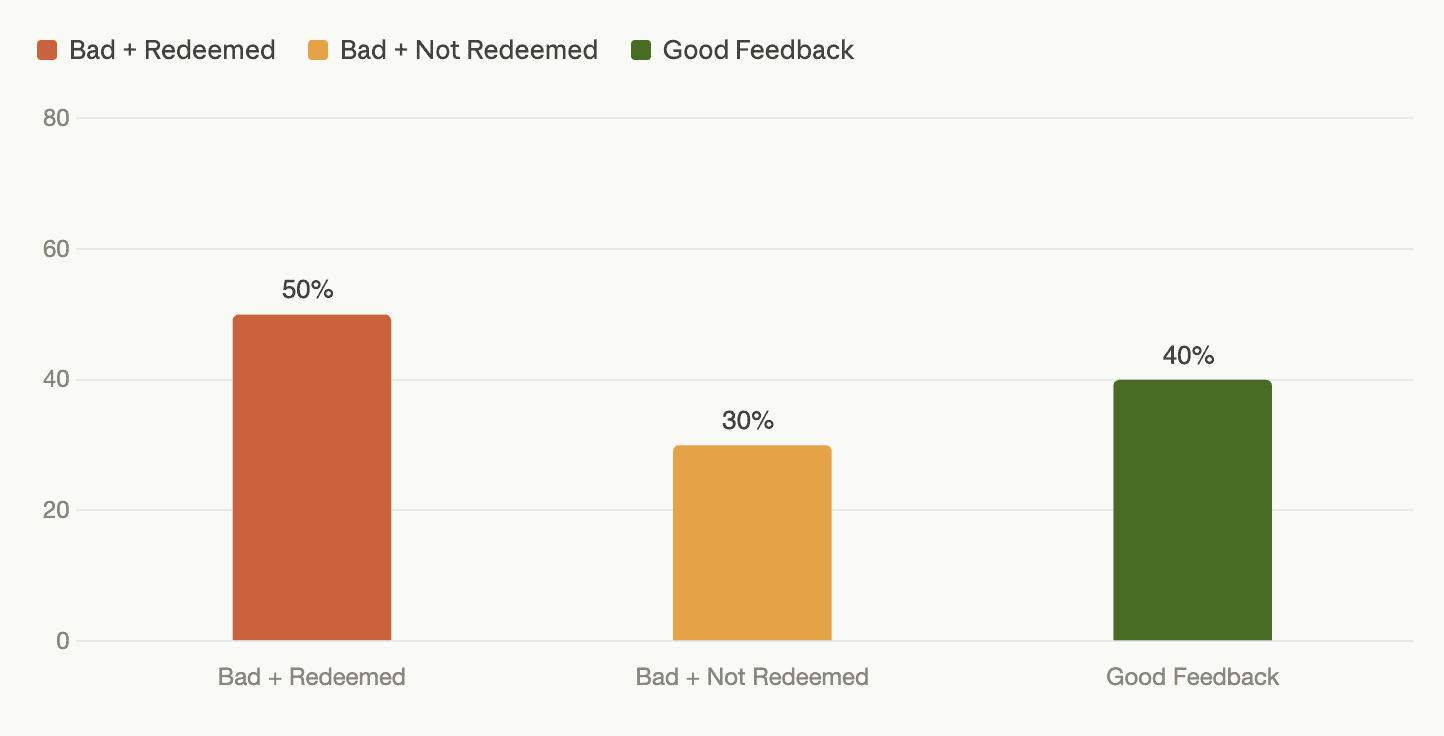
Redeemed guests have a 10% higher return rate than happy guests, and 20% higher return rate than guests who received an offer but didn't redeem it.
On return rates within 30 days: 50% of redeemers came back, compared to 40% for guests with good feedback (+10 percentage points) and 30% for non-redeemers (+20 percentage points).
The pattern was consistent across 100+ locations, over the full six-month window, which rules out seasonal noise or a single outlier month.
What this means for operators: Your unhappy guests are not lost. They are in a high-stakes decision window. How you respond in the next 24–48 hours determines whether they become your most frequent customers or churn permanently.
How is your recovery program performing? Talk to our team today!
The Offer Opens the Door. The Follow-Up Brings Guests Walk Through It.
Here's the key finding in the data: simply sending a recovery offer does not drive loyalty. Redemption does.
The non-redeemed cohort, guests who received the exact same voucher but never used it, returned at significantly lower rates than both redeemers and even guests who left happy. Sending the offer without driving redemption may actually signal to the guest that the brand is going through the motions.
This is where most QSR operators lose the recovery. The offer goes out. No one follows up. The guest forgets, or assumes the brand doesn't really care whether they come back.
The brands that win recovery treat it as a two-step process: the offer opens the door; the follow-up gets the guest to walk through it.
See how top brands recover unhappy guests. Talk to our team.
The 3-Step Recovery Loop
Turning this data into operational reality requires a repeatable system. One that doesn't depend on a manager remembering to follow up, or a district leader manually auditing complaint queues.
Step 1: Respond within 24 hours
As we covered in our previous article, speed of response is itself a signal. A fast, personalized acknowledgment tells the guest they've been heard before any offer is made.
Step 2: Send a simple, frictionless recovery offer
Complexity kills redemption rates. A single clear incentive tied to a return visit is what moves the needle. The easier it is to redeem, the more likely it gets used.
Step 3: Follow up with guests who haven't redeemed
This is the step most brands skip entirely. A timely SMS or email nudge sent a few days after the original offer is what separates brands with strong recovery rates from those still wondering why their offers aren't working.
Brands using Momos Guest AI have this loop running automatically, without the store manager needing to manage a separate workflow.
How Momos makes this happen
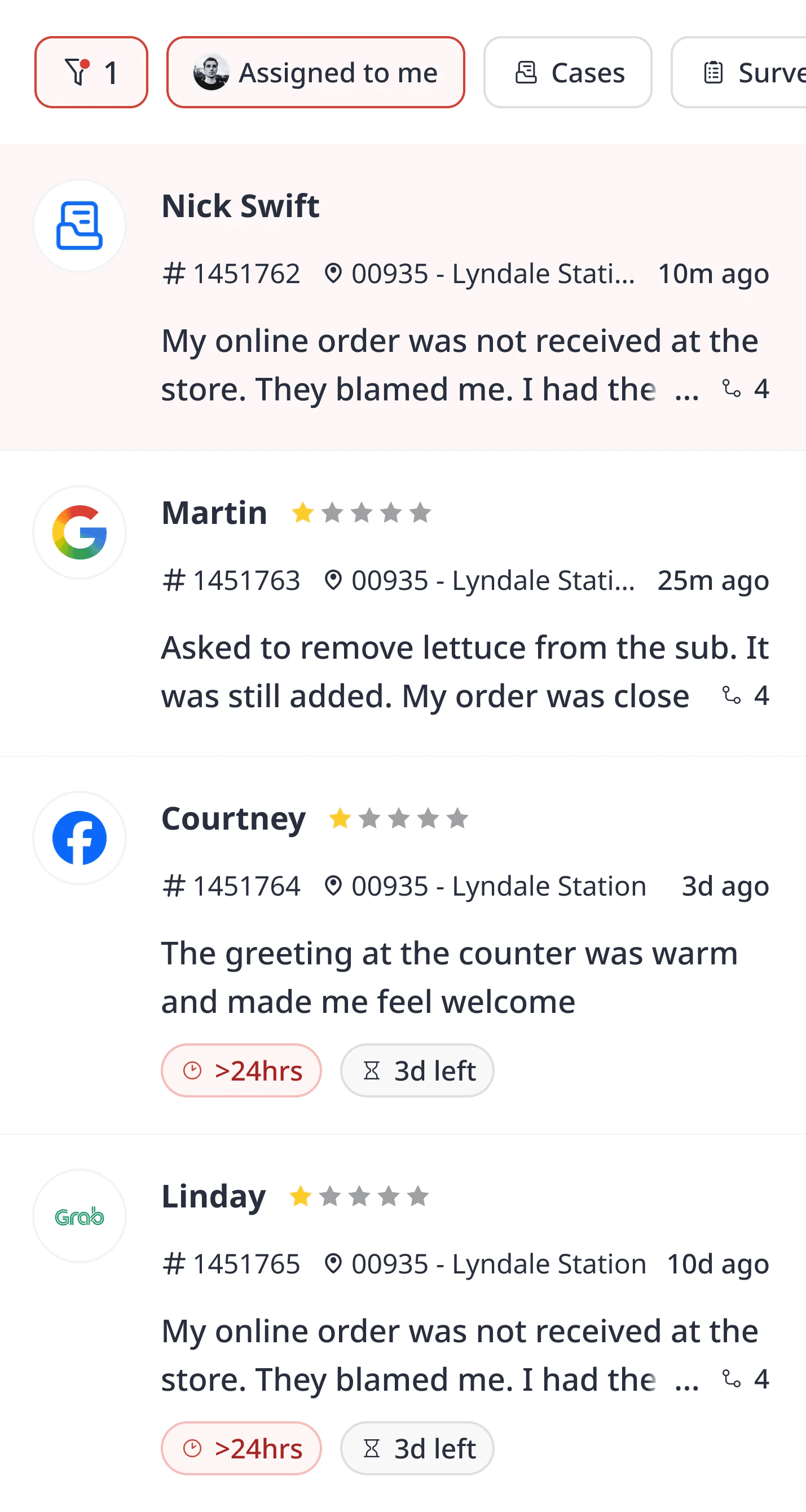
Most brands have the intention to recover guests but not the infrastructure. Momos Guest AI handles two of the hardest parts of this loop automatically: triggering the right recovery offer the moment a low-rating review comes in, and sending follow-up nudges via SMS or email to guests who received an offer but haven't redeemed it yet. No manual queue. No missed windows. The recovery runs whether or not a manager is on top of it that day.
Want the full data behind the trend?
Download the 2026 Industry Report: Make Every Location Your Best Location to see the complete analysis of 30,000+ locations, including what separates top-performing stores from laggards on every dimension of guest recovery.
The Bottom Line
The data is clear: recovery works, but only when it's completed. A guest who had a bad experience and came back on a redeemed offer isn't just salvaged. They are, on average, one of your highest-frequency returning customers.
The brands pulling ahead in 2026 aren't the ones with the fewest complaints. They're the ones with the best systems for turning complaints into loyalty.
For underperforming stores, a strong recovery program may be the fastest path to stabilization available. It doesn't require a new marketing budget. It requires closing the loop.
 AI agents automate all guest interactions, 24/7, across all locations of your restaurant.


" transform="translate(3.219 19.212)" width="152.45224485148515px"/><path d="M 0 11.619 C 7.071 11.39 33.491 21.738 40.35 21.268 C 38.499 18.19 37.116 14.915 35.507 11.625 C 33.7 7.867 32.587 3.926 31.702 0" fill="transparent" height="21.28391189647101px" id="I9fuJaf7q" stroke-dasharray="" stroke-linecap="round" stroke-linejoin="round" stroke-width="4.97" stroke="rgb(0, 0, 0)" transform="translate(139.727 55.754)" width="40.34950693069311px"/></svg>)