

Local SEO for Restaurants
Local SEO for restaurants is the work of helping every location appear when nearby guests search Google, Maps and other local search tools for a place to eat.
| Local SEO for Restaurants at a glance | |
|---|---|
| Also called | Local search optimization, local search marketing, map SEO |
| Goal | Appear in map results and local organic results when nearby guests search |
| Google's three factors | Relevance, distance and prominence |
| Core assets | Business profiles, location pages, consistent listings, reviews and structured data |
| Main profile | Google Business Profile (called Google My Business from 2014 to 2021) |
| Structured data | schema.org Restaurant, a type of FoodEstablishment and LocalBusiness |
| Key measures | Calls, direction requests, website clicks, orders and reservations per location |
| Paid shortcut | None; Google says you can't pay for a better local ranking |
Key takeaways
- Local SEO is everything you do to help each restaurant location appear when someone nearby searches for a place to eat.
- Google says local results depend on relevance, distance and prominence, and only relevance and prominence are within your control.
- Accurate profiles, a page for every location, consistent listings and a steady flow of genuine reviews are the foundations for a multi-location brand.
- Structured data such as schema.org Restaurant markup helps search engines read your hours, address, cuisine and menu correctly.
- Measuring calls, directions, website clicks and orders per location shows where local SEO is working and which locations need attention.
What is Local SEO for Restaurants?
Local SEO for restaurants is the work of helping every one of your locations show up when guests nearby search for somewhere to eat. It covers the map results on Google and other platforms, the local results below them, and the details guests see before they decide: hours, menu, photos, reviews and directions.
For a single restaurant, local SEO mostly means a well-kept Google Business Profile. For a brand with dozens or hundreds of locations, it becomes an operating discipline: accurate data for every location, a page for each restaurant, consistent listings across many sites, and a steady flow of reviews.
The payoff is practical. A guest who searches "tacos near me" at 7 p.m. is ready to order or walk in, and local search decides which of your locations, if any, they see first.
How local SEO works for restaurants
When someone searches with local intent, Google usually shows a map with a short list of businesses, known as the local pack, followed by regular web results. Google Maps, Apple Maps and review apps show similar lists. Local SEO aims to place each location in those lists with complete, accurate information.
Google explains in its help article on how to improve your local ranking that local results are based mainly on three factors.
| Factor | What Google says it means | How much you control it |
|---|---|---|
| Relevance | How well a profile matches what someone is searching for | High: categories, description, menu and attributes |
| Distance | How far each result is from the location in the search, or from the searcher | Low: your address is fixed |
| Prominence | How well known the business is, including links, articles, directories, reviews and ratings | Medium: built over time |
Google also says there's no way to request or pay for a better local ranking. Everything in local SEO therefore comes down to making each location relevant, accurate and well known.
A local SEO example
Imagine a fast casual brand with 40 locations. A guest in one neighborhood searches "healthy lunch near me." Google compares the profiles of nearby restaurants: their categories, menus and descriptions (relevance), their distance from the guest, and their reviews and reputation across the web (prominence).
If your nearest location lists the wrong hours, uses a generic category and has few recent reviews, a competitor with a complete profile may appear instead, even if your restaurant is closer. Fixing those three issues is the kind of local SEO work that pays off quickly.
Local SEO ranking factors Google confirms
Many local SEO checklists list dozens of "ranking factors." Google itself names a shorter set of practices in its help pages, and these are the ones worth building on first.
- Complete business information. Google advises adding complete, detailed information so it can match your profile to relevant searches.
- Accurate hours and location. Google suggests keeping opening hours current, including special hours for holidays, and verifying each location.
- Reviews. Google states that review count and review score factor into local ranking, and it encourages businesses to respond to reviews.
- Photos. Google recommends adding photos to show guests what to expect.
- Prominence on the web. Google draws on links, articles and directories it finds about your business.
Beyond these, much of what the industry believes about local ranking comes from correlation studies and testing by agencies and software vendors. Those findings can be useful, though they are best treated as informed opinion, since Google doesn't publish the weight of each factor.
Local SEO for multi-location restaurants
A brand with many locations faces problems a single restaurant never sees. Data has to stay accurate across hundreds of profiles, ownership is often split between head office and franchisees, and small errors repeat at scale.
Google offers tools designed for this. Its help pages describe bulk verification for businesses with 10 or more locations, and store codes, a unique identifier for each location, that let you update profiles through a spreadsheet upload. A consistent store code system also makes reporting by location much easier.
Governance matters as much as tooling. It helps to decide who owns each profile, who can change hours and photos, and who replies to reviews, then document it. Our playbook on how to rank every location on Google Maps walks through this for multi-location brands.
| Local SEO task | Usually owned by | Why |
|---|---|---|
| Brand name, categories, logo | Head office | Consistency across every location |
| Hours, holiday closures, temporary changes | Location or area manager | They know first when something changes |
| Location pages on the website | Marketing or web team | One template, local details per location |
| Review replies | Guest experience team or location | Speed and local knowledge |
| Reporting | Marketing or operations | Compare locations and spot gaps |
Location pages and local SEO
Each location deserves its own page on your website with its name, address, phone number, hours, menu, ordering and reservation links, and a few local details such as parking or nearby landmarks. That page becomes the source of truth that your profiles and listings point to.
Thin, near-identical pages are a common reason location pages underperform. A page that only swaps the city name gives search engines and guests little reason to prefer it, which is why it pays to add genuinely local content: photos of that restaurant, its own menu variations, or local catering options.
Our article on why location pages aren't ranking covers the most frequent fixes in more detail.
NAP consistency and listings in local SEO
NAP stands for name, address and phone number. Local SEO practitioners have long held that consistent NAP details across the web help search engines trust a business's information. Google doesn't publish how it weighs consistency, but inconsistent details clearly confuse guests who find an old number or address.
Google's guidelines for representing your business ask that your name reflect the name you use in the real world. Its help pages state that adding unnecessary information to the name isn't permitted and could result in suspension, so a location name like "Brand Name Best Pizza Downtown" carries real risk.
Restaurants appear on many more sites than Google: Apple Maps, Bing, Yelp, Tripadvisor, OpenTable and delivery apps among them. Our guide to third-party review sites explains how they differ and which ones matter most in each market.
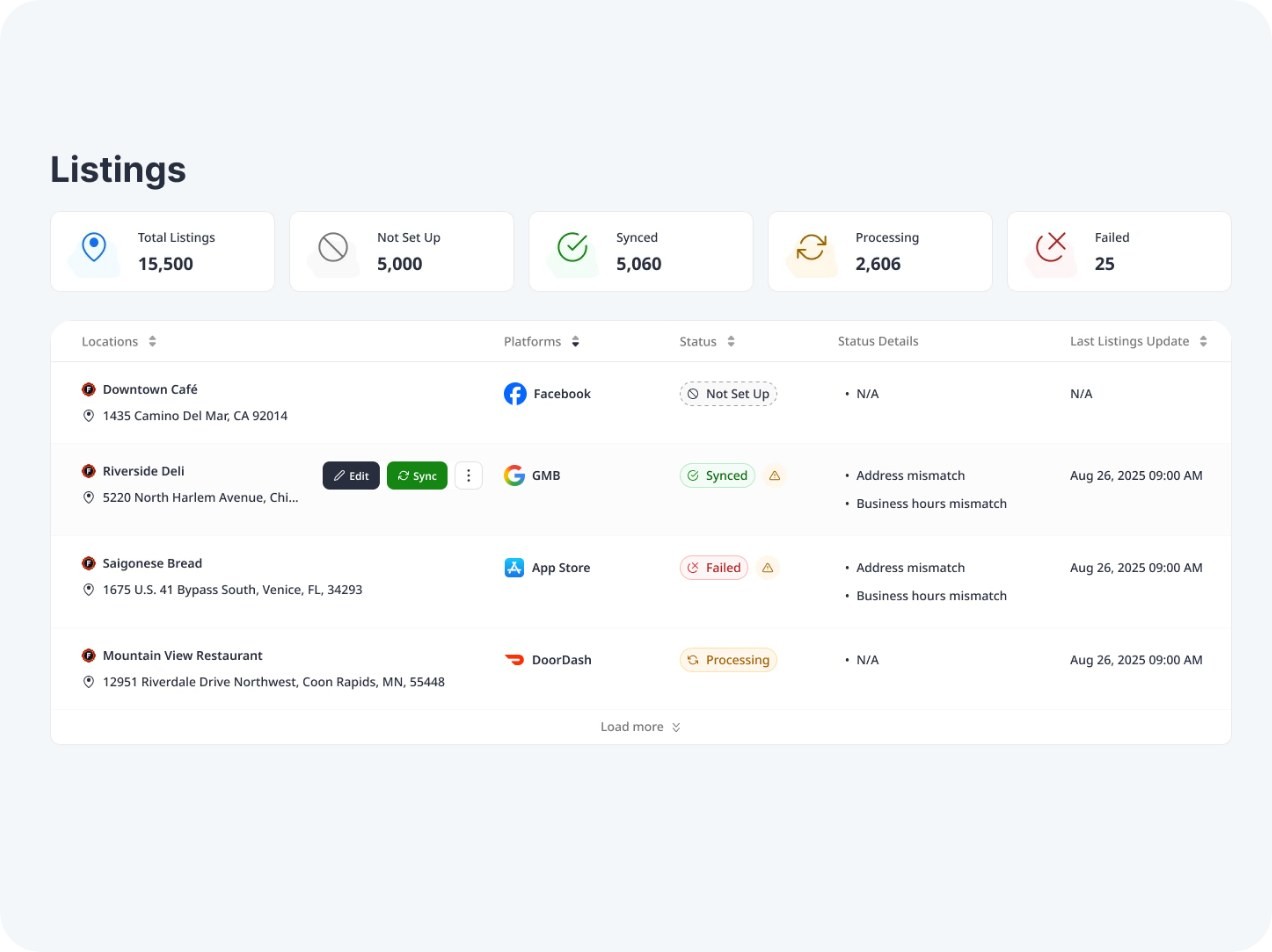
Keeping the same details on every one of those sites by hand becomes impractical past a few locations. Listings management tools publish a single, approved set of location data to many platforms and flag changes made elsewhere.
Reviews and local SEO
Reviews affect local SEO in two ways. Google lists review count and score as part of prominence, and reviews also influence whether a guest who sees your listing chooses it over the one beside it.
A steady flow matters more than an occasional burst. Tracking review velocity per location shows which restaurants are slowing down before it affects their visibility.
Your star rating on each platform is often the first thing guests compare in a list of nearby options, so it's worth watching how each location compares with the restaurants that appear beside it.
Asking every guest for a review in the same way keeps you within Google's policies, which prohibit incentives and selectively soliciting positive reviews. Our guide on getting more five-star Google reviews shows a compliant approach.
Structured data for local SEO
Structured data is code on your web pages that describes your business in a format search engines can read reliably. Google's local business structured data documentation explains how markup can tell Google about your hours, address and other details, and it uses a restaurant as its example.
On schema.org, Restaurant is a type of FoodEstablishment, which is itself a type of LocalBusiness. That means a restaurant page can use general business properties alongside food-specific ones.
| Property | What it describes | Restaurant example |
|---|---|---|
| name, address, telephone | Core location details | Matches your profile and signage exactly |
| openingHoursSpecification | Regular and special hours | Different hours on Sunday |
| servesCuisine | Type of cuisine | Mexican, ramen, salads |
| hasMenu | Link to the menu | The location's own menu page |
| acceptsReservations | Whether bookings are taken | True, or a booking URL |
| priceRange | Relative price level | $$ |
| geo | Latitude and longitude | The restaurant's coordinates |
Markup should describe what's on the page and match what guests see. Google's documentation notes that structured data helps it understand a page, and it doesn't guarantee any particular appearance in results.
Local SEO vs. traditional SEO vs. local ads
| Approach | Where it shows | What drives it | Cost model |
|---|---|---|---|
| Local SEO | Map results, local pack, location pages in organic results | Relevance, distance, prominence | Time and tools |
| Traditional SEO | Organic web results for broader searches | Content, links and technical quality | Time and tools |
| Local search ads | Sponsored map and search placements | Bids, budget and ad quality | Pay per click or action |
Most restaurant brands use all three. Traditional SEO helps your brand site rank for searches such as "catering menu," local SEO earns visibility for "near me" searches, and ads can support new openings while organic visibility builds.
How to measure local SEO
Measuring local SEO works best at the level of the location, since a brand average hides the restaurants that need help. Google's Business Profile performance view reports interactions such as calls, direction requests and website clicks, along with how people found the profile.
| Local SEO measure | What it tells you |
|---|---|
| Calls, direction requests, website clicks | How often searchers act on your profile |
| Orders and reservations from profile links | Revenue that started in local search |
| Searches that show your profile | Whether visibility is growing |
| Map ranking for key searches by area | Where each location appears for "near me" queries |
| Review count, rating and reply rate | The prominence and trust signals guests see |
| Listing accuracy | Share of listings with correct name, address, phone and hours |
Tagging the website link in each profile with UTM parameters lets your analytics separate visits from local search. Pairing those numbers with your review response rate and rating trends gives a fuller picture of each location's local presence.
Limitations of local SEO
- Distance is fixed. A location far from where guests search will struggle for those searches, however strong its profile.
- Google controls the layout. Changes to the local pack, ads or AI features can shift clicks without any change on your side.
- Attribution is partial. Calls and direction requests are counted when guests tap them, so phoning from a copied number or walking in won't appear.
- Results take time. Reviews, content and links build gradually, and competitive markets move slowly.
- Ranking factors are opaque. Google describes its factors in general terms, so much of the detailed advice in the industry is based on testing rather than confirmation.
How to improve local SEO for restaurants
Improvement usually starts with accuracy and then builds prominence. A short audit of every location shows where to begin.
- Verify and complete every profile. Primary and secondary categories, hours, menu, ordering links, attributes and recent photos give Google more to match against searches.
- Keep hours current. Holiday and temporary hours are among the details guests notice most when they're wrong.
- Publish a strong page for each location. Local content, an embedded map, the menu and structured data turn the page into a reliable source.
- Align listings everywhere. The same name, address and phone number on every platform reduces confusion for guests and search engines.
- Build a steady flow of reviews. Asking every guest consistently, through receipts, QR codes or post-order messages, keeps reviews recent.
- Reply to reviews promptly. Thoughtful replies show future guests that each location listens.
- Earn local mentions. Local press, community events and partnerships add to prominence in a way that also builds the business.
- Report by location. Comparing locations monthly reveals which ones need attention.
For a broader view of how local search fits your marketing, the Momos local marketing solution brings reviews, listings and guest messages together for multi-location brands.
Best local SEO tools for restaurants
Choosing a local SEO tool for a restaurant group depends on which part of the work takes most of your time. Some tools focus on publishing location data to many directories, while others focus on reviews, replies and the guest conversations that build prominence. Multi-location reporting and clear permissions for franchisees matter in either case.
| Tool | Best known for |
|---|---|
 MomosBest pick | Guest AI for multi-location restaurants. Reviews from Google, reservation and delivery platforms arrive in one Unified Inbox, with AI categorization by topic and sentiment, Alfie AI replies in your brand's voice and reporting across every location. |
 Yext | Listings and location data management across search engines, maps and directories |
 Birdeye | Reviews, listings and customer messaging for multi-location businesses |
 Reputation | Enterprise reputation management across reviews, listings and social media (formerly Reputation.com) |
 Chatmeter | Local brand reputation management with listings, review and sentiment analytics |
Each of these tools covers a different mix of listings, reviews and reporting. Comparing them against your own platforms, markets and number of locations, ideally with a trial at a handful of restaurants, is the most reliable way to choose.
Common local SEO mistakes
- Stuffing keywords into the business name. Google's guidelines ask for your real-world name, and extra keywords can lead to suspension.
- Letting holiday hours slide. A guest who arrives to a closed door after checking Google is unlikely to trust the listing again.
- Duplicate profiles. Old or duplicate profiles split reviews and confuse guests, so finding and resolving them is worth the effort.
- Pointing every profile to the homepage. Linking each location's profile to its own location page gives guests the right menu and hours.
- Near-identical location pages. Swapping only the city name adds little value for guests or search engines.
- Ignoring platforms beyond Google. Guests also search Apple Maps, Yelp, Tripadvisor and delivery apps, where outdated details cost visits.
- Offering incentives for reviews. Google's policies prohibit them, and they can lead to removed reviews.
History of local SEO
Local search grew out of printed directories such as the Yellow Pages, where businesses competed for visibility by category and town. Online, Google's local listings were managed through the Local Business Center, which the Google Maps blog announced in April 2010 would be renamed Google Places.
Google merged Places into Google+ Local in 2012, then consolidated its tools as Google My Business in June 2014. In November 2021, Google renamed the product Google Business Profile and moved much of its management into Search and Maps, as 9to5Google and Search Engine Land reported at the time.
Ranking changes shaped the practice too. In July 2014, Google rolled out a local algorithm update that Search Engine Land named "Pigeon," which tied local results more closely to web search signals. In August 2015, industry publications reported that Google had reduced its local pack from seven listings to three.
Structured data arrived alongside these changes. Google, Microsoft and Yahoo launched schema.org in June 2011, giving websites a shared vocabulary for describing businesses, including restaurants. In January 2023, Apple introduced Apple Business Connect, which lets businesses manage how they appear in Apple Maps and other Apple apps.
Frequently asked questions
What is local SEO for restaurants?
Local SEO for restaurants is the practice of improving how each location appears in local search, especially Google Maps and the map results at the top of Google. It covers your business profiles, location pages, listings, reviews and structured data, so that guests nearby find accurate information and choose to visit.
How does Google rank restaurants in local search?
Google says local results are based mainly on relevance, distance and prominence. Relevance is how well your profile matches the search, distance is how far you are from the searcher or the place they named, and prominence is how well known your restaurant is, which includes your review count and score.
Do reviews help local SEO?
Yes. Google states that review count and review score factor into local search ranking. Reviews also shape whether a guest clicks on your listing, so a steady flow of recent, genuine reviews and thoughtful replies supports both visibility and conversion.
Does each restaurant location need its own page?
A dedicated page for each location gives search engines and guests one clear, accurate source for that restaurant's address, hours, menu and ordering links. It's also the natural page to link from each location's Google Business Profile.
Can I put keywords in my Google Business Profile name?
Google's guidelines ask for your business name to match the name you use in the real world, on your storefront, website and signage. Its help pages say that adding unnecessary information to the name isn't permitted and can lead to suspension of the profile.
How long does local SEO take to work?
Corrections such as fixing hours or a wrong address can show up within days, while gains from reviews, content and links build over months. Results vary by market, competition and how much work each location needed at the start.
Is local SEO different for a franchise?
The same principles apply, with an extra layer of coordination. Franchise brands usually need clear rules about who owns each profile, who can edit hours and photos, and who replies to reviews, so that every location stays accurate and on brand.