

Post-Visit Survey
A post-visit survey is a short survey sent automatically after a dine-in, takeout or delivery visit, linked to that visit, to capture the guest's feedback.
| Post-Visit Survey at a glance | |
|---|---|
| What it is | A short survey triggered by a specific visit or order |
| Also called | Post-order survey, post-transaction survey, transactional survey |
| Typical triggers | Closed check, completed pickup, delivered order, finished reservation |
| Channels | Email, SMS, receipt link or code, QR code, app prompt |
| Typical length | One rating, two or three follow-ups and a comment box |
| Linked data | Location, order ID, visit type, daypart and items ordered |
| Key metric | Response rate = completed surveys ÷ invitations |
| Review rule | Every guest gets the same review invitation, whatever their score |
Key takeaways
- A post-visit survey is triggered by a specific visit or order, so every answer arrives with its location, channel, time and order attached.
- Timing works best when it follows the visit type, for example after dinner for dine-in guests and after the food has arrived for delivery guests.
- Your response rate is completed surveys divided by invitations sent, and tracking it by channel and location shows where guests are going unheard.
- The survey earns its keep when low scores reach a manager the same day and the guest hears back while the visit is still fresh.
- If your survey invites guests to post a public review, showing that invitation to every guest, whatever their score, keeps you clear of review gating.
What is Post-Visit Survey?
A post-visit survey is a short survey a restaurant sends automatically after a guest's visit or order. It's triggered by that specific visit, whether a dine-in meal, a takeout pickup or a delivery, and reaches the guest by email, text, receipt link, QR code or app.
The defining feature is the link to the visit. Each response arrives with the location, time, channel and often the order itself attached, so a comment about cold fries can be traced to the right store, shift and order.
Post-visit surveys are the most common way restaurants run a guest satisfaction survey. That entry covers survey goals, questions, sampling and sample sizes, while this one focuses on the trigger, timing by visit type, the visit data and the follow-up that makes each response useful.
How a post-visit survey works
Every post-visit survey program follows the same path from visit to action:
- Trigger. An event in your point of sale, ordering or reservation system, such as a closed check or a delivered order, starts the process.
- Eligibility. Rules decide who gets a survey, for example skipping guests surveyed in the last 30 days or orders without consent to contact.
- Invitation. The guest receives a link by email, text or app, or scans a code on the receipt.
- Response. The guest answers a few questions, and the answers are saved with the visit's details.
- Routing. Low scores and urgent topics go straight to the location's manager.
- Follow-up. The guest gets a reply where it's needed, and themes feed each location's weekly review.
Steps 5 and 6 are where most of the value lies. A survey that only produces a monthly score misses the chance to win back the guest who had a bad night.
A post-visit survey example
Suppose one location of a fast casual brand serves 6,000 orders in a month. After removing orders with no contact details and guests surveyed recently, 2,400 guests receive a survey by email or text.
Of those, 380 open the survey and start answering, and 312 complete it. The response rate is 312 ÷ 2,400 = 13.0%, and 312 ÷ 380 = 82.1% of guests who started went on to finish. These are illustrative numbers.
Because every response is linked to its order, the team can see that most low scores came from dinner delivery orders on weekends. That points to a specific fix, such as packaging or driver handoff, and a follow-up survey shows whether it worked.
Post-visit survey response rate calculator
Enter one period's numbers for a location or your whole brand. The calculator shows your response rate and where guests drop out between the invitation and the last question. The default values are only an example.
The formula is response rate = completed surveys ÷ invitations sent × 100. A low start rate points to the invitation itself, such as its timing, sender or wording, while a drop between starting and finishing usually means the survey is too long for a phone.
Post-visit survey timing by visit type
The best moment to ask depends on how the guest experienced your food. A survey that arrives before a delivery guest has eaten, or a day after a dine-in guest has forgotten the details, gets fewer and vaguer answers.
| Visit type | Usual trigger | Common timing |
|---|---|---|
| Dine-in | Check closed or paid | Within a few hours, often that evening |
| Takeout and pickup | Order marked as picked up | Within a few hours, after the meal |
| Direct delivery | Order marked as delivered | After the guest has had time to eat |
| Drive-thru and counter | Receipt code or QR code | Whenever the guest scans |
| Catering | Event date | The day after the event |
| Reservation | Reservation completed | That evening or the next morning |
Most restaurant brands see better answers when the survey arrives close to the meal, since memories of a visit fade quickly. Testing two send times at a few locations shows what works for your own guests.
Post-visit survey channels and visit data
Each channel identifies the visit in a different way, which affects how precisely you can trace a response and whether you can follow up.
| Channel | How the visit is identified | Can you follow up? |
|---|---|---|
| Email after an online or loyalty order | Order ID in the link | Yes, by email |
| SMS after an order | Order ID in the link | Yes, by text with consent |
| App prompt | Order in the guest's account | Yes, in the app |
| Receipt code or link | Code printed for that check | Only if the guest leaves contact details |
| QR code on table, bag or receipt | Location, sometimes table or order | Only if the guest leaves contact details |
A QR code printed per location, or per order on the receipt, is the main way to reach walk-in guests you have no contact details for. Codes unique to each check give you the same order-level detail as an emailed link.
Third-party delivery apps usually keep guests' contact details, so post-visit surveys mostly reach guests who ordered directly from you. Feedback from app orders arrives instead as delivery app ratings, which are worth reading alongside your own survey results.
Tying responses to the visit
The more of the visit you attach to a response, the faster a manager can act on it. Most programs capture these fields automatically from the trigger:
- Location. The single most important field, since it decides who owns the follow-up.
- Order or check ID. Lets a manager pull up exactly what was ordered and when.
- Visit type and daypart. Separates drive-thru lunch from dine-in dinner, which often score very differently.
- Items ordered. Shows whether complaints cluster around one dish or a new menu item.
- Guest identity. Linking the response to a loyalty or first-party guest data profile shows whether a regular or a first-time guest had the problem.
Post-visit survey questions and length
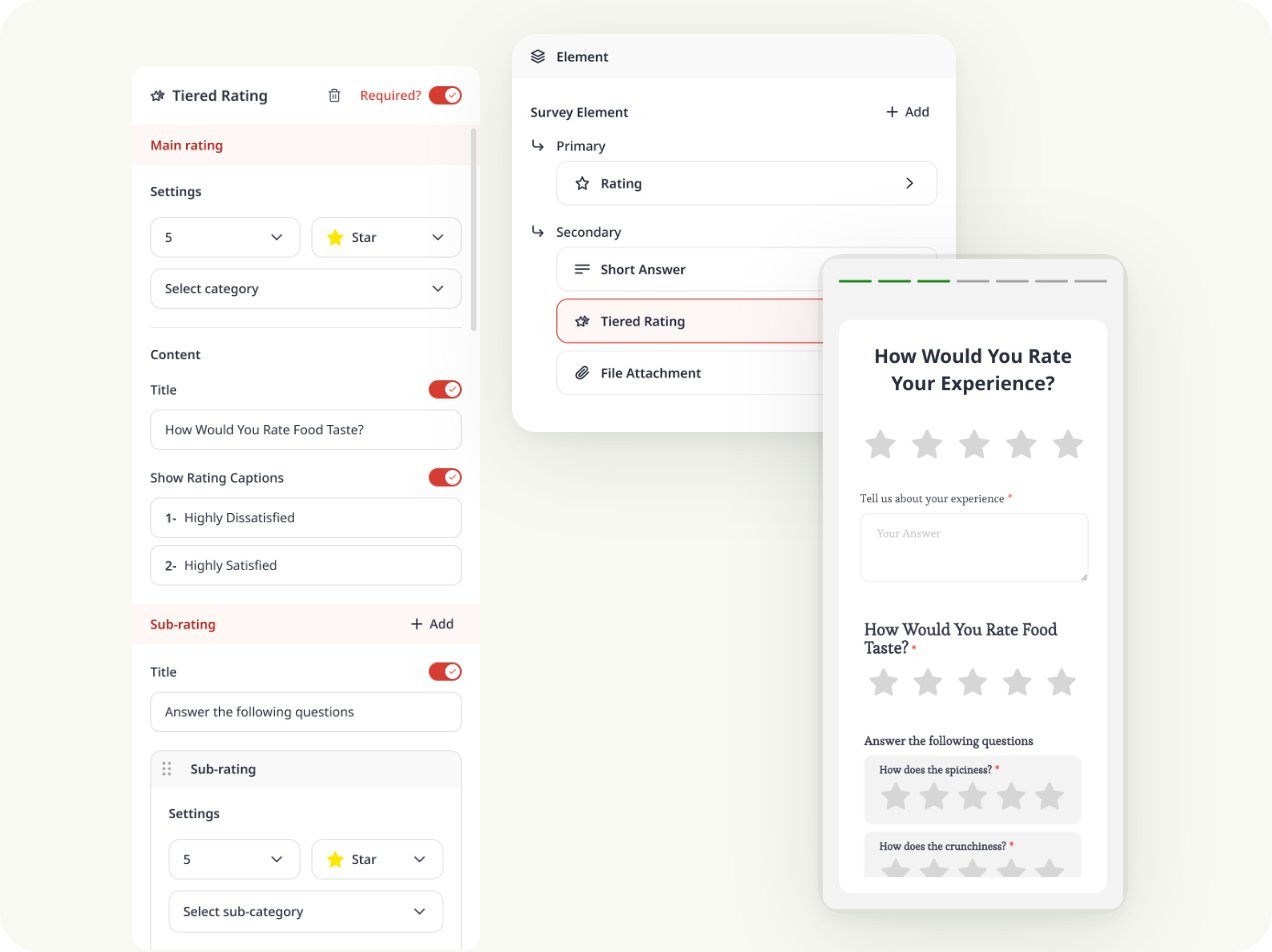
A post-visit survey is usually short: one headline rating, two or three follow-up questions and an optional comment box. Guests answer on their phones, often within minutes, so every extra question costs completed responses.
Matching the follow-up questions to the visit type makes them more useful. Delivery guests can tell you whether the order was complete and arrived hot, dine-in guests can rate service and atmosphere, and drive-thru guests can rate speed and accuracy.
The headline rating is typically CSAT, NPS or a star rating, asked first so it isn't colored by the questions that follow.
Momos's list of restaurant survey questions offers examples for dine-in, takeout and delivery surveys.
Post-visit survey response rates
Your response rate is completed surveys divided by invitations sent. There is no reliable public benchmark for restaurant post-visit surveys, because published figures depend heavily on channel, timing, length and how each company counts invitations.
The way you count invitations matters most for printed codes. With email or text you know exactly how many guests you invited, while with receipt and QR codes the closest equivalent is the number of receipts or bags that carried the code.
Several practices tend to raise response rates:
- A recognizable sender. Guests open messages from a brand name they know.
- A link that opens on the first question. Every extra tap before the first answer loses guests.
- Sending close to the visit. The meal is still fresh, so answering feels natural.
- One reminder at most. A single follow-up recovers some guests, and more feel like spam.
- Visible action. Guests who see that feedback leads to replies and changes are more willing to answer next time.
Closing the loop on a post-visit survey
The fastest value from a post-visit survey comes from the low scores. Because each response is linked to a location and order, a manager can reply to an unhappy guest the same day, often with an apology and an offer to come back.
That routine is known as closed-loop feedback. The reply repairs the relationship with one guest, and the fix at the location protects everyone who comes after.
Automating the first step keeps it reliable at scale. A post-order survey workflow that routes low scores to the right manager within minutes means no unhappy guest waits days for an answer.
Positive responses deserve attention too. Sharing compliments with the team member a guest mentioned is a simple form of recognition, and it reminds crews that guests notice good work.
Post-visit surveys and review gating
Many brands use the end of a post-visit survey to invite guests to post a public review. That's allowed, as long as every guest sees the same invitation. Showing the review link only to guests who gave high scores is review gating, which Google's policies prohibit.
US rules add to the platform policies. The FTC's 2024 rule on fake reviews and testimonials bans suppressing negative reviews through threats or intimidation and bans incentives conditioned on positive sentiment. Rules change, so it's worth checking the current version.
Messaging consent matters for text surveys. The FCC's guide to unwanted robocalls and texts explains that automated texts to a mobile phone need the owner's prior consent, which is why most brands collect an opt-in at ordering or checkout.
Post-visit survey vs. other feedback methods
| Method | When it's sent | Linked to a visit? | Best for |
|---|---|---|---|
| Post-visit survey | Automatically after each visit | Yes | Fast, location-level feedback and recovery |
| Guest satisfaction survey | Usually as a post-visit survey | Usually | Measuring satisfaction over time |
| Relational survey | Quarterly or yearly | No | Brand-level loyalty such as relational NPS |
| Comment card | During the visit | Location only | Simple in-person feedback |
| Online review | Whenever the guest chooses | Rarely | Public reputation |
The terms overlap in practice. "Guest satisfaction survey" describes what you measure, and "post-visit survey" describes when and how you ask, so most restaurant satisfaction surveys are post-visit surveys.
Limitations of post-visit surveys
- Coverage gaps. Email and text surveys reach only guests who left contact details, which often means loyalty members and direct online customers.
- Missing delivery app guests. Orders placed through third-party apps usually can't be surveyed directly.
- Strong opinions answer first. Guests with a very good or very bad visit are more likely to respond than guests whose visit was simply fine.
- Survey fatigue. Regulars who are asked after every visit stop answering unless you limit how often each guest is surveyed.
- Integration effort. Order-level linking depends on connecting your point of sale or ordering system, which can take work across many locations.
How to improve a post-visit survey
Match the survey to the visit. A delivery survey that asks about order accuracy and temperature gets more useful answers than a generic one, because it asks about what the guest actually experienced.
Limit how often each guest is asked. A rule such as one survey per guest per month protects your most loyal guests from fatigue and keeps their answers thoughtful.
Route low scores in minutes. Sending low scores and urgent topics, such as allergies, straight to the location manager turns the survey into a recovery tool.
Show guests what changed. Mentioning a recent improvement in the invitation, such as new packaging, tells guests their answers matter and encourages them to respond.
Review response rates by location. A location with a much lower response rate than its peers may have a broken trigger, a missing QR code or a receipt printer problem.
Best post-visit survey tools
The most useful post-visit survey tools connect to your point of sale and ordering systems, send invitations automatically by visit type, attach the visit's details to each response, and route low scores to the right manager. For multi-location brands, reporting across locations matters as much as the survey itself.
| Tool | Best known for |
|---|---|
 MomosBest pick | Guest AI for multi-location restaurants. Post-visit surveys arrive in one Unified Inbox alongside reviews from Google, reservation and delivery platforms, with AI categorization by topic and sentiment, recovery offers for unhappy guests and reporting across every location. |
 Ovation | Post-visit guest surveys for restaurants, with SMS follow-up to resolve issues privately |
 SMG (Service Management Group) | Guest experience measurement and benchmarking for multi-unit restaurant and retail brands |
 Medallia | Enterprise experience management across survey, digital and contact center feedback |
 Qualtrics | Enterprise survey and experience management platform with advanced analytics |
 SurveyMonkey | General-purpose online surveys and forms |
These tools range from restaurant-focused platforms to general survey builders. Momos's comparison of Momos and Ovation shows how two restaurant-focused approaches differ, and comparing tools against your own channels and locations will help you choose.
Common post-visit survey mistakes
- Sending one survey for every visit type. Delivery and dine-in guests experience different things, so generic questions miss the details.
- Sending too early or too late. A delivery survey that arrives before the food does, or a dine-in survey sent days later, gets vague answers.
- Losing the visit data. A response without location and order details is hard to act on.
- Letting low scores wait. A guest who reports a problem and hears nothing back is less likely to return.
- Surveying the same guests too often. Regulars stop answering, and your sample shifts toward occasional guests.
- Showing the review link only to happy guests. That's review gating, which Google's policies prohibit.
History of the post-visit survey
Restaurants first collected feedback after a visit through comment cards left on tables or handed out with the check. As chains grew, many printed survey invitations on receipts, asking guests to call a phone number or visit a website, often in return for an offer on their next visit.
QR codes, invented in 1994 by Denso Wave in Japan, later gave guests a quick way to open a survey from a receipt or table. Email and text messaging made it possible to send a survey automatically within minutes of an order.
Regulation shaped how surveys reach guests. The US Telephone Consumer Protection Act of 1991 governs automated calls and texts, and in 2024 the Federal Trade Commission finalized its rule on consumer reviews and testimonials, which affects how surveys can invite guests to post reviews.
Today, post-visit surveys are typically triggered directly by point of sale and ordering systems, and AI tools sort the responses by topic and sentiment and help managers reply.
Frequently asked questions
What is a post-visit survey?
A post-visit survey is a short survey a restaurant sends automatically after a guest's visit or order. Because it is triggered by that visit, each response is linked to the location, channel, time and order, which makes it easy to act on.
When should a post-visit survey be sent?
Usually within a few hours of the visit, while the guest still remembers the details. For delivery, it works best after the food has arrived and the guest has had a chance to eat, and for catering, the day after the event.
How many questions should a post-visit survey have?
Most restaurant post-visit surveys use one headline rating, two or three short follow-up questions and an optional comment box. Guests usually answer on a phone, so a survey that takes under a minute tends to get the most completed responses.
What is a good response rate for a post-visit survey?
There is no reliable public benchmark for restaurants, because response rates vary with channel, timing, survey length and how invitations are counted. Your own rate by channel and location, tracked month by month, is the most useful comparison.
How is a post-visit survey different from a guest satisfaction survey?
A guest satisfaction survey describes what you measure, satisfaction with the experience. A post-visit survey describes when and how you ask, triggered by one specific visit. Most restaurant satisfaction surveys are delivered as post-visit surveys.
Can I send post-visit surveys by text message?
Yes, if the guest has given consent. In the US, the FCC's rules under the Telephone Consumer Protection Act require prior consent for automated texts, so a clear opt-in at ordering or checkout is the usual approach.
Can a post-visit survey ask guests for a Google review?
Yes, as long as every guest sees the same invitation whatever score they gave. Showing the review link only to happy guests is review gating, which Google's policies prohibit.