

Review aggregation
Review aggregation is collecting reviews and ratings from many sites into one feed, page or summary score, like an aggregate star rating.
| Review aggregation at a glance | |
|---|---|
| Also called | Review syndication (when shown on your own site), review consolidation |
| Three common meanings | A unified review feed, a review aggregator site, an aggregate rating |
| Typical sources for restaurants | Google, Yelp, Tripadvisor, delivery apps, booking platforms, surveys |
| How reviews are collected | Platform APIs, official integrations, data exports |
| Aggregate rating | An average score plus the number of ratings behind it |
| Structured data type | schema.org AggregateRating |
| Key rules | Platform terms of use; Google review snippet policies; US FTC rule on consumer reviews (2024) |
| Best for | Brands that need one view of reviews across many platforms and locations |
Key takeaways
- Review aggregation brings reviews from every platform and location into one place, and that's what makes review management practical at scale.
- The term also describes review aggregator sites, which compile ratings from other sources, and the aggregate rating that sums up many reviews in one number.
- An aggregate rating means little without the count behind it, so a 4.6 from 900 reviews and a 4.6 from 12 reviews deserve different levels of trust.
- Since 2019, Google hasn't shown review stars in search for businesses that mark up reviews about themselves on their own website.
- When you display aggregated reviews on your site, it matters that you show them fairly, since the FTC's 2024 rule covers misleading review suppression.
What is review aggregation?
Review aggregation is the practice of collecting reviews and ratings from many sources and bringing them together in one place. That place might be a single feed, a page or a summary score.
If you run a restaurant brand, it usually means pulling reviews from Google, Yelp, Tripadvisor, delivery apps and booking platforms for every location into one view. Without it, your team would need a separate login, and a separate routine, for each platform at each restaurant.
People use the term in three related ways, and each one matters to restaurant operators:
- A unified review feed. Software that collects your reviews from every platform into one inbox or dashboard.
- A review aggregator site. A website that compiles ratings published elsewhere and summarizes them, like Google's "Reviews from the web" panel.
- An aggregate rating. The single score, like 4.4 stars from 820 reviews, that sums up many individual ratings.
We cover all three below. Aggregation is the foundation of review management, since you can only reply to, analyze and act on reviews you can see.
What review aggregation means
| Meaning | What it is | Example for a restaurant |
|---|---|---|
| Unified review feed | Collecting your own reviews from many platforms into one tool | Every location's Google, Yelp and delivery reviews in one shared inbox |
| Review aggregator site | A site that compiles reviews or ratings published elsewhere | Ratings from other review sites shown in Google's local business panel |
| Aggregate rating | A summary score with the number of ratings behind it | "4.4 stars, 820 reviews" on your Google Business Profile |
| Review syndication | Showing aggregated reviews somewhere else, often your website | A reviews widget on each location page |
When restaurant operators talk about review aggregation, they almost always mean the first sense: one place to see every review. The other meanings shape how guests come across your ratings in search.
How review aggregation works
Review aggregation software follows a similar sequence, whatever the vendor.
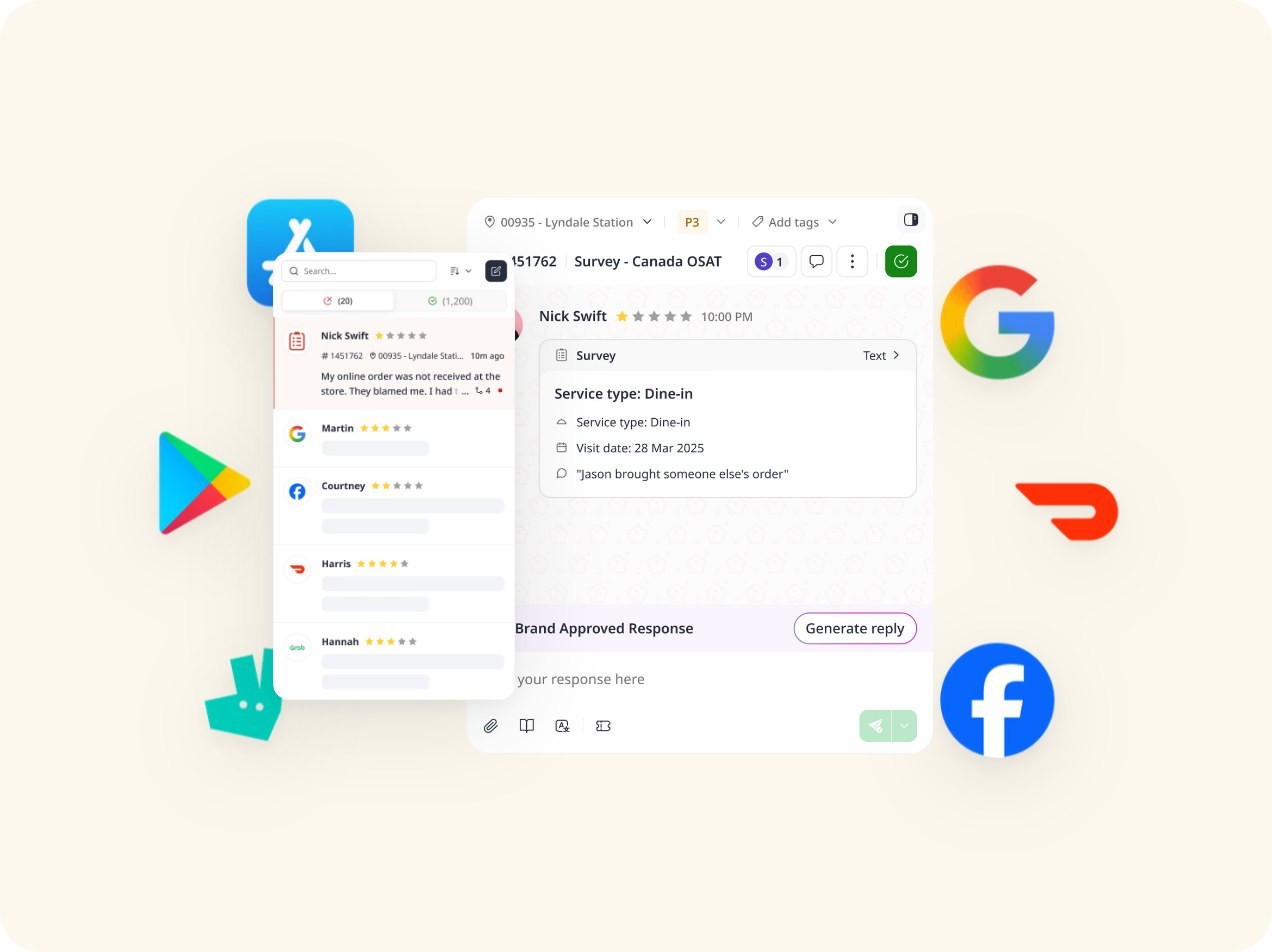
1. Connecting sources
The tool connects to each platform where your guests leave reviews. The most reliable connections use official APIs or partner integrations, which return reviews with their rating, text, date and location.
Google, for example, offers Business Profile APIs for review data. They let approved applications list and reply to reviews for the locations a business manages. You can see the platforms we connect to on our integrations page.
2. Matching reviews to locations
Each review needs to be attached to the right restaurant. Matching depends on accurate, consistent listings, which is one reason listings management and review aggregation work well together.
3. Normalizing the data
Platforms use different scales and formats. Most use one to five stars, while some delivery apps collect thumbs-up or percentage ratings that don't convert neatly to stars. Good aggregation keeps the original rating and labels the platform, so comparisons stay honest.
4. Enriching each review
Once your reviews sit in one place, they can be tagged by topic and tone. Sentiment analysis adds themes like wait time or order accuracy. That makes patterns across platforms visible and surfaces guest insights that no single platform shows.
5. Displaying and routing
The aggregated reviews then appear in an inbox, a dashboard or alerts, and are routed to the people responsible for each location. A location-level operator report puts each restaurant's reviews in front of its manager.
Review aggregation example: combining ratings
Aggregation often raises a practical question: what's a location's overall rating across platforms? Picture a location with three platform ratings (made up for this example).
| Platform | Average rating | Number of reviews | Rating × reviews |
|---|---|---|---|
| 4.4 | 800 | 3,520 | |
| Yelp | 3.8 | 150 | 570 |
| Tripadvisor | 4.0 | 50 | 200 |
| Total | 1,000 | 4,290 |
A simple average of the three platform scores gives (4.4 + 3.8 + 4.0) ÷ 3 = 4.07. That gives 50 Tripadvisor reviews the same weight as 800 Google reviews.
A weighted average counts every review once:
Combined rating = sum of (rating × reviews) ÷ total reviews = 4,290 ÷ 1,000 = 4.29
The weighted figure better reflects what the location's guests said overall. Even so, it's wise to report each platform's rating next to it, because guests see each platform's own score and each one has a different audience.
Any aggregate rating is only as meaningful as the review count behind it. A star rating built on a handful of reviews can swing sharply with each new one, so the count and review recency belong next to the average. Some tools fold these measures into a single reputation score.
Aggregate ratings and review aggregation in search
On Google, the rating on your Business Profile is itself an aggregate. Google's help page on review scores explains that the score is the average of all ratings published on Google for the place, on a scale of one to five stars.
On your own website, you can describe ratings with schema.org's AggregateRating markup. It records the average (ratingValue) and the number of ratings or reviews (ratingCount or reviewCount), and search engines use it for review rich results.
There's an important limit for restaurants. In 2019, Google announced that it would stop showing review rich results for "self-serving" reviews on LocalBusiness and Organization pages. That covers reviews about a business on its own site, whether added directly or through an embedded third-party widget.
So aggregating your reviews onto your website can help visitors who are deciding where to eat, while the stars in search come mainly from your Google Business Profile. For local visibility, strong profiles for every location matter more.
Review aggregation vs. review management
| Practice | What it does | Output |
|---|---|---|
| Review aggregation | Collects reviews and ratings from many sources | A unified feed, a combined rating or a reviews widget |
| Review management | Monitors, answers, requests and analyzes reviews | Replies, new reviews, insights and operational fixes |
| Online reputation management | Manages everything said about the brand online | A stronger reputation across reviews, social media and search |
| Listings management | Keeps business details accurate across directories | Correct hours, menus and locations everywhere |
Aggregation is the data layer. It tells you what guests are saying, and management and the wider reputation work decide what you do about it.
Benefits of review aggregation
- Nothing goes unseen. Reviews on smaller platforms or at quieter locations appear alongside everything else.
- Faster replies. One feed removes the time spent logging in to each platform, which supports a stronger review response rate.
- Fair comparisons between locations. Consistent data lets you compare ratings, review velocity and themes across restaurants, which shows how location-level reputation drives growth.
- Clearer patterns. Seeing every platform together shows whether a complaint is local to one app or common across channels.
For a large brand, the effect can be big. Potbelly, for example, consolidated guest feedback and streamlined recovery across 472 locations. Condado Tacos turned its feedback into chain-wide guest intelligence.
Limitations of review aggregation
- Coverage depends on access. Platforms decide what third-party tools can retrieve, and some limit the reviews or details available through their APIs. Coverage can differ from one vendor to another.
- Terms of use apply. Many platforms restrict automated copying of their content and set rules for displaying it elsewhere, including attribution.
- Ratings don't always combine cleanly. Different scales, audiences and filtering systems mean a combined rating is a useful summary, while each platform's own figure is still the one guests see.
- Delays and gaps occur. Reviews can arrive in your feed with a lag, and a platform may later filter or remove some of them.
There's also a display risk if you show aggregated reviews on your website. The FTC's 2024 rule on consumer reviews covers review suppression. That includes misrepresenting that the reviews you display reflect most or all of those you received when negative ones are hidden.
How to set up review aggregation
- Listing every review source. A complete list covers search and maps, review sites, delivery apps, booking platforms and your own guest surveys.
- Claiming and verifying each location's listings. Verified ownership is usually required before a tool can connect and reply.
- Connecting sources through official integrations. These give you more reliable data than copying reviews by hand.
- Checking the location mapping. A quick audit catches reviews attached to the wrong restaurant.
- Deciding how to report ratings. Your dashboards can show a weighted combined rating, each platform separately, or both. Agreeing on one approach keeps reports consistent.
- Routing reviews to owners. Alerts for low ratings and location-level views help each manager act on their own reviews.
Once the feed is in place, your team or our AI review manager can work through it. Operational insights then help turn recurring themes into changes at each location.
Best review aggregation tools
When you compare review aggregation tools, the main questions are which platforms they connect to in your markets and how reliably they match reviews to locations. It also matters whether the feed leads straight into replying and reporting. For restaurants, delivery and booking coverage matters as much as Google coverage.
| Tool | Best known for |
|---|---|
 MomosBest pick | Our Guest AI Platform for multi-location restaurants. Our Unified Inbox brings reviews from Google, reservation and delivery platforms together with surveys, website inquiries and direct messages. AI categorization sorts them by topic and sentiment, and one dashboard reports across every location. |
 ReviewTrackers | Review monitoring and analytics across review sites for multi-location brands |
 Birdeye | Reviews, listings and customer messaging for multi-location businesses |
 Reputation | Enterprise reputation management across reviews, listings and social media (formerly Reputation.com) |
 Chatmeter | Local brand reputation management with review and sentiment analytics |
 Yext | Business listings and information management across search engines, maps and directories |
Each tool connects to a different mix of platforms. The most useful first step is to check coverage against the sites where your guests actually leave reviews.
Common review aggregation mistakes
- Leaving out delivery and booking platforms. These reviews often explain problems with packaging, accuracy or reservations that Google reviews miss.
- Showing a combined rating without the count. An average means little without the number of reviews behind it.
- Averaging platform scores without weighting. A simple average lets a platform with few reviews pull the result as much as one with hundreds.
- Marking up your own reviews to chase stars in search. Google stopped showing these review snippets for local businesses in 2019.
- Showing only positive reviews on your website. Selective display can mislead visitors and may fall under rules on review suppression, much as review gating does when requesting reviews.
- Collecting reviews without acting on them. Aggregation only creates value when someone replies, spots the patterns and fixes what guests describe.
History of review aggregation
Review aggregation first became widely known through film criticism. Rotten Tomatoes, launched in 1998, collected film reviews from many publications and summed them up as a single score. The model later spread to other media.
Search engines then made aggregate ratings part of search results. In May 2009, Google introduced rich snippets, which could show review ratings drawn from markup on a web page directly in the results.
In 2011, Google, Bing and Yahoo launched schema.org, a shared vocabulary for structured data. Today it includes an AggregateRating type, which it describes as the average rating based on multiple ratings or reviews.
Local search added its own form of aggregation. In 2016, Google announced "Reviews from the web", which brings aggregated user ratings from up to three review sites to the panels shown for local places, including restaurants.
Meanwhile, multi-location businesses faced a practical version of the same problem: reviews scattered across dozens of platforms. Review management software answered it by aggregating every review into one feed, the sense most operators use today.
Frequently asked questions
What is review aggregation?
It's the process of collecting reviews and ratings from many sources into a single place. For a restaurant brand, that usually means pulling Google, Yelp, Tripadvisor, delivery app and booking reviews for every location into one feed, often with a combined rating.
What is a review aggregator?
A review aggregator is a website or tool that compiles reviews or ratings published elsewhere and summarizes them. Rotten Tomatoes is a well-known example for film. For local businesses, Google introduced "Reviews from the web" in 2016, which shows ratings from other review sites in the panel for a place.
Can I show my Google reviews on my restaurant's website?
Many businesses display reviews from Google and other platforms on their website through widgets or their review software. It helps to follow each platform's display and attribution terms and to show reviews fairly. Keep in mind that Google won't show star snippets in search for reviews a business publishes about itself.
How is an aggregate rating calculated?
An aggregate rating is usually the average of all individual ratings, shown with the number of ratings it's based on. If you combine platforms yourself, weighting each platform's average by its number of reviews gives a fairer result than a simple average of the platform scores.
Will AggregateRating markup give my restaurant stars in Google?
Probably not for reviews of your own restaurant. Since a 2019 update, Google doesn't show review rich results for LocalBusiness and Organization pages that carry reviews about themselves. Your Google Business Profile rating still appears in Google Search and Maps.
Is it allowed to scrape reviews from other sites?
Many review platforms restrict automated copying in their terms of use and offer official APIs or partner programs instead. If you use official integrations, or a vendor that has them, your review feed stays reliable and within each platform's rules.
What's the difference between review aggregation and review management?
Review aggregation collects the reviews, and review management is what your team does with them, including replying, requesting new reviews, analyzing themes and fixing problems. Aggregation is usually the first step of a review management program.