

Review management
Review management is the ongoing work of monitoring, answering, requesting and analyzing guest reviews across every platform and location.
| Review management at a glance | |
|---|---|
| Also called | Online review management, review response management |
| Part of | Online reputation management |
| Core activities | Monitor, respond, request, analyze, act |
| Key platforms for restaurants | Google, Yelp, Tripadvisor, delivery apps, booking platforms |
| Main metrics | Response rate, response time, star rating, review volume, review recency, sentiment by topic |
| Usually owned by | Marketing or guest experience teams, with location managers |
| Key rules | Platform review policies; US FTC rule on consumer reviews (2024) |
| Best for | Restaurant brands with many locations and a steady flow of reviews |
Key takeaways
- Review management is a repeating cycle of monitoring, responding, requesting and analyzing reviews, and each step depends on the one before it.
- If you run several locations, a shared inbox, clear ownership and an escalation path keep reviews from slipping through the cracks.
- Response rate and response time are the measures your team controls most directly, so they make a good starting point for goals.
- Written reviews tell you what to fix, and your star rating improves when those fixes reach every location.
- Asking every guest for a review is fair practice, while gating, buying or incentivizing reviews breaks platform rules and, in the US, federal law.
What is review management?
Review management is the day-to-day work of keeping track of the reviews guests leave about your business. It covers replying to them, encouraging new ones and turning what they say into improvements.
If you run a restaurant brand, those reviews are spread across Google, Yelp, Tripadvisor, delivery apps and booking platforms, often for dozens or hundreds of locations. Review management gives that stream of feedback a clear process and an owner. Every review gets seen, and the important ones get a thoughtful reply.
It sits inside the wider discipline of online reputation management, which also covers listings, social media and press. Review management focuses on the reviews themselves. For most restaurants, they're the most visible and most frequently updated part of their reputation.
The work matters because guests read reviews right when they're deciding where to eat or order. Your star rating, the number and freshness of your reviews, and the tone of your replies all shape that decision.
How review management works
Think of review management as a cycle of five activities. Each one feeds the next, so a gap in one step weakens the whole process.
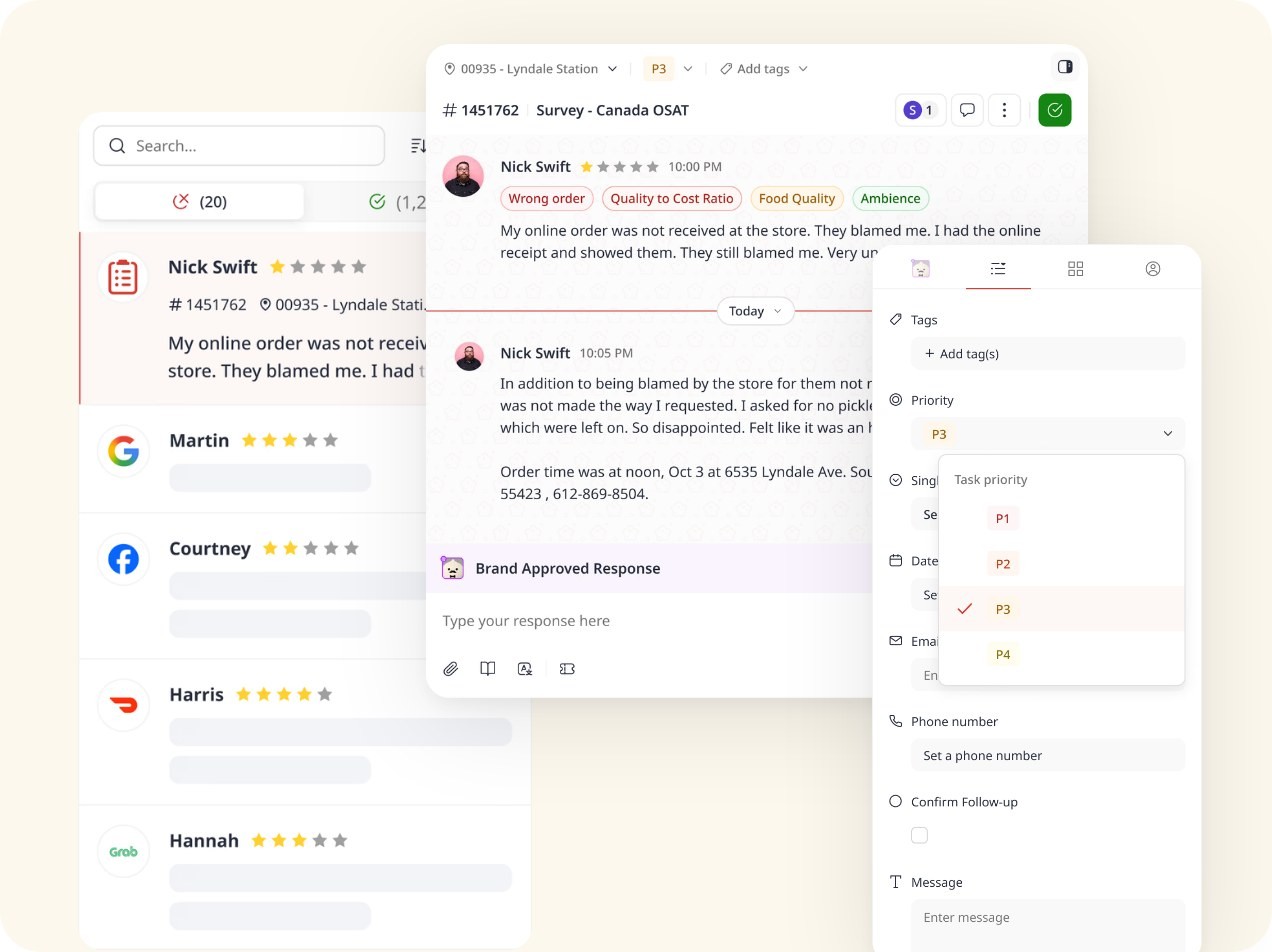
1. Monitoring reviews
Monitoring means seeing every new review, on every platform, for every location, soon after it's posted. Most brands do this by connecting their platforms to one shared inbox with alerts for low ratings.
If you run many locations, a central view matters most, because reviews on smaller platforms or at quieter locations are the ones most likely to go unread.
2. Responding to reviews
Responding means writing a public reply and, where details or compensation are involved, following up privately. Each reply speaks to two audiences: the guest who wrote the review and every future guest who reads it.
The share of reviews you answer is your review response rate, and how fast you reply matters too. A careful reply to a negative review acknowledges the specific problem, takes ownership and invites the guest to continue the conversation privately.
Each platform also sets its own rules for replies. Tripadvisor's management response guidelines, for example, ask owners to keep replies relevant to the review, leave out guests' personal details and avoid promotional content.
3. Requesting reviews
Review solicitation means inviting guests to share their experience, through receipts, follow-up messages, QR codes or your loyalty app. A steady flow of new reviews keeps your review velocity healthy and your review recency current.
Google lets you share a review link or QR code from your Business Profile, and the same page prohibits offering incentives in exchange for reviews. Fair practice means inviting every guest, which we come back to in the section on rules below.
4. Analyzing reviews
Analysis groups reviews by topic and tone so you can see patterns across locations and over time. Sentiment analysis does this automatically, tagging each review with themes like wait time, order accuracy or staff friendliness.
That answers questions a star average can't. Which locations, for example, are seeing more complaints about cold food since a menu change?
5. Acting on what reviews say
The final step sends each insight to the people who can fix it: location managers, kitchen leads, trainers or the packaging team. A location-level operator report is one way to put each restaurant's recurring themes in front of its manager.
When a guest has had a poor experience, a structured customer recovery process gives your team a way to make it right and invite them back.
Review management for multi-location brands
Once you have many locations, review management becomes a coordination problem as much as a writing one. You need to settle who replies, who fixes, and how the right person hears about a serious review quickly.
Many restaurant groups use a split model, where a central team sets standards and individual locations act on what they learn.
| Role | Typical responsibilities in review management |
|---|---|
| Central marketing or guest experience team | Reply guidelines and brand voice, routine replies, reporting across locations |
| Location or general manager | Operational follow-up, staff coaching, private contact with guests when needed |
| Area or regional manager | Location comparisons, recurring issues across a district, escalations |
| Operations, food safety or legal | Allegations of illness, injury, discrimination or legal threats |
Access settings keep the model workable. Collaboration permissions can give each manager a view of their own locations while the central team sees the whole brand.
Some large brands manage replies through software connected to Google's own interfaces. Google's Business Profile API documentation on review data describes how approved applications can list reviews and post replies for the locations a business manages.
Review management example
Picture a fast casual brand with 30 locations (made up for this example). In one month, its guests leave 1,800 reviews across four platform types.
| Platform | New reviews | Replies sent |
|---|---|---|
| 1,200 | 1,080 | |
| Delivery apps | 360 | 270 |
| Yelp | 180 | 135 |
| Tripadvisor | 60 | 45 |
| Total | 1,800 | 1,530 |
The brand's overall response rate for the month is:
Response rate = replies sent ÷ reviews received × 100 = 1,530 ÷ 1,800 × 100 = 85%
Of the 1,800 reviews, 216 have one or two stars. The team replied to 210 of them, a negative-review response rate of 210 ÷ 216 × 100 = 97.2%.
Sentiment analysis shows that 81 of the 216 negative reviews mention wait times, which is 37.5%. Most of those come from four locations that recently cut a lunchtime shift. Now operations has a clear fix to test, and next month's reviews will show whether it worked.
Review management metrics
| Metric | What it tells you | How it's usually tracked |
|---|---|---|
| Response rate | The share of reviews that receive a reply | By platform, location and star rating |
| Response time | How long guests wait for a reply | Median hours from review to reply |
| Average star rating | How guests rate you overall | Monthly, by platform and location |
| Review volume and velocity | How many new reviews arrive | Per week or month, per location |
| Review recency | How fresh your latest reviews are | Days since the most recent review |
| Sentiment by topic | What guests praise and criticize | Share of positive and negative mentions per theme |
| Reputation score | A combined view of the measures above | A single index, if your tool provides one |
On Google, the review score is the average of all ratings published for the place. Google notes that an updated score can take up to two weeks to show up after a new review.
A reputation score can be useful for ranking locations, though each vendor calculates its own. The individual measures behind it usually tell you more about what to change.
Review management vs. reputation management
Review management overlaps with several related practices, and the differences shape which team and which tool you need.
| Practice | Focus | Typical owner |
|---|---|---|
| Review management | Monitoring, answering, requesting and analyzing reviews | Marketing or guest experience |
| Online reputation management | Everything said about the brand online, including reviews, social media, press and search results | Marketing, PR and leadership |
| Review aggregation | Collecting reviews from many platforms into one feed or rating | Usually handled by software |
| Listings management | Accurate hours, menus and details across search engines and directories | Marketing or local SEO |
In practice, review aggregation is the foundation that makes review management possible at scale. And for most restaurants, review management is the largest single part of reputation management.
Review management rules and platform policies
What you can do with reviews is governed by platform policies and, increasingly, by consumer protection law.
| Rule | What it means for review management |
|---|---|
| Google's prohibited and restricted content policy | Lists rating manipulation, including discouraging negative reviews and selectively soliciting positive reviews from customers |
| Google Business Profile guidance on reviews | Prohibits offering incentives in exchange for a review, a changed review or the removal of a negative one |
| Yelp's guidelines for businesses | Ask businesses to refrain from requesting reviews and prohibit paid or incentivized reviews |
| FTC rule on consumer reviews and testimonials (announced August 2024) | Bans fake reviews, buying positive or negative reviews and certain forms of review suppression in the US, with civil penalties for knowing violations |
Asking only happy guests for reviews, a practice called review gating, breaks Google's policy. Laws and policies change, so it's a good habit to check the current version in each market where you operate.
How to set up review management
A review management program usually comes together in six steps.
- Claiming and verifying every listing. To reply, you need ownership of each location's profile on Google and the other platforms your guests use.
- Connecting all platforms to one place. A shared inbox means nobody has to log in to each site separately.
- Agreeing on ownership and escalation. It helps to settle who replies to which reviews, and which topics go straight to operations, food safety or legal.
- Writing reply guidelines. A short guide to tone, sign-offs and sensitive topics keeps replies consistent across locations.
- Setting a review request routine. Inviting every guest through receipts or post-visit messages keeps reviews coming.
- Reviewing the numbers each month. Comparing response rate, rating and topics by location shows where to focus.
If AI drafts your replies, they stay personal when the agent is trained to sound like your brand at every location and passes sensitive reviews to a person.
Benefits of review management
- Guests see that you listen. Thoughtful replies reassure future guests who read a negative review and the response beneath it.
- Problems surface sooner. A rise in complaints at one location shows up within days.
- Ratings reflect improvements. A steady flow of new reviews lets your average catch up with the changes you've made.
- Teams save time. One inbox and AI-drafted replies cut the hours spent switching between platforms.
At scale, the time savings can be large. bb.q Chicken, for example, doubled response rates and saved 300+ hours a month with our AI-powered review management.
Limitations of review management
Reviews come from a self-selected group of guests, and people with very good or very bad experiences are often the most likely to write one. So your reviews are a valuable signal, though they may differ from how a typical guest feels.
Review management also can't fix an operational problem on its own. Replies limit the damage of a bad experience, and your rating only improves once the cause is solved at the location.
Finally, platforms control their own rules, display and filtering. A review may be held back by a platform's filter, and changes in policy or API access can affect what your tools can see and do.
Pairing reviews with private feedback, like a post-visit survey, gives you a broader and more representative picture of the guest experience.
Best review management tools for restaurants
The most useful review management tools for restaurant brands cover every platform your guests use, show results by location and help your team reply quickly in a consistent voice. As you add locations, routing reviews to the right manager and connecting feedback to recovery matter more.
| Tool | Best known for |
|---|---|
 MomosBest pick | Our Guest AI Platform for multi-location restaurants. Reviews from Google, reservation and delivery platforms land in one Unified Inbox, and our Alfie agent in the AI review manager resolves reviews in your brand's voice. AI categorization, recovery offers and reporting across locations help you act on feedback. |
 Birdeye | Reviews, listings and customer messaging for multi-location businesses |
 Reputation | Enterprise reputation management across reviews, listings and social media (formerly Reputation.com) |
 ReviewTrackers | Review monitoring and analytics across review sites for multi-location brands |
 Chatmeter | Local brand reputation management with review and sentiment analytics |
 Ovation | Guest feedback surveys and review generation for restaurants |
 Podium | Review requests and customer messaging for local businesses |
The right choice depends on your platforms, how many locations you have and how your team divides the work. A trial at a handful of locations is a reliable way to compare.
Common review management mistakes
- Replying only to negative reviews. Thanking guests who leave positive reviews encourages more of them and shows every reader that you pay attention.
- Using the same template everywhere. Guests recognize copied replies, which weakens the effect of answering at all.
- Debating reviewers in public. A calm reply that moves the conversation to a private channel serves you better with future readers.
- Leaving smaller platforms unwatched. Delivery app and Tripadvisor reviews often reveal problems that Google reviews miss.
- Letting reviews stay in the inbox. Recurring themes need to reach the location managers who can fix them.
- Asking only happy guests for reviews. Selective requests break Google's rules on rating manipulation and give you a less honest picture of your restaurants.
- Treating the star average as the goal. The written reviews explain what the average can't, and they point to the changes that move it.
History of review management
Review management grew alongside consumer review sites. Tripadvisor (founded in 2000) and Yelp (founded in 2004) gave guests a public place to describe their meals, and owners could soon reply publicly under each review.
Google's local reviews, now part of Google Business Profile, brought ratings directly into search results and Google Maps. Owners can reply once their profile is verified, as Google's help page on managing customer reviews explains.
Delivery platforms added their own ratings, and booking platforms began collecting reviews tied to confirmed reservations. A restaurant group could suddenly have reviews in a dozen places, each with its own login.
Software followed. Dedicated tools began pulling reviews into one feed, a practice known as review aggregation, and later added reporting across locations. More recently, AI has made it practical to categorize every review by topic and to draft replies at scale.
Frequently asked questions
What is review management?
It's the practice of keeping track of the reviews guests leave about your business, replying to them, encouraging new ones and using what they say to improve. For a restaurant brand, it covers Google, review sites, delivery apps and booking platforms across every location.
Is review management the same as online reputation management?
Review management is one part of online reputation management. Reputation management also covers listings, social media, press and search results. Review management focuses on the reviews and ratings guests leave on public platforms.
Should you reply to every review?
Replying to as many reviews as you can is good practice, and replying to every negative review is a sensible baseline. When volume is high, an AI agent can draft replies to routine positive reviews. That frees your team to spend its time on the reviews that need a personal touch.
How fast should a restaurant respond to reviews?
A reply within 24 to 48 hours is a sensible goal, and sooner for negative reviews. A quick, specific reply shows the guest, and everyone who reads it later, that you're paying attention.
Can AI write review replies?
Yes. Many review management tools now draft replies with AI, and some can send them on their own. Replies stay credible when the agent follows your brand voice, mentions the details the guest raised and hands sensitive reviews, like food safety complaints, to a person.
Is it legal to ask guests for reviews?
Most platforms allow it, as long as you ask every guest in the same way and offer nothing in return. Google prohibits incentives and selective requests to happy guests, and Yelp asks businesses to refrain from requesting reviews at all. Policies change, so it helps to check each platform's current rules.
Who should own review management in a restaurant group?
Many groups split the work. A central marketing or guest experience team sets the reply guidelines, handles escalations and reports on trends. Location managers follow up on operational issues at their own restaurants.