

Reputation Score
A reputation score is a composite index that combines star ratings, review volume, recency, responses and sentiment into one number for online reputation.
| Reputation Score at a glance | |
|---|---|
| Also called | Online reputation score, reputation index, review score |
| What it is | A composite index of several reputation signals |
| Typical inputs | Star rating, review volume, review recency, response rate and time, sentiment, listing accuracy |
| Typical scale | 0–100, though some vendors use other ranges |
| Standard formula | None. Each vendor and brand defines its own components and weights |
| Common method | Normalize each input, weight it, and add the results |
| Best for | Comparing locations and tracking reputation over time with one number |
| Main risk | Weights that hide a weak component, or a formula nobody can explain |
Key takeaways
- A reputation score combines several signals, such as your star rating, review volume, recency, response rate and sentiment, into one number.
- No standard definition exists, so two vendors' reputation scores for the same restaurant can differ and can't be compared directly.
- The weights are a choice, and documenting them, keeping them stable and showing each component next to the total makes the score trustworthy.
- Your star rating is usually the largest single input, while volume, recency and responses show whether that rating is current and well managed.
- The most useful reputation scores are calculated per location, so each manager can see which component to work on.
What is Reputation Score?
A reputation score is a single number that summarizes how your business is perceived online. It combines several signals, typically your star ratings, how many reviews you receive, how recent they are, how consistently you respond and what guests say, into one index.
Because the score is a composite, its meaning depends entirely on how it is built. Reputation management vendors each define their own version, and many restaurant groups create an internal one. There is no industry standard formula, which makes it essential to know what goes into the number you're looking at.
For a multi-location restaurant brand, a reputation score is useful because it turns a large amount of data into one comparable figure per location. It sits within the wider practice of online reputation management and builds on the star rating each platform calculates.
How a reputation score works
Most reputation scores follow the same three steps, whatever the vendor:
- Choosing the components. Each component measures one aspect of reputation, such as average rating or response rate.
- Normalizing each component. Each input is converted to a common scale, usually 0 to 100, so a star rating and a percentage can be combined.
- Weighting and adding. Each normalized score is multiplied by its weight, and the results are added together.
Reputation score = Σ (component score × weight) ÷ Σ weights
Here is a worked example for one location, using illustrative weights: rating 35%, review volume 15%, recency 15%, response rate 15% and sentiment 20%. These weights are an example, and your own choice may differ.
| Component | Input | Normalized (0–100) | Weight | Points |
|---|---|---|---|---|
| Star rating | 4.3 average | (4.3 − 1) ÷ 4 × 100 = 82.5 | 35% | 28.875 |
| Review volume | 250 reviews vs. a target of 500 | 50 | 15% | 7.5 |
| Recency | 12 reviews in the last 30 days vs. a target of 20 | 60 | 15% | 9 |
| Response rate | 85% of reviews answered | 85 | 15% | 12.75 |
| Sentiment | 72% of mentions positive | 72 | 20% | 14.4 |
The points add up to 72.525, so this location's reputation score is 73 out of 100.
The table shows the components as well as the total, which is what makes the score useful. Volume is the weakest component here, and it carries the largest available gain: 50 points of headroom at a 15% weight is worth up to 7.5 points.
Reputation score calculator
Enter one location's figures and, if you like, change the weights. The weights below are an illustration of one reasonable starting point, and the calculator rescales them if they don't add up to 100.
The calculator caps volume and recency at 100 once you reach your target, and it converts the star rating so that 1 star scores 0 and 5 stars score 100. Different normalizations are equally valid, which is one reason vendor scores differ.
Reputation score components
| Component | What it measures | Common way to normalize | Go deeper |
|---|---|---|---|
| Star rating | Average rating per platform | (rating − 1) ÷ 4 × 100, or a rating weighted by review count | Star rating |
| Review volume | Total reviews across platforms | Share of a target, or a rank among your locations | Review aggregation |
| Review recency and velocity | How many new reviews arrive and how fresh they are | Reviews per month against a target | Review velocity, review recency |
| Response | Share of reviews answered and speed of replies | Response rate as a percentage | Review response rate |
| Sentiment | What guests say in their reviews | Share of positive mentions | Sentiment analysis |
| Listings | Accurate hours, menus and contact details | Share of complete, correct listings | Listings management |
Star rating component
Your average rating is usually the heaviest input, because it is what guests see first. Each platform calculates it differently: Google's help page on review scores describes a plain average, and Uber's ratings policy gives priority to the most recent merchant ratings.
When you combine platforms, weighting each by its share of reviews or by its importance to your business keeps one small platform from dominating the score.
Volume and recency components
Volume shows how much evidence stands behind your rating, and recency shows whether it reflects the current experience. A location with a 4.6 rating and no reviews in three months is in a weaker position than the rating alone suggests.
Small samples deserve particular care. Evan Miller's widely cited essay How Not To Sort By Average Rating (2009) explains why a raw average from a handful of ratings is unreliable, which is why some scores discount ratings backed by few reviews.
Response component
Response rate and response time are the components most directly under your team's control.
EN Group, for example, achieved a 98% customer response rate using Momos.
Sentiment component
Sentiment measures what guests actually write, which a star average can't capture. Sentiment analysis classifies each review or each topic within it, so the score can reflect, for example, rising complaints about wait times before they lower your rating.
Types of reputation score
Vendor reputation scores
Reputation management platforms calculate their own scores from the data they collect. These are convenient and often come with benchmarks, though the exact formula is usually unpublished.
Because each vendor's components and scales differ, a vendor score is best compared only with other scores from the same vendor.
Internal reputation scorecards
Many restaurant groups build their own score from the metrics they already track. The advantage is transparency: everyone knows exactly what moves the number. Dashboards that let you customize your headline metrics make it practical to show an internal score next to its components.
Location-level and brand-level scores
A location-level score shows each manager where to focus. A brand-level score, usually a weighted average of locations, gives leadership one trend line. Both are useful, and the location view tends to drive more change.
Reputation score vs. star rating
| Feature | Star rating | Reputation score |
|---|---|---|
| What it is | Average rating on one platform | Composite index of several signals |
| Who calculates it | The platform | You or your software vendor |
| Seen by guests | Yes | No, it is an internal management metric |
| Inputs | Ratings that count on that platform | Ratings, volume, recency, responses, sentiment and more |
| Standard method | Mostly a simple average, with platform rules | None; each formula differs |
| Best for | How new guests see you | Comparing locations and tracking overall reputation |
Your star rating is the number guests act on, so it deserves attention in its own right. The reputation score adds context, showing whether that rating is well supported, current and actively managed, and it pairs naturally with private measures such as CSAT and NPS.
How to build a reputation score for your brand
A useful internal reputation score is simple enough for every general manager to understand. These steps reflect common practice:
- Deciding what the score is for. A score for comparing locations needs inputs every location can influence, such as response rate and review volume.
- Choosing four to six components. More components make the score harder to explain and each one less influential.
- Normalizing consistently. Setting targets that are realistic for your locations, and documenting how each input becomes a 0–100 score, keeps results stable.
- Choosing and documenting the weights. Weights reflect your priorities. Testing a few alternatives shows how much the ranking of locations depends on them.
- Keeping the formula stable. Changing weights every quarter makes trends meaningless, so changes are best made rarely and recorded.
- Always showing components next to the total. An operator report that lists each location's score with its components tells managers what to work on.
How to interpret a reputation score
A reputation score is most informative as a comparison: between locations, and over time for the same location. A five-point gap between two locations matters more when you can see which component explains it.
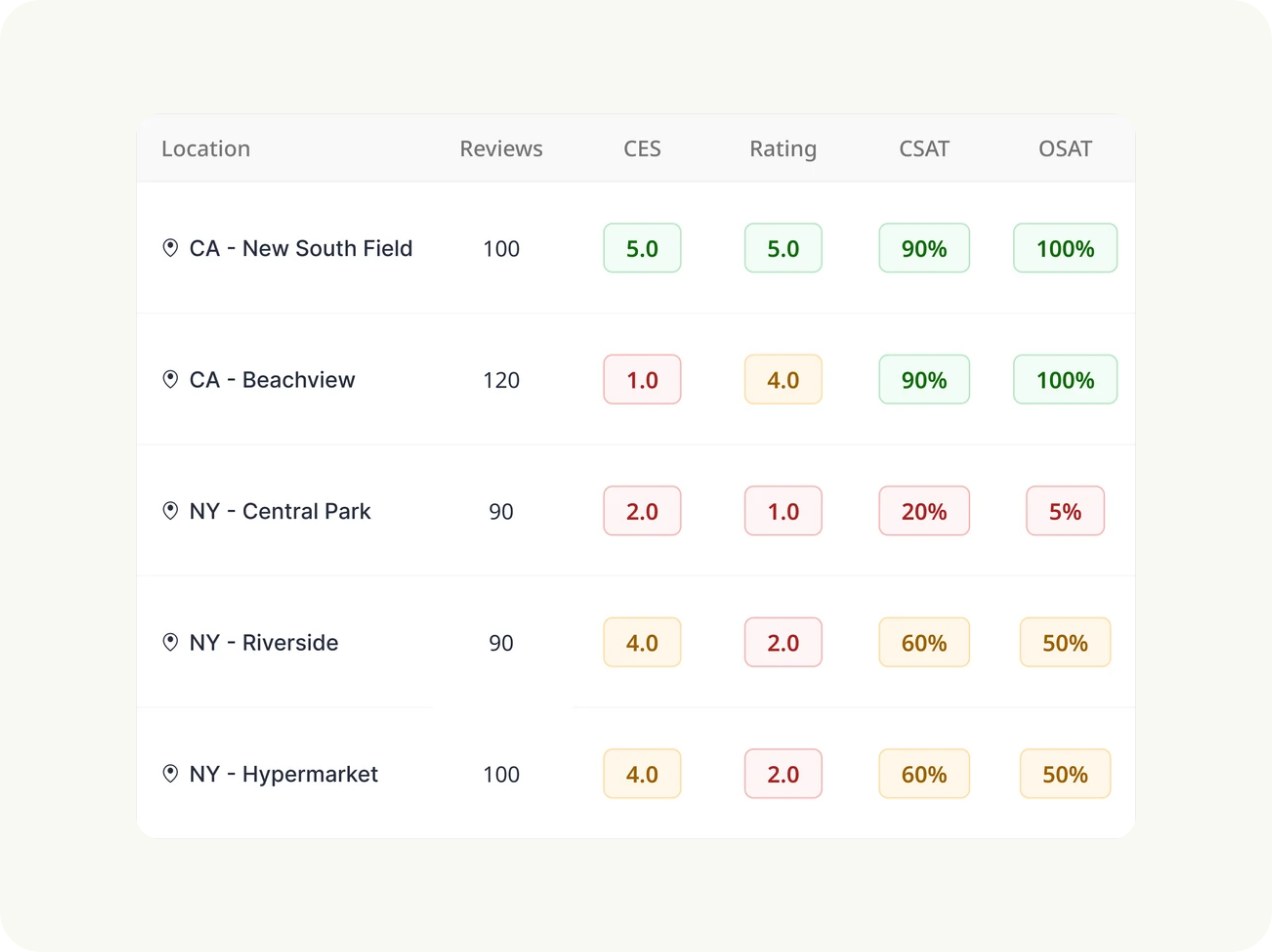
Month-to-month movements at low-volume locations can come from a handful of reviews, so a rolling three-month view smooths out much of that noise. Pairing the score with sales data shows whether changes in reputation come with changes in visits.
Published research supports paying attention to the rating component in particular. Michael Luca's Harvard Business School working paper Reviews, Reputation, and Revenue: The Case of Yelp.com (2011) found that a one-star increase in Yelp rating led to a 5 to 9% increase in revenue for independent restaurants.
Limitations of a reputation score
- Arbitrary weights. The weights are judgments, and a different set can reorder your locations.
- Masking. A strong response rate can offset a falling star rating in the total, hiding the problem guests actually see.
- Opaque vendor formulas. An unpublished method makes it hard to know what to improve or why the score moved.
- Platform rules underneath. Inputs inherit each platform's filtering; Yelp, for example, leaves reviews that aren't currently recommended out of its star rating.
- Gaming. Any score tied to bonuses invites shortcuts, such as fake or incentivized reviews, which the FTC's 2024 rule on fake reviews prohibits.
How to improve your reputation score
Improving a reputation score means improving its components, starting with the one that offers the largest gain at each location.
- Raising response rate and speed. Replying to every review, with help from an AI review manager that drafts replies in your brand's voice, lifts the response component quickly. Lee's Famous Recipe Chicken boosted review response rates by 24%.
- Growing volume and recency fairly. Inviting every guest through review solicitation and review boosting adds fresh reviews. Caribou Coffee achieved 61% more reviews across 57 locations.
- Fixing what lowers ratings and sentiment. Recurring themes in negative reviews point to operational fixes, and a thoughtful negative review response with customer recovery can win guests back.
- Keeping listings accurate. Correct hours and menus prevent avoidable complaints from guests who arrive to find you closed.
Best reputation score tools for restaurants
When choosing a tool to calculate or track a reputation score, the most important factors are coverage of every platform your guests use, transparency about how any score is calculated, and reporting that breaks the score down by location and component.
| Tool | Best known for |
|---|---|
 MomosBest pick | Guest AI for multi-location restaurants. Reviews from Google, reservation and delivery platforms arrive in one Unified Inbox, AI categorization tracks sentiment by topic, the Alfie assistant drafts and sends replies, and reporting shows every location in one dashboard. |
 Reputation | Enterprise reputation management that publishes its own proprietary Reputation Score (formerly Reputation.com) |
 Birdeye | Reviews, listings and customer messaging for multi-location businesses |
 Chatmeter | Local brand reputation management with review and sentiment analytics |
 ReviewTrackers | Review monitoring and reporting across many review sites |
 Yext | Business listings and information management across search engines, maps and directories |
It helps to ask each vendor how its score is built and whether you can see the components.
Common reputation score mistakes
- Treating a vendor score as a universal standard. Scores from different formulas can't be compared.
- Reporting the total without components. Managers can't act on a number they can't break down.
- Changing the weights often. Frequent changes break the trend line.
- Over-weighting volume. Rewarding volume heavily can push teams toward review requests that break platform rules.
- Ignoring low-volume locations' noise. A few reviews can swing a small location's score.
- Forgetting the guest's view. Guests never see your reputation score; they see your star rating and your replies.
History of the reputation score
Combining several indicators into one index is a long-established technique. The OECD and the European Commission's Joint Research Centre set out the method in their Handbook on Constructing Composite Indicators (2008), including steps for normalizing indicators, weighting them and testing how sensitive the result is to those choices.
Online, the idea took hold as reviews spread across Google, Yelp, Tripadvisor and delivery apps. A brand with dozens of locations and several platforms needed one way to see where it stood, and reputation management software began offering a single score.
Today, several vendors publish proprietary scores. Reputation, for example, publishes a Reputation Score built from components such as review sentiment, volume, recency and response. Other platforms use different components, weights and scales, and none of these formulas has become a shared standard.
Frequently asked questions
How is a reputation score calculated?
Most reputation scores convert each input, such as average rating, review volume, recency, response rate and sentiment, to a common 0–100 scale, multiply each by a weight and add the results. The inputs and weights differ from one vendor or brand to another. The calculator on this page shows the method with example weights you can change.
Is there a standard reputation score?
No single organization defines one. Reputation management vendors publish their own proprietary scores with different inputs, weights and scales, and many restaurant groups build an internal version. Comparing scores is only meaningful when they come from the same formula.
What is the difference between a reputation score and a star rating?
A star rating is the average rating guests give you on one platform, calculated by that platform. A reputation score is a composite you or your software calculate, which usually includes the star rating plus volume, recency, response and sentiment signals across several platforms.
What is a good reputation score?
It depends entirely on the formula. On a 0–100 scale built like the calculator on this page, a location's score is best judged against your other locations and its own trend. Vendor benchmarks only apply to that vendor's formula.
How often should I calculate a reputation score?
Monthly works well for most restaurant groups, because review counts per location are often too small for weekly scores to be stable. Watching the components weekly, especially new negative reviews and unanswered reviews, keeps you responsive between monthly readings.
Does replying to reviews improve my reputation score?
In most formulas, yes, since review response rate or response time is a common component. Replies also shape how future guests read your reviews, which can influence the ratings component over time.
Can I improve my reputation score by asking for reviews?
Inviting every guest to review raises volume and recency, which most scores reward. Asking only happy guests is review gating, which platforms prohibit, and paying for positive reviews is banned under the FTC's 2024 rule.