

Win-back campaign
A win-back campaign is a series of targeted messages, often with an offer, that invites guests who've stopped visiting your restaurant to come back.
| Win-back campaign at a glance | |
|---|---|
| What it is | Targeted outreach that invites lapsed guests to come back |
| Who it targets | Guests who've been away well beyond their usual visit pattern |
| Common channels | Email, SMS, app push and direct mail |
| Key metrics | Reactivation rate and incremental lift over a holdout group |
| Lift formula | Reactivation rate of the campaign group − reactivation rate of the holdout group |
| US email law | CAN-SPAM Act (2003) |
| US SMS law | Telephone Consumer Protection Act (1991) |
| Landmark research | Thomas, Blattberg and Fox, Journal of Marketing Research (2004) |
Key takeaways
- A win-back campaign invites guests who've stopped visiting to come back, and it uses what you know about their past visits to pick the message, offer and channel.
- When you define "lapsed" against each guest's own visit habits, you find the guests who are really slipping away, from weekly regulars to occasional diners.
- If a guest left after a bad experience, they'll respond better to an apology and a fix than to a generic discount, so service recovery belongs in your win-back program.
- A holdout group that gets no message shows you how many guests would have come back anyway, and it's the only way to measure your campaign's true incremental lift.
- Marketing texts and emails come with consent and opt-out rules, like the TCPA and CAN-SPAM in the US, and checking the current rules before you send protects your brand.
What is win-back campaign?
A win-back campaign is a planned series of messages that invites lapsed guests (people who used to visit and have stopped) to come back. You use what you know about each guest's past visits to decide who to contact, what to say, which channel to use and whether to add an offer.
Every restaurant loses guests over time. Some move away or change their habits. Some drift to a competitor, and some leave after a disappointing visit. A win-back campaign reaches them while they still remember you, which usually costs less than finding a brand-new guest.
If your brand has several locations and a loyalty program, an app or online ordering, your first-party guest data makes win-back measurable. You can see exactly who stopped visiting, who came back after a message and how much they spent.
How a win-back campaign works
Most win-back campaigns follow the same five steps, whether you're running one for a single location or for hundreds.
- Define lapsed. Decide how long a guest has to be away, compared with their usual visit pattern, before they count as lapsed.
- Segment. Group your lapsed guests by value, visit habits and the likely reason they left.
- Choose the message and channel. Match each segment with email, SMS, app push or mail, and decide whether it gets an offer.
- Send a sequence. Plan two or three messages over several weeks, and stop as soon as the guest comes back.
- Measure against a holdout. Compare the guests who got the campaign with similar guests who didn't.
Defining lapsed guests for win-back
The simplest definition uses a fixed window, like anyone who hasn't visited in 90 days. It's easy to run, but it treats a weekly regular and a twice-a-year diner the same way.
A better definition compares each guest with their own pattern. Say a guest usually comes in every 10 days. For them, a 30-day absence means something. A guest who visits every few months is simply between visits after 30 days.
Many brands use a rule of thumb of two to three times a guest's usual gap between visits. The right multiple depends on your format. Before you settle on one, it's worth checking how many guests come back on their own after different gaps.
Win-back segmentation
Your lapsed guests left for different reasons, so one message rarely suits them all. Recency, frequency and spend are the classic place to start, and guest feedback tells you why they left.
| Segment | How you spot them | Win-back approach |
|---|---|---|
| Lapsed regulars | High past frequency, now absent | Personal note that recognizes their history |
| Unhappy guests | Low survey score, complaint or negative review before leaving | Apology, explanation of the fix, recovery offer |
| One-time guests | A single visit, never returned | A reason to try again, like a new item |
| High spenders | Large average check or catering orders | Personal outreach from the location |
| Channel switchers | Moved from dine-in to delivery, or the reverse | Message about the channel they use now |
This kind of segmentation depends on a unified guest profile that joins orders, loyalty and feedback. It shows you both what a guest did and what they told you.
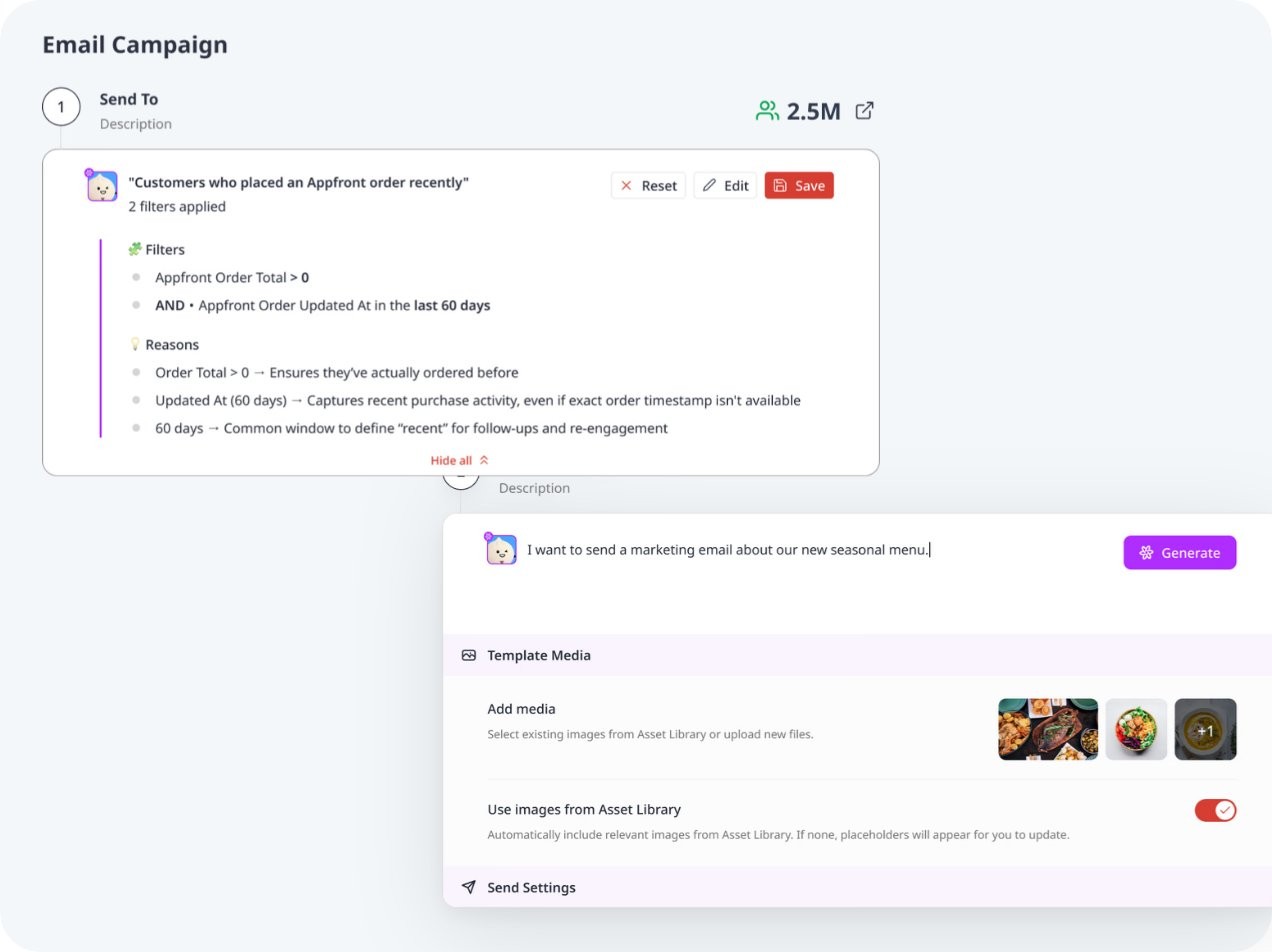
Win-back channels: email, SMS and app push
Email is cheap and has room for a story, photos and menu news. It works well for longer sequences and for guests who signed up through online ordering or loyalty.
SMS is short and immediate, so it's a good fit for a time-limited offer or a reminder. It also has the strictest consent rules in the US, which is why it's best saved for guests who've explicitly opted in to marketing texts.
App push only reaches guests who installed your app and allowed notifications. For them, it's quick and cheap, and a push can link straight to ordering.
Direct mail reaches guests you only have an address for, like catering customers. It costs more per guest, so it's usually kept for high-value segments.
Win-back offers and non-offer messages
An offer gives a lapsed guest a concrete reason to come back, like a free item or a discount on their next order. The catch is that you also pay for guests who would have returned anyway.
Messages without an offer, like news of a seasonal menu, a reopened patio or a simple "we miss you," cost nothing per redemption. They tend to work for guests who drifted away out of habit.
Many brands start with a message that has no offer, then add one in a later message to guests who haven't responded.
Research backs up using offers as a bridge. Thomas, Blattberg and Fox studied it in the Journal of Marketing Research (2004). In the business they looked at, a low price to reacquire customers, followed by higher prices once they returned, worked best. The offer brings a guest back, and the experience keeps them.
Win-back timing and sequence
The longer a guest stays away, the more their habits settle somewhere else. That's why a first message sent soon after a guest crosses your lapsed threshold usually has the best chance.
| Message | Timing | Typical content |
|---|---|---|
| 1 | When the guest crosses the lapsed threshold | Reminder, menu news, no offer |
| 2 | One to two weeks later, if they haven't returned | Modest offer with a clear expiry date |
| 3 | Two to three weeks after that | Stronger offer or a final "we'd love to see you" |
If you stop the sequence as soon as a guest orders or visits, you won't send a discount to someone who's already back. Guests who don't respond to any message can rest for a few months before you try again.
Win-back through service recovery
Some of your lapsed guests left because something went wrong. To them, a generic discount can feel tone-deaf. A reply that acknowledges the problem and explains what changed speaks to the real reason they stopped coming.
Service recovery works best soon after the complaint, before the guest has decided not to return. Send a recovery offer along with a personal apology, and the complaint becomes a reason to come back.
Our recovery playbook walks through how to turn an unhappy guest into a loyal one, from the first reply to the return visit.
If a guest complained in public, they deserve a public reply too. A thoughtful negative review response shows the guest, and everyone else reading, that you took the problem seriously.
The results can be big. Papa Murphy's, for example, turns guest feedback into $2M in recovered revenue.
Win-back consent rules: TCPA and CAN-SPAM
Win-back messages are marketing, so marketing rules apply. What follows is general information about US law. Rules change and differ by state and country, so it's sensible to check the current versions with your lawyer.
SMS and the TCPA
The Telephone Consumer Protection Act (1991) governs marketing calls and texts in the US. The FCC's consumer guide to stopping unwanted robocalls and texts explains that commercial texts sent with autodialing technology need the recipient's prior written consent. Guests can give it electronically, for example through a website form.
Guests can withdraw consent at any time in any reasonable way. Under FCC rules that took effect on April 11, 2025, you have to honor revocation requests within 10 business days, and replies like "stop," "unsubscribe" or "cancel" count as requests.
FCC rules also limit telephone solicitations to between 8 a.m. and 9 p.m. in the recipient's local time, and several states add their own telemarketing laws. Sending win-back texts during the day keeps you within these limits, and it's more considerate of your guests.
Email and CAN-SPAM
The CAN-SPAM Act (2003) covers commercial email. The FTC's compliance guide for business lists its requirements. They include accurate sender information, honest subject lines, a valid postal address, a clear way to opt out and honoring opt-outs within 10 business days.
Outside the US, the rules are often stricter. Canada's Anti-Spam Legislation (CASL) and the UK's Privacy and Electronic Communications Regulations generally require consent before marketing emails and texts. That's why brands in several countries usually build to the strictest standard.
How to measure a win-back campaign
The main number is the reactivation rate: the guests who returned within a set window divided by the lapsed guests you contacted. A 30- or 60-day window after the first message is common.
On its own, reactivation overstates success, because some lapsed guests come back anyway. That's what a holdout group is for. It's a random share of lapsed guests who get no message, so you can see what would have happened without the campaign.
Incremental lift = reactivation rate of the campaign group − reactivation rate of the holdout group. Multiply the lift by the number of guests you contacted, and you get the incremental guests the campaign brought back.
It's also worth tracking whether reactivated guests stick around. A second visit within the next 60 or 90 days shows the campaign rebuilt a habit, and that number belongs with your wider restaurant KPIs.
A win-back campaign example
Say you run a 30-location fast casual brand and find 5,000 loyalty members who usually visit every two weeks and haven't ordered in six weeks. You randomly hold out 1,000 of them and send a three-message sequence to the other 4,000.
Within 60 days, 360 of the 4,000 guests you contacted come back, a reactivation rate of 360 ÷ 4,000 = 9.0%. In the holdout group, 50 of 1,000 return on their own, or 5.0%.
Your incremental lift is 9.0% − 5.0% = 4.0 percentage points, so the campaign brought back about 4,000 × 0.04 = 160 extra guests. At an average spend of $30, that's $4,800 in incremental sales on their first visit back.
The offer cost $6 for each of the 360 guests who redeemed it, or $2,160, including the guests who would have come anyway. The campaign netted $4,800 − $2,160 = $2,640 before food and labor costs, plus any future visits from guests who stay.
Win-back campaign calculator
Enter the results of one win-back campaign. You'll see the reactivation rate, the incremental lift over your holdout group and the incremental sales after offer costs. The defaults match the example above.
A small holdout group gives a noisy estimate, so the lift from a few hundred guests can swing a lot from one campaign to the next. You can trust the result more if you hold out a larger group or repeat the test over several campaigns.
Win-back vs. retention vs. reacquisition
| Approach | Who it targets | Typical tools |
|---|---|---|
| Retention | Active guests, to keep them visiting | Loyalty program, great service, regular communication |
| Win-back | Lapsed guests who know your brand | Targeted sequences, recovery offers, personal outreach |
| New guest acquisition | People who've never visited | Advertising, local search, delivery app placement |
Retention keeps the guests you have, and win-back recovers the ones who are drifting. Both usually cost less per guest than acquisition, because the guest already knows your food and you already know how to reach them. Our guide to loyalty programs that keep guests coming back covers the retention side.
Limitations of win-back campaigns
- Some guests are gone for good. Guests who moved away or changed their diet won't come back, whatever you offer.
- Offers attract bargain hunters. Heavy discounts can bring back guests who only visit when there's a deal.
- Contact data is incomplete. Walk-in and third-party delivery guests often leave no email or phone number, so you can't reach them directly.
- Measurement needs discipline. Without a holdout group, reactivation rates overstate what the campaign achieved.
- Message fatigue is real. Too many messages lead to unsubscribes, which shrinks your audience for every future campaign.
Best win-back tools for restaurants
The most useful win-back tools connect what a guest ordered with what they told you, so you can tell a guest who drifted away from one who left unhappy. If you run several locations, segmentation by location, consent management and holdout reporting matter most.
| Tool | Best known for |
|---|---|
 MomosBest pick | Our Guest AI Platform for multi-location restaurants. Reviews, surveys and messages land in one Unified Inbox, with AI categorization by topic and sentiment, recovery offers to win back unhappy guests and reporting across every location. |
 Podium | Review requests and customer messaging for local businesses |
 Birdeye | Reviews, listings and customer messaging for multi-location businesses |
 Ovation | Post-visit guest surveys for restaurants, with SMS follow-up to resolve issues privately |
 Medallia | Enterprise experience management across survey, digital and contact center feedback |
Loyalty, CRM and email platforms also run win-back sequences, so many brands pair one of them with a guest feedback tool. Compare your options against your own channels and data, and our roundup of restaurant loyalty software can help you choose.
Common win-back mistakes
- Using one lapsed window for everyone. A fixed 90-day rule misses weekly regulars who are already slipping away.
- Leading with the biggest discount. If you open with a large offer, guests learn to wait for one.
- Ignoring why guests left. A cheerful promotion sent to a guest with an unresolved complaint can make things worse.
- Skipping the holdout group. Without one, you can't tell how many guests the campaign actually brought back.
- Texting without clear consent. Marketing texts to guests who never opted in risk legal claims and hurt trust.
- Stopping at the first return. A guest who comes back needs a reason to make the second and third visit too.
History of win-back campaigns
Win-back grew out of direct marketing. Catalog and mail-order companies used recency, frequency and monetary value to decide which past customers to mail, and restaurants picked up similar ideas through mailed coupons and birthday offers.
In 1990, Frederick Reichheld and W. Earl Sasser argued in "Zero Defections: Quality Comes to Services," published in Harvard Business Review, that reducing customer defections can raise profits substantially. Their article drew attention to the customers who leave.
Jill Griffin and Michael Lowenstein's book Customer WinBack (Jossey-Bass, 2001) laid out a practical method for recovering lost customers. In 2004, Jacquelyn Thomas, Robert Blattberg and Edward Fox published "Recapturing Lost Customers" in the Journal of Marketing Research. It modeled how reacquisition offers and later pricing affect whether returning customers stay.
Regulation shaped the channels. The Telephone Consumer Protection Act (1991) set consent rules for calls and later texts, and the CAN-SPAM Act (2003) set rules for commercial email. Today, loyalty apps, online ordering and AI segmentation let you spot lapsed guests automatically and tailor each message to the guest's history and feedback.
Frequently asked questions
What is a win-back campaign for a restaurant?
It's a planned series of messages, sent by email, SMS, app push or mail, that invites guests who've stopped visiting to come back. It usually pairs a personal reminder with a reason to return, like a new menu item or an offer.
When is a restaurant guest considered lapsed?
A guest usually counts as lapsed once the time since their last visit is well beyond their normal pattern, say two to three times their usual gap between visits. A weekly regular who hasn't come in for a month is lapsed. A twice-a-year diner may simply be between visits.
What is a good reactivation rate for a win-back campaign?
There's no reliable industry benchmark, because results depend on how you define lapsed, the channel and the offer. The more useful number is your lift over a holdout group, which shows how many extra guests came back because of the campaign.
Should a win-back campaign always include a discount?
No. Many guests respond to a reminder, menu news or a personal note, and you can save an offer for a later message or for higher-value guests. If you test offer and non-offer messages against each other, you'll see which earns more for the cost.
Do I need consent to send win-back texts?
In the US, the FCC says marketing texts sent with autodialing technology need the recipient's prior express written consent under the Telephone Consumer Protection Act. Guests can also withdraw consent at any time in any reasonable way. Rules change and vary by state and country, so it's wise to check with your lawyer.
How do you measure a win-back campaign?
Compare the reactivation rate of guests who got the campaign with a randomly chosen holdout group who didn't. The difference is your incremental lift. Multiply it by the group size and average spend, and you have the campaign's incremental revenue.
How is a win-back campaign different from a loyalty program?
A loyalty program rewards guests who are still visiting, which helps you keep them. A win-back campaign goes to guests who have already stopped, so its messages acknowledge the gap and give them a specific reason to come back.