評判は売上につながる:お客様の認識がブランド成長を左右する理由
執筆者:アマンダ・ジェイコブ

⟦embed:keyTakeaways⟧
Customer perception used to be a side effect of marketing.
Now, it is the marketing.
In today’s on-demand, review-driven world, your brand’s reputation isn’t just about how customers feel—it’s about whether they show up again, leave a review, or recommend you to the next person in line. And for multi-location brands, managing that perception at scale is no longer optional. It's a direct growth lever.
Your Reputation Is More Than Stars. It’s Revenue.
We’ve all seen the stats:
98% of consumers read online reviews before visiting a local business
57% will only consider businesses rated 4 stars or higher
A one-star improvement on Google can increase revenue by 5–9%
(Sources: BrightLocal, Harvard Business Review)
But here’s what those numbers don’t show:
Your reputation affects every customer decision point—discovery, conversion, loyalty, and word of mouth.
Whether someone’s ordering a burger, booking a facial, or picking a dentist, your rating (and what people say) is likely the first and last thing they see.
The Multi-Location Challenge: Reputation Gets Fragmented
If you operate 10, 100, or 500 locations, reputation gets messy—fast.
Different managers, different levels of customer service, different review volumes. One location might be killing it at 4.8 stars. Another is dragging the group down at 3.6.
And when customers search for your brand, they see everything.
Use Case: A 300-location restaurant group used AI to monitor review patterns across regions. By identifying high-frequency complaints in key metros and retraining staff, they raised their average Google rating from 3.9 to 4.4 in 6 months—and saw a 12% bump in foot traffic.
⟦embed:bnProof⟧
Perception Doesn’t Just Reflect Quality—It Shapes It
Here’s the kicker: Customers don’t just review what happened. They review how they felt about it.
You could deliver a perfect meal, on time. But if no one greets the customer, or the app experience is clunky, the review still suffers.
That’s why managing perception means managing moments:
How fast was the response to a bad review?
Did someone follow up on a 3-star survey?
Did the team close the loop when a customer complained?
When those signals go ignored, the perception sticks—and spreads.
AI + Automation Make It Scalable
The good news? You don’t need a full-time team in every store to manage reputation.
With the right AI customer experience platform, you can:
Auto-respond to positive and neutral reviews with brand-aligned messages
Flag negative reviews to the right manager instantly
Use customer feedback software to spot location-level issues in real time
Track impact by location, region, and overall brand
Real Result: One Momos client with 90+ locations increased their Google review volume by 200% in under 4 months, while cutting manual review response time to nearly zero.
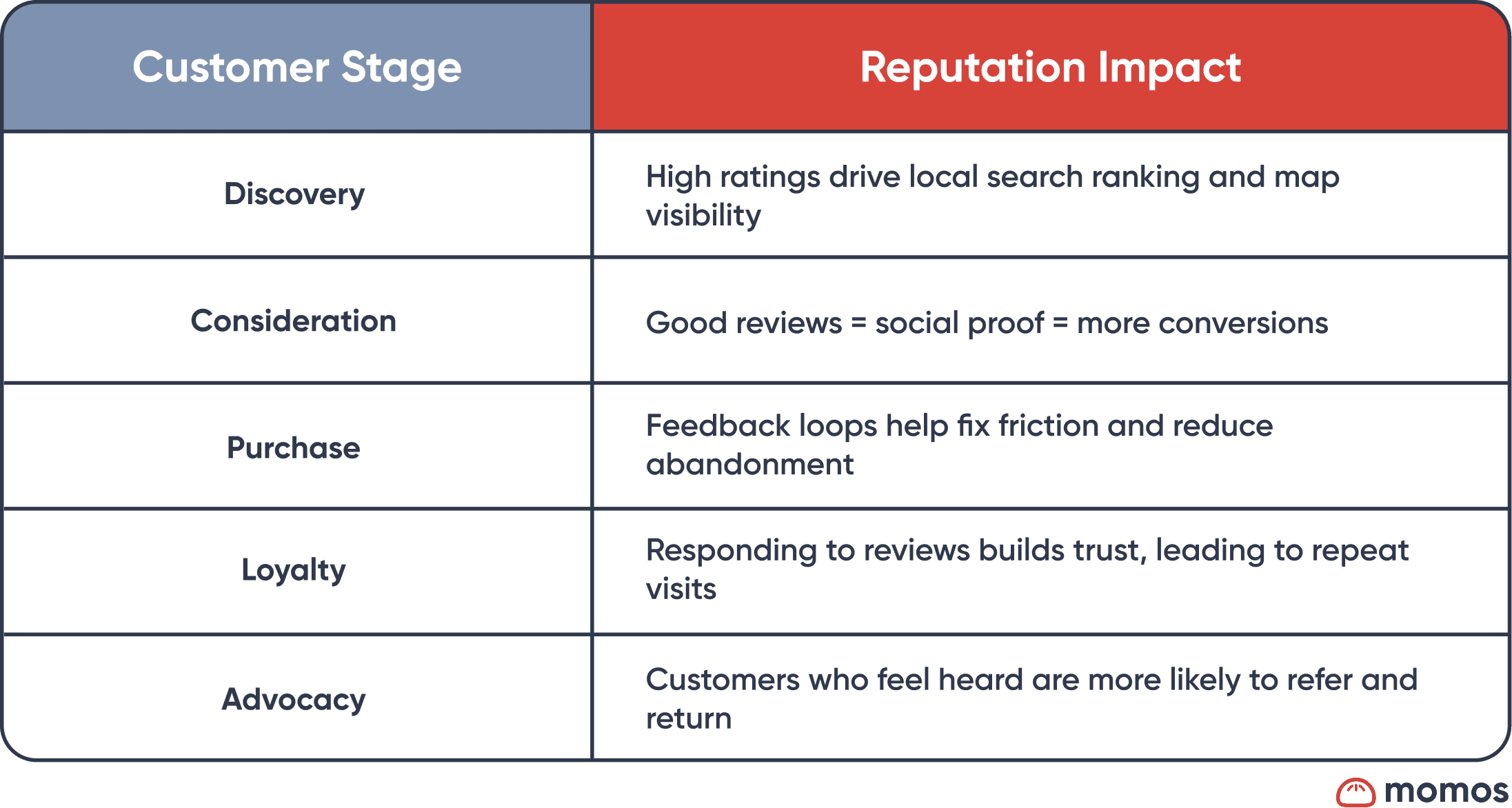
Reputation Fuels Every Stage of Growth
Let’s break it down:
Key Takeaways for Operators and CX Leaders
Your reputation is a leading indicator of revenue—not a nice-to-have.
Perception at the location level drives brand-wide results.
AI makes reputation management scalable across every channel, every store, every day.
Want to Grow Faster by Managing Perception Smarter?
Momos helps multi-location businesses turn feedback into growth. From auto-responses to AI-powered review insights, our platform turns your reputation into a real business asset.
Restaurant Reputation and Revenue: FAQ
How does online reputation affect restaurant revenue?
Your reputation shapes every step of a guest's decision, from discovering you to ordering, coming back and recommending you. Your rating and what people say about you is often the first and last thing a guest sees before choosing. A stronger reputation brings more visits, and a weaker one quietly sends guests elsewhere.
Why is reputation harder to manage across many locations?
Each location has different managers, different service levels and different review volumes, so ratings can vary widely across the brand. When people search for your brand, they see all of it, including your weakest stores. Managing reputation at scale means tracking each location and fixing the ones that pull the group down.
Why do guests leave bad reviews even when the food was fine?
Guests review how they felt about the visit as well as what happened. A perfect meal delivered on time can still earn a poor review if nobody greeted the guest or the app was clunky. That's why perception depends on moments like how fast you respond to a bad review and whether someone follows up after a complaint.
How can AI help with restaurant reputation management?
AI lets you manage reputation without a full-time team in every store. It can reply to positive and neutral reviews with on-brand messages, send negative reviews to the right manager right away, and surface location-level issues from feedback in real time. You can then track the impact by location, region and brand.
Does Momos help multi-location brands manage their reputation?
Yes, Momos is an AI guest experience platform built for multi-location brands. Its AI Review Manager replies to reviews around the clock in a Unified Inbox, and its review insights help you spot problems at specific locations. That turns guest feedback into something your operations and marketing teams can act on.
 AIエージェントが、貴店の全店舗におけるすべてのお客様対応を年中無休・24時間体制で自動化します。


" transform="translate(3.219 19.212)" width="152.45224485148515px"/><path d="M 0 11.619 C 7.071 11.39 33.491 21.738 40.35 21.268 C 38.499 18.19 37.116 14.915 35.507 11.625 C 33.7 7.867 32.587 3.926 31.702 0" fill="transparent" height="21.28391189647101px" id="I9fuJaf7q" stroke-dasharray="" stroke-linecap="round" stroke-linejoin="round" stroke-width="4.97" stroke="rgb(0, 0, 0)" transform="translate(139.727 55.754)" width="40.34950693069311px"/></svg>)