18 Best Customer Support Software (2026)
執筆者:ヴィンセント・グエン

⟦embed:keyTakeaways⟧
If you're running a restaurant, you probably know the tremendous value of fast, responsive customer communication.
It's easy to respond to guests when you're just a small food store. However, as a multi-location business or a franchise, it becomes increasingly harder.
That's exactly where a customer support software shines through.
The 18 Best Customer Support Software For Restaurants
With all those criteria laid out, here’s my recommendation list of the 18 best customer support software for your business:
⟦embed:ICVcesric⟧
1. Momos
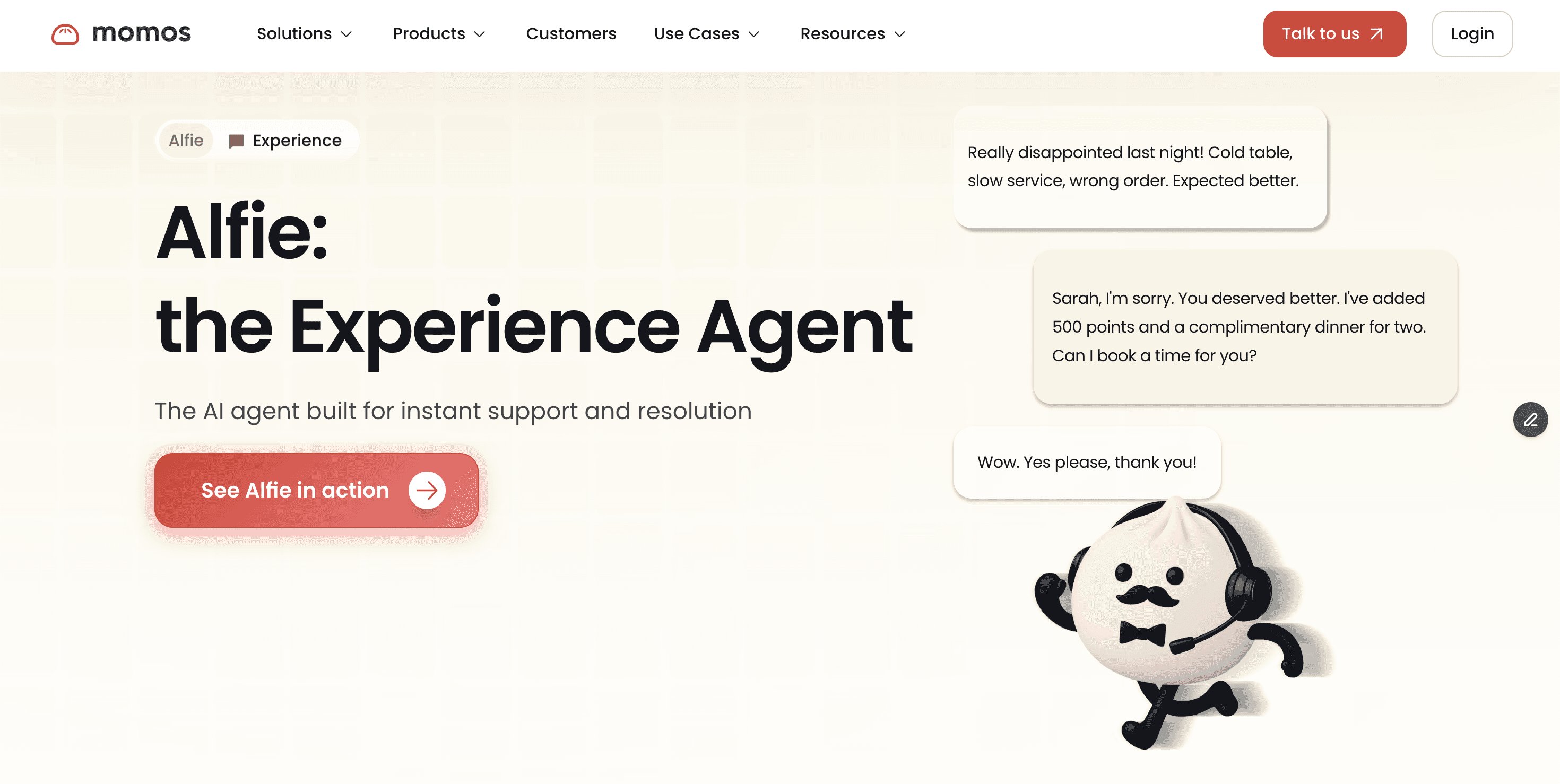
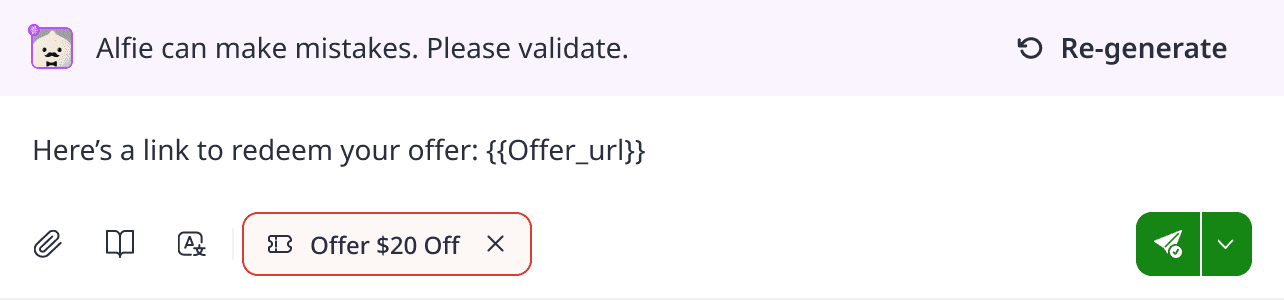
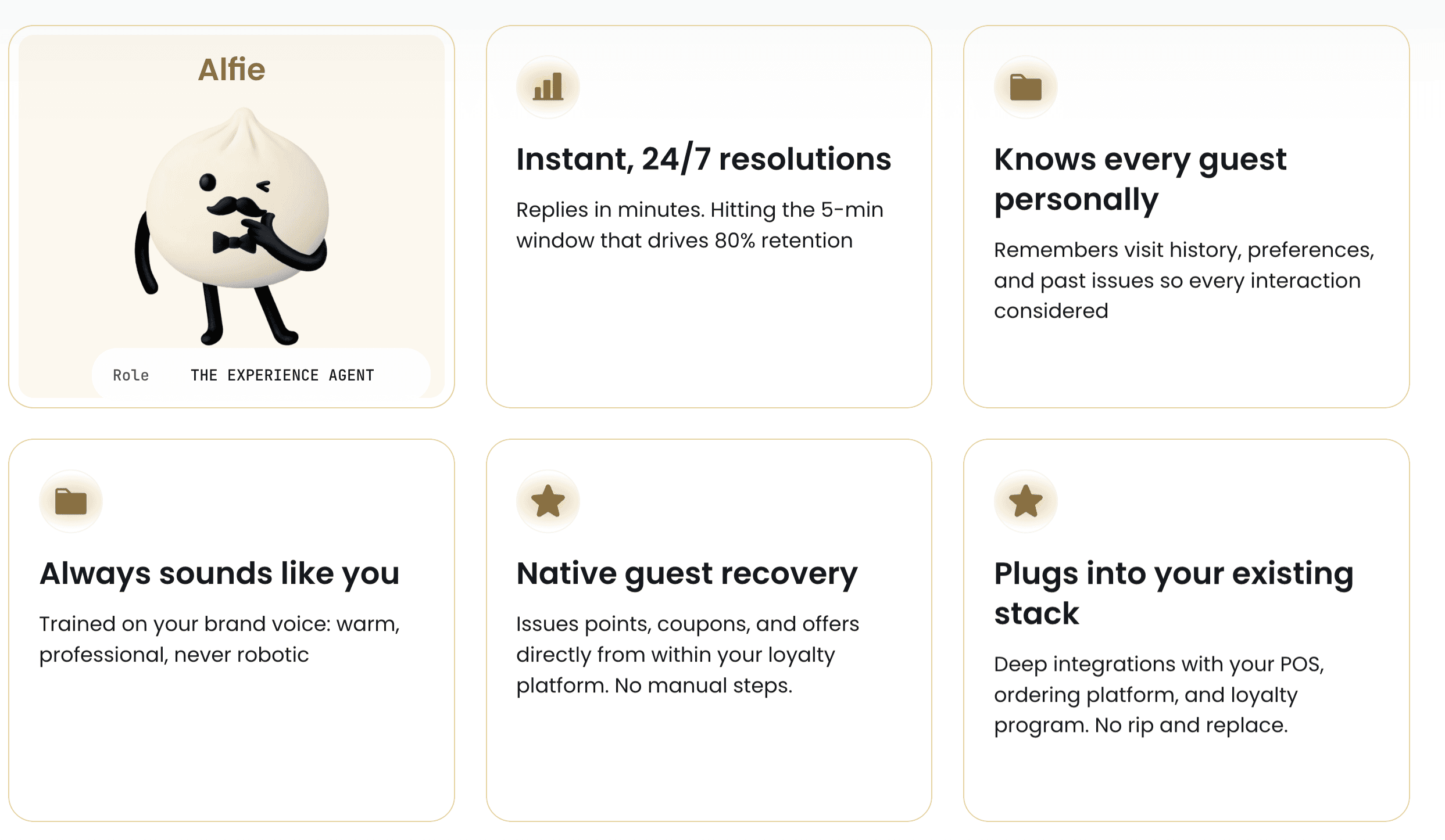
Momos runs guest support for restaurant brands through Alfie, an AI Experience Agent that sits inside its wider guest platform. Alfie answers guests around the clock on chat, email, phone, social and delivery apps, resolves what it can by itself, and passes the rest to your team with the whole conversation attached.
Think of it as an AI chatbot built for restaurants that can also settle a complaint on the spot with loyalty points, a coupon or an offer. Just Salad, which has 120+ locations, reports 1,200+ hours saved each month and 99% faster responses since adopting Momos.
Key features
One agent on every channel: Alfie covers website chat, your mobile app, email and contact forms, phone, Instagram and WhatsApp messages, and delivery apps such as DoorDash and Grubhub.
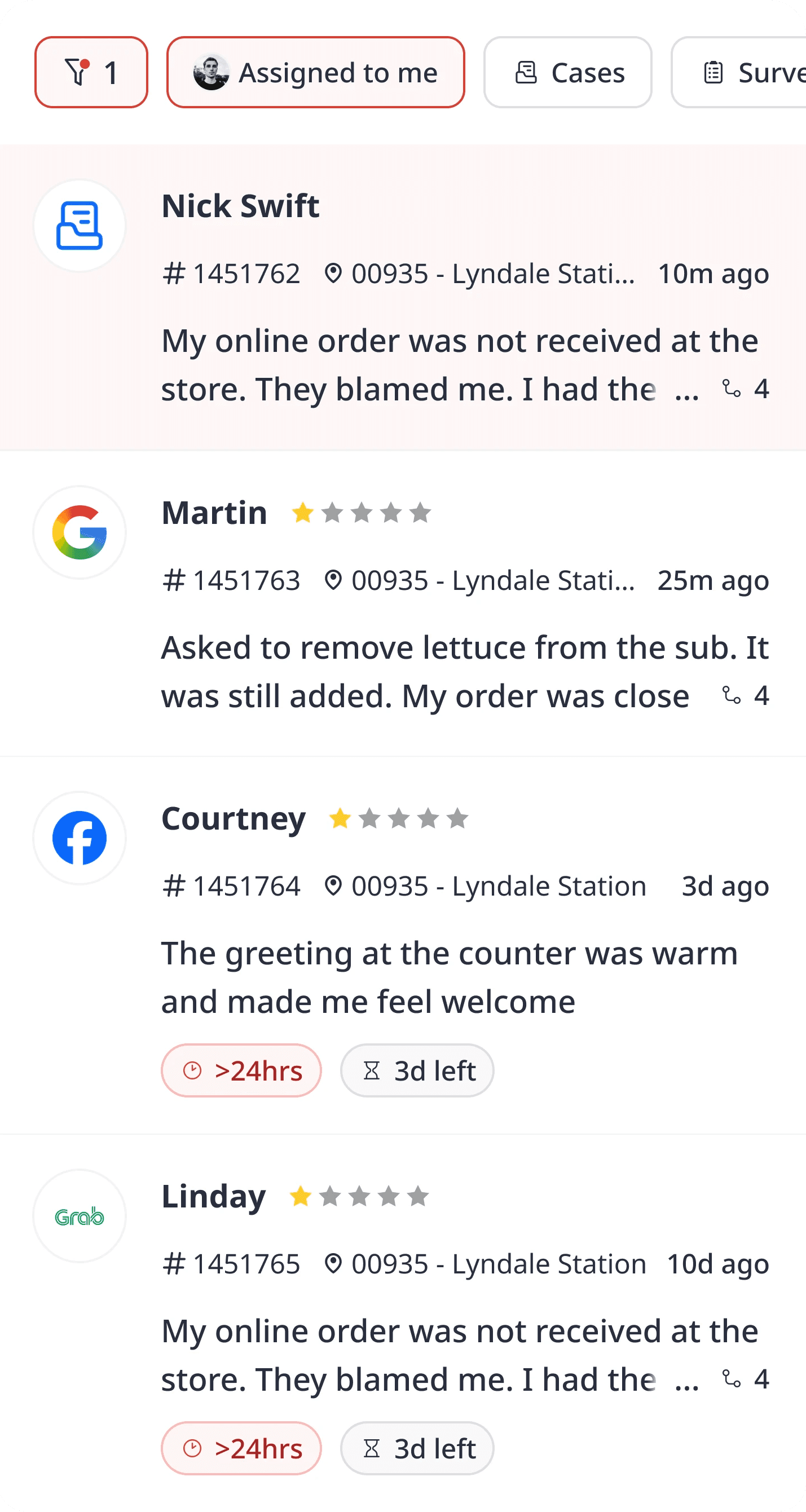
Escalation with context: When a case needs a person, Alfie flags it along with the conversation history and a suggested next step.
Guest details beside each ticket: Agents see spend, order history and ratings, and AI summaries condense long threads into a few lines.
Recovery in the conversation: Points, coupons and offers come straight from your loyalty and POS platforms without switching tools.
Return tracking: Alfie notes if an unhappy guest visits again, so you can see which recoveries actually worked.
Routing by location: AI triage in the Unified Inbox sends every case to the store it belongs to.
Pros
Trained on your restaurants: Momos teaches Alfie your menu, FAQs and recovery playbooks, so answers reflect how your stores actually work.
Fewer tools: Support tickets, reviews and survey feedback share one inbox and one guest history.
Multilingual support: Real-time translation lets each location help guests in their own language.
Managed rollout: Momos handles setup and new-location rollouts, with customer success after launch.
Cons
Pricing by quote: Prices aren't published, and you start with a demo.
Hospitality only: It's built for restaurant and hospitality brands, so a support team in another industry would need a general help desk.
Setup takes a week: Training Alfie and approving its answers with the Momos team comes before launch.
Price and plans
Momos doesn't publish prices; you get a custom quote after a demo.
⟦embed:kDYbCzxGy⟧
2. Zendesk
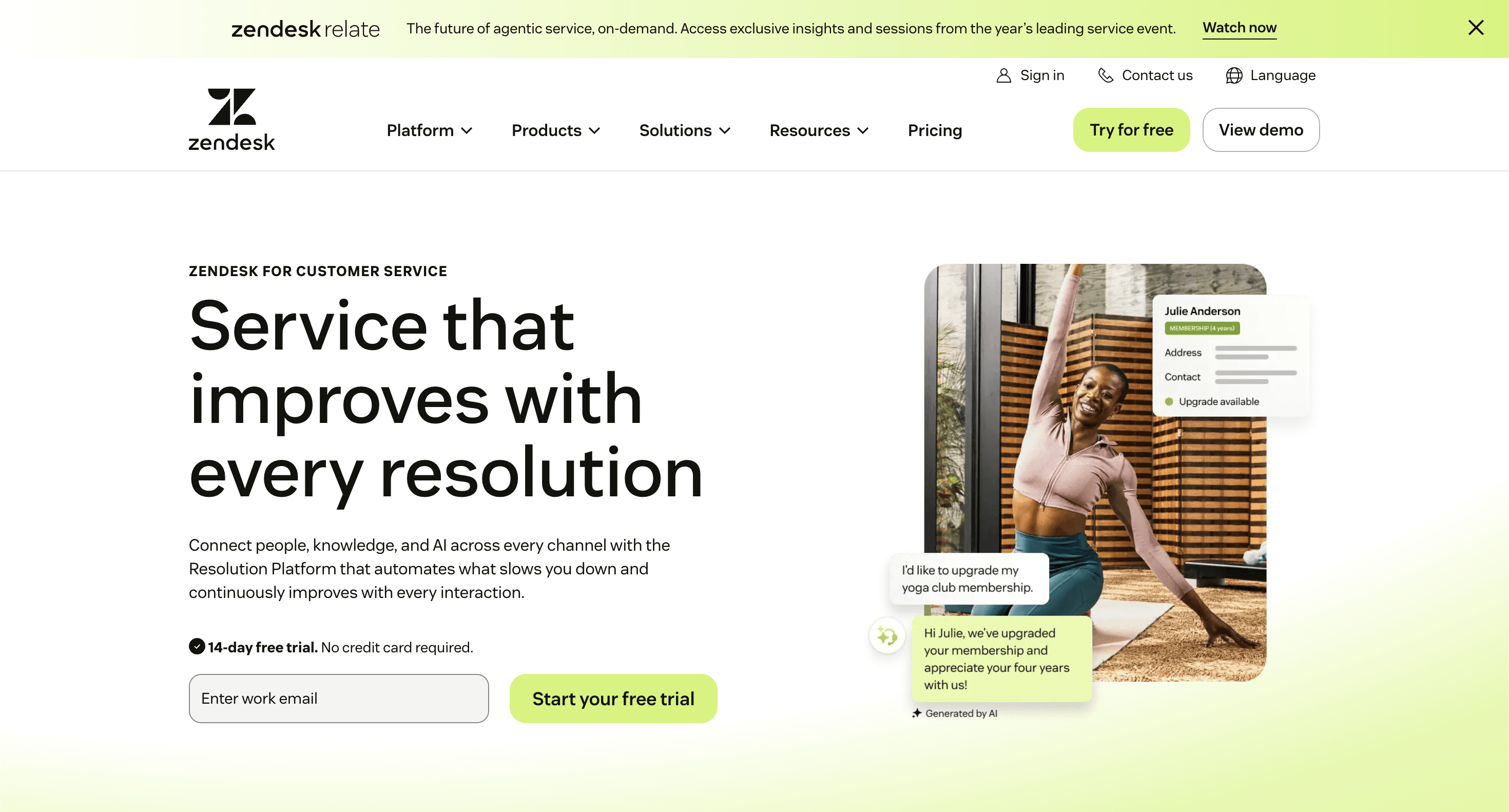
Zendesk is a customer service platform, sold today as the Zendesk Resolution Platform, that combines ticketing, messaging, voice, a help center and AI agents. It's built for mid-size and large businesses that field many questions on many channels, and food brands such as Grubhub, Grill'd and Impossible Foods run their support on it.
In March 2026, Zendesk completed its purchase of Forethought, whose self-improving AI agents work across chat, email and voice.
Key features
Single agent workspace: Email, messaging, live chat, social messages and phone calls arrive in one view, with the customer's history beside each ticket.
AI agents: Bots answer routine order, refund or opening-hours questions across chat, email and voice and pass harder cases to a person.
Routing and triggers: Omnichannel routing and automated triggers send each request to the right team; Suite Professional adds skills-based routing and an IVR phone tree.
Copilot: This add-on suggests replies and next steps while your team works a conversation.
Help center: A self-service knowledge base lets guests find allergen or booking answers without contacting you.
Pros
Every channel together: Your team handles email, chat, social and calls without switching apps.
Room to grow: A large app marketplace and optional add-ons let you add channels and automation without changing tools.
Clear entry prices: Per-agent prices are published, and the trial gives you two weeks on Suite Professional.
Well reviewed: Zendesk has a 4.3/5 rating on G2 from more than 7,000 reviews.
Cons
Copilot costs extra: The agent assistant is a $50 per agent, per month add-on (billed annually) for Professional and higher.
AI billed by resolution: Plans include 5 or 10 automated resolutions per agent each month; extra ones cost $1.50 committed or $2.00 pay-as-you-go.
Basic entry plan: Support Team covers email and ticketing; AI agents and telephony start at Suite Team.
General-purpose: Restaurant work such as public review replies or loyalty offers may need another tool.
Price and plans
Zendesk offers a 14-day free trial of Suite Professional. Prices are per agent, per month, billed annually; monthly billing costs more.
Support Team: $19 per agent, per month ($25 billed monthly).
Suite Team: $55 per agent, per month ($69 billed monthly).
Suite Professional: $115 per agent, per month ($149 billed monthly).
Suite Enterprise + Copilot: Custom pricing from sales.
3. Freshdesk
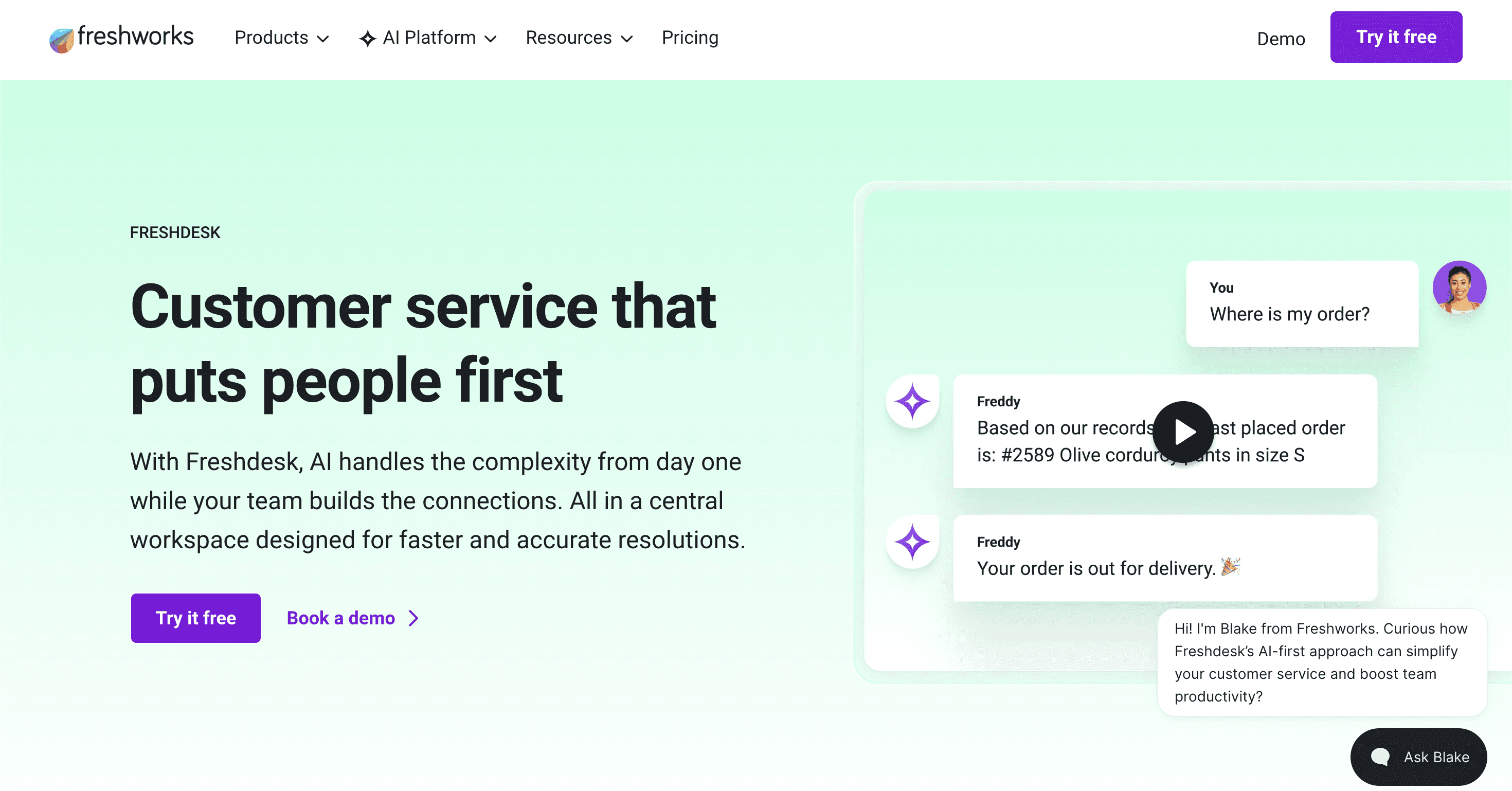
Freshdesk is the helpdesk from Freshworks, built for teams that answer customers across email, chat, phone and social. Its Freddy AI layer adds AI agents that resolve routine questions, a copilot for human agents and insights on why people get in touch.
For a restaurant group with a central guest services desk, refund requests, catering questions and gift card problems become tickets with an owner and a deadline. In November 2025, Freshworks added the Freshdesk Command Center, one workspace for every channel with Freddy AI Copilot built in.
Key features
Omnichannel ticketing: Email, chat, phone and social messages arrive as tickets in one inbox, so a complaint never sits unseen in a separate app.
Freddy AI Agent: Answers common questions on chat and email around the clock, and you build and test it in the no-code AI Agent Studio.
Freddy AI Copilot: Summarizes long threads, drafts replies and suggests the next step for your agents.
Automations: Rules assign tickets, set SLA timers and send follow-ups so nothing waits too long.
Self-service portal: A knowledge base lets guests find opening hours, refund steps or allergen details on their own.
Order lookups: Integrations such as Shopify, Stripe and FedEx bring order details into the ticket.
Pros
Low entry price: The Growth plan costs $19 per agent per month on annual billing.
AI sessions included: Each paid plan comes with 500 Freddy AI Agent sessions, once per account, so you can test automation before buying more.
Proven at scale: Decathlon and Bridgestone are among the brands with Freshworks customer stories.
Strong user rating: Freshdesk has 4.4/5 on G2 from 3,754 reviews.
Cons
No free plan: New accounts get a 14-day Enterprise trial, and the account is suspended if you don't continue on a paid plan.
Copilot costs extra: Freddy AI Copilot is a $29 per agent per month add-on, offered on Pro and Enterprise only.
Metered AI agent: After the included 500 sessions, more cost $49 per 100.
General-purpose helpdesk: Public review replies and guest surveys aren't part of it, so restaurants need another tool for those.
Price and plans
New accounts get a 14-day trial of the Enterprise plan. Prices are per agent, per month, billed annually; Freddy AI Copilot is a $29 add-on on Pro and Enterprise, and extra AI Agent sessions cost $49 per 100.
Growth: $19 per agent, per month.
Pro: $55 per agent, per month.
Enterprise: $89 per agent, per month.
4. Intercom
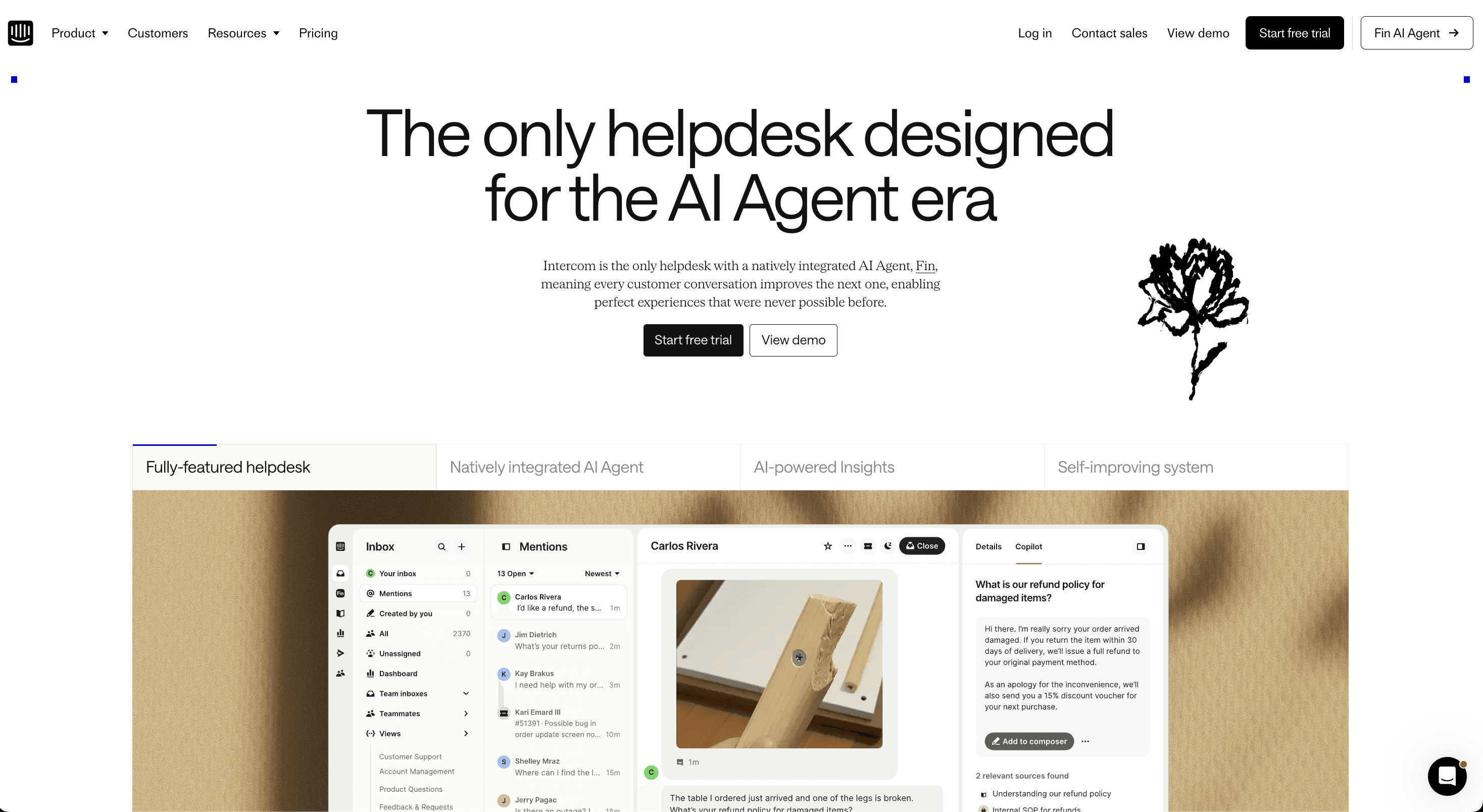
Intercom is a customer service platform built around Fin, an AI agent that answers customers from your help content, plus a helpdesk where your team takes over what Fin can't resolve. It covers chat, email, phone, WhatsApp, SMS and social messages.
The company behind it renamed itself Fin in May 2026, and Salesforce completed its acquisition in September 2026. The helpdesk keeps the Intercom name, and customers include Anthropic, Lightspeed and Synthesia.
Key features
Fin AI agent: Answers questions across chat, email, WhatsApp, SMS and social from your help articles, and passes harder cases to a person.
Fin Voice: Picks up phone calls and handles common questions, such as opening hours, before routing callers to your team.
Shared inbox and tickets: Agents work every channel from one inbox, with Copilot drafting suggested answers.
Help center: Customers search answers themselves, and the same articles feed Fin.
Proactive messages: Messages trigger on what customers do on your site or in your app, such as stalling at checkout.
Reporting: Dashboards track how Fin and your human team perform.
Pros
AI and people in one place: Fin, the inbox and the help center share context, so customers don't repeat themselves after a handoff.
Published pricing: Seat and Fin prices are on Intercom's website, and the free trial needs no credit card.
Pay per outcome: Fin is charged once per conversation it resolves, however many questions it answers along the way.
User rating: Fin by Intercom has a 4.5 out of 5 rating on G2.
Cons
Variable bill: Seats plus a fee per Fin outcome mean costs rise with conversation volume.
Copilot costs extra: The assistant for human agents is an add-on priced per agent.
Fin minimum elsewhere: Running Fin on top of another helpdesk carries a minimum monthly commitment.
General purpose: Intercom serves every industry, so restaurant work such as replying to Google or Yelp reviews needs another tool.
Price and plans
You can try Intercom free for 14 days. Seat prices are per month, billed annually, and Fin is billed by usage.
Essential: $29 per seat, per month (new customers currently see $19).
Advanced: $85 per seat, per month.
Expert: $132 per seat, per month.
Fin AI agent: From $0.99 per outcome.
Copilot add-on: $29 per agent, per month billed annually, or $35 billed monthly.
5. HubSpot Service Hub
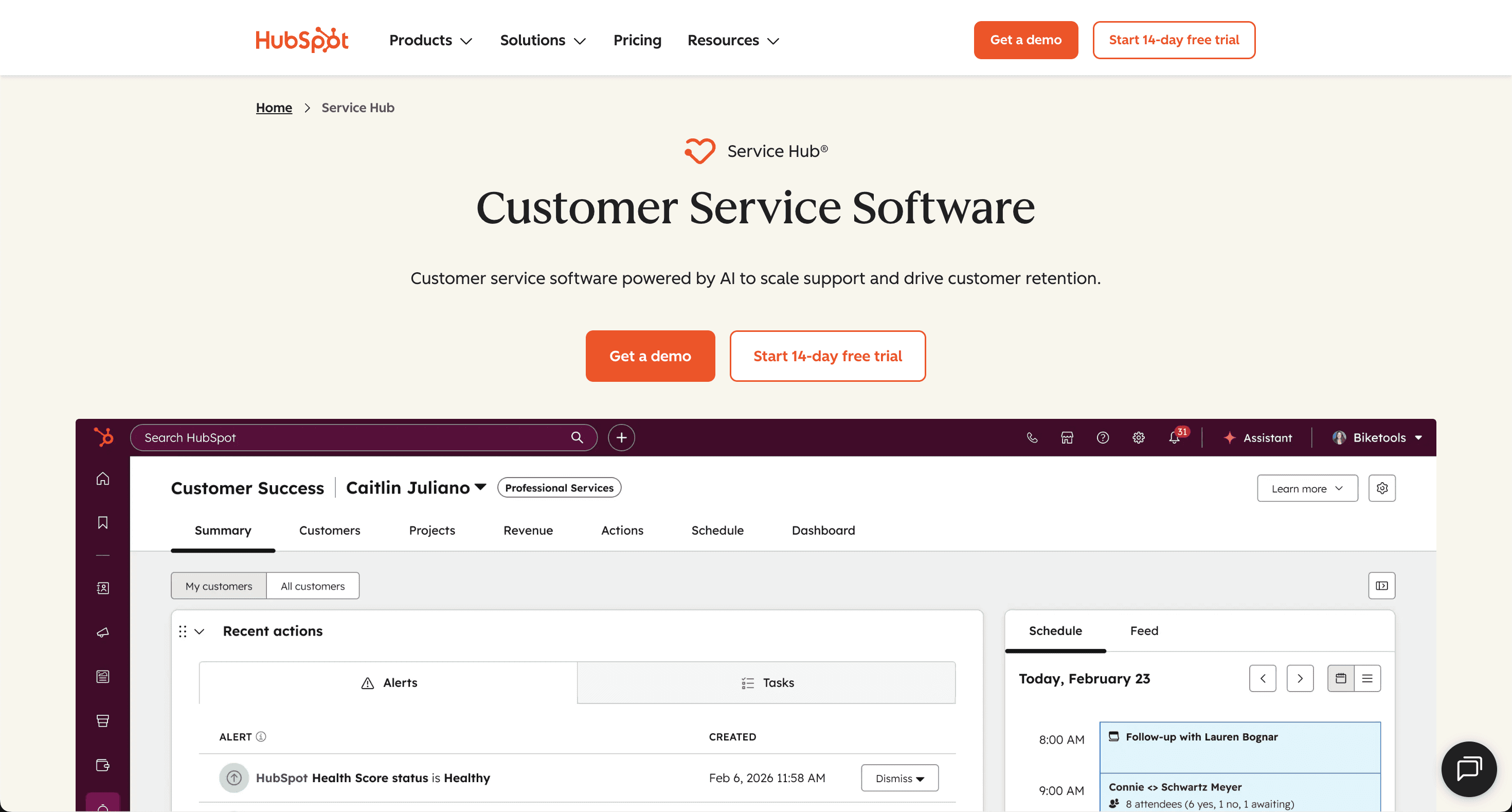
HubSpot Service Hub is customer service software built on the HubSpot CRM. It brings together a help desk with ticketing, a knowledge base, a customer portal and feedback surveys, plus Breeze Customer Agent, HubSpot's AI agent for answering customer questions.
For a restaurant brand that already runs marketing or catering sales in HubSpot, every support conversation lands on the same contact record as those emails and deals. In April 2026, HubSpot said Customer Agent resolves 65% of conversations and switched it to pricing per resolved conversation.
Key features
Help desk workspace: Email, chat, WhatsApp, Facebook Messenger and calls arrive in one queue, with routing and custom views.
Breeze Customer Agent: The AI agent answers email and chat questions around the clock from your knowledge base and hands harder cases to a person.
Self-service: A knowledge base and a secure customer portal let people find answers and check on their requests.
Routing and SLAs: Assignment workflows added in June 2026 send VIP or language-specific tickets to the right agent, and SLA rules flag anything waiting too long.
Feedback surveys: NPS, CSAT and CES results appear next to each customer's history.
Pros
One customer record: Agents see marketing emails, sales deals and past tickets before they reply.
Low-cost start: Free tools cover up to 2 users, and paid plans come with a 14-day free trial.
Pay per result: Customer Agent costs $0.50 per resolved conversation, so you pay when it closes a question.
Well rated: On G2, users give HubSpot Service Hub 4.4 out of 5 across 3,016 reviews.
Cons
Onboarding fees: Professional carries a required one-time $1,500 onboarding fee, and Enterprise one of $3,500.
Key tools on higher plans: The knowledge base and Customer Agent need Professional or Enterprise.
Best inside HubSpot: If your guest data lives in another CRM, you get less from the shared record.
No review replies: As a general help desk, it doesn't answer public reviews on Google or Yelp, so restaurants need another tool for that.
Price and plans
Free tools cover up to 2 users, and paid plans have a 14-day free trial. Paid plans are priced per seat, and AI agent use draws on HubSpot Credits.
Starter: $20 per seat, per month (HubSpot runs discounts for new customers).
Professional: $90 per seat, per month, billed annually, plus a one-time $1,500 onboarding fee.
Enterprise: $150 per seat, per month, plus a one-time $3,500 onboarding fee.
6. Salesforce Service Cloud
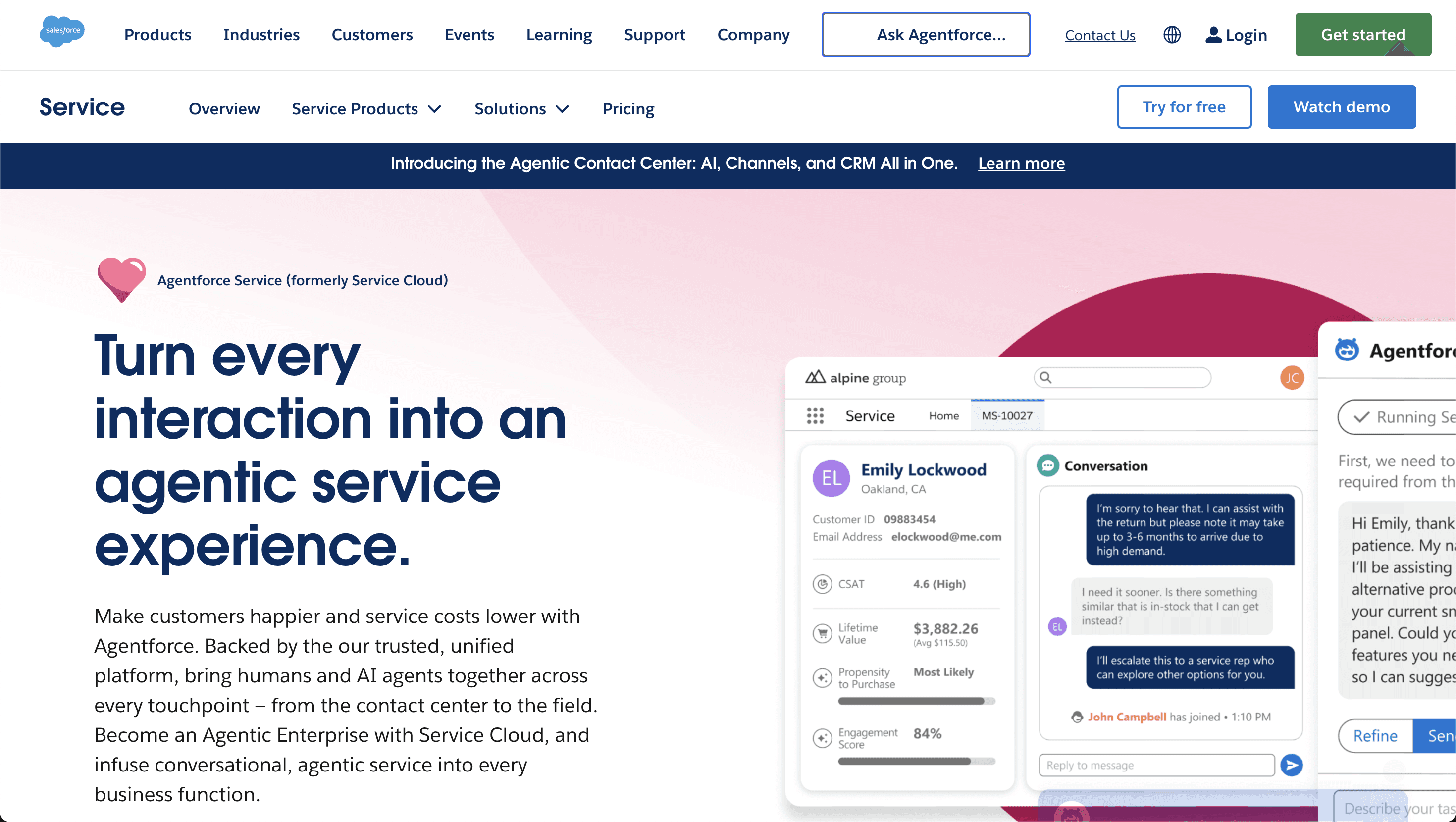
Salesforce Service Cloud is Salesforce's customer service platform, also sold under the name Agentforce Service. It brings cases from every channel into one console on top of the Salesforce CRM, with AI agents that can answer customers before a person steps in.
For a large restaurant or hospitality group, the draw is shared data: support reps and AI agents work from the same guest record your sales and marketing teams use. OpenTable runs customer service on it, and in March 2026 Salesforce launched Agentforce Contact Center, adding native voice and digital channels in the US and Canada.
Key features
Agent console: Calls, emails, chats, messaging apps and social posts arrive as cases next to the customer's full history, in one workspace.
AI agents: Agentforce agents handle common questions such as booking changes or order status at any hour and pass harder ones to your team.
Help for reps: AI drafts responses, summarizes long cases and classifies incoming requests so they reach the right queue.
Service levels: Entitlements, SLAs, routing and omni-channel queues, plus a self-service help center and dashboards on team performance.
Pros
One customer record: Service history sits beside sales and marketing data, which makes personal replies and automation easier.
Highly configurable: Routing, queues and SLA rules can follow the way each brand or location works.
Trial without a card: You can test it free for 30 days with no credit card.
Well rated: Its G2 average is 4.4 stars out of 5.
Cons
AI agents cost more: The AI agent for customer service comes with the Advanced edition at $395 per user per month, or as a paid add-on.
Metered AI: AI use draws on Flex Credits, with 500K per org on Core and 1 million on Advanced; extra credits are paid.
Annual commitments: Pro Suite and every higher edition are billed annually, and Pro Suite requires a contract.
A big platform: It's built for brands already on Salesforce, so a small team without it takes on a lot of setup.
Price and plans
Salesforce offers a 30-day free trial with no credit card, and prices are per user, per month.
Starter Suite: $25 per user, per month, billed monthly or annually; transaction fees apply.
Pro Suite: $100 per user, per month, billed annually, with a contract.
Core: $195 per user, per month, billed annually.
Advanced: $395 per user, per month, billed annually.
Max: $550 per user, per month, billed annually.
⟦embed:bnAlfieNight⟧
7. Gorgias
Gorgias is a helpdesk and AI Agent platform for online stores, built around Shopify order data. Email, chat, social, SMS and voice land in one inbox, and agents can see and change a customer's orders without leaving the ticket.
For a restaurant, it fits the part of the business that ships: packaged sauces, merch, gift cards or meal kits sold through a Shopify store. BrüMate, Tommy John and Try The World use it, and the public roadmap for 2026 focuses on tighter control over what AI Agent knows and faster responses.
Key features
Shared inbox: Messages from email, chat, social, SMS and phone calls arrive in a single queue your team works together.
Order actions: Edit, refund or cancel a Shopify order from the ticket sidebar.
AI Agent: Resolves routine questions such as order status and returns using your policies, and passes the rest to your team.
Gorgias Voice: Adds a phone menu, call routing and AI summaries of calls inside the helpdesk.
Revenue statistics: Show which support conversations ended in a sale.
Pros
Priced by volume: Plans follow ticket count and are never priced per agent, so adding seasonal staff doesn't change the bill.
Quick order fixes: With the order inside the ticket, a question about a damaged box can become a refund or replacement without switching tools.
AI paid on results: You pay for AI Agent only when it fully resolves a request.
Rated well: Gorgias has a 4.6/5 rating on G2.
Cons
Ecommerce focus: Most of the tooling assumes an online store, so a restaurant without one gets little from the order features.
Overage fees: Tickets beyond your plan cost $0.40 each on Starter and Basic, and $0.36 on Pro and Advanced.
AI counts twice: Each AI Agent interaction is charged and also counts toward your helpdesk tickets.
Revenue reports on higher plans: Revenue attribution starts on Pro, at $300 a month billed annually.
Price and plans
Gorgias offers a 7-day free trial with no credit card. Plans are priced by monthly ticket volume, and annual billing lowers the price on Basic and above.
Starter: $10 per month for 50 tickets, billed monthly.
Basic: $50 per month billed annually ($60 monthly) for 300 tickets.
Pro: $300 per month billed annually ($360 monthly) for 2,000 tickets.
Advanced: $750 per month billed annually ($900 monthly) for 5,000 tickets.
AI Agent: $0.90 per automated interaction on annual plans, $1.00 on monthly plans.
8. Kustomer
Kustomer is an AI-native customer service platform and CRM that puts every conversation, order and past issue on one customer timeline. Its AI comes in three parts: Concierge answers customers, Envoy assists human reps, and Architect helps you build and improve AI agents and workflows.
Meta divested Kustomer in 2023, and it raised a $30M Series B led by Norwest in August 2025. Its customers include sweetgreen, a useful reference for restaurant brands, along with Everlane and HexClad. In March 2026, it launched Kustomer AI, a standalone platform that adds its AI to an existing helpdesk, starting with Zendesk.
Key features
Customer timeline: Orders, chats, emails and calls sit in one record, so agents and AI see the full history before answering.
Omnichannel inbox: Email, chat, voice, SMS, WhatsApp and social messages arrive in the same workspace.
Concierge: The customer-facing AI agent resolves requests across channels using what it knows about that customer.
Envoy: Reps see order history, open issues and sentiment, with suggested replies and next steps.
Routing and workflows: AI-based routing and a workflow builder prioritize conversations and send them to the right team.
Kustomer Voice: Phone support with calls, SMS and transcription, billed by usage.
Pros
Context for automation: Because AI works from the same timeline as your agents, automated answers can draw on orders and earlier conversations.
Keeps Zendesk if you want: Kustomer AI can run on top of an existing Zendesk setup.
Restaurant reference: sweetgreen appears on its customer list.
G2 rating: Across 558 G2 reviews, Kustomer averages 4.4 out of 5.
Cons
Quote only: Enterprise and Ultimate show "Talk to Sales" in place of a price.
AI billed on top: Concierge and Envoy are add-ons with their own per-conversation or per-user fees.
Implementation fee: Some configurations need a statement of work and a separate implementation charge.
Sized for high volume: It's built for consumer brands with large contact volumes, so a single restaurant may not need this much platform.
Price and plans
Kustomer doesn't publish prices for its Enterprise and Ultimate plans; you talk to sales for a quote. Its pricing details page lists these add-on rates.
Concierge (AI agent for customers): $0.75 per engaged conversation.
Envoy (AI for reps): $50 per user, per month.
Kustomer Voice: From $0.02 per minute.
9. Help Scout
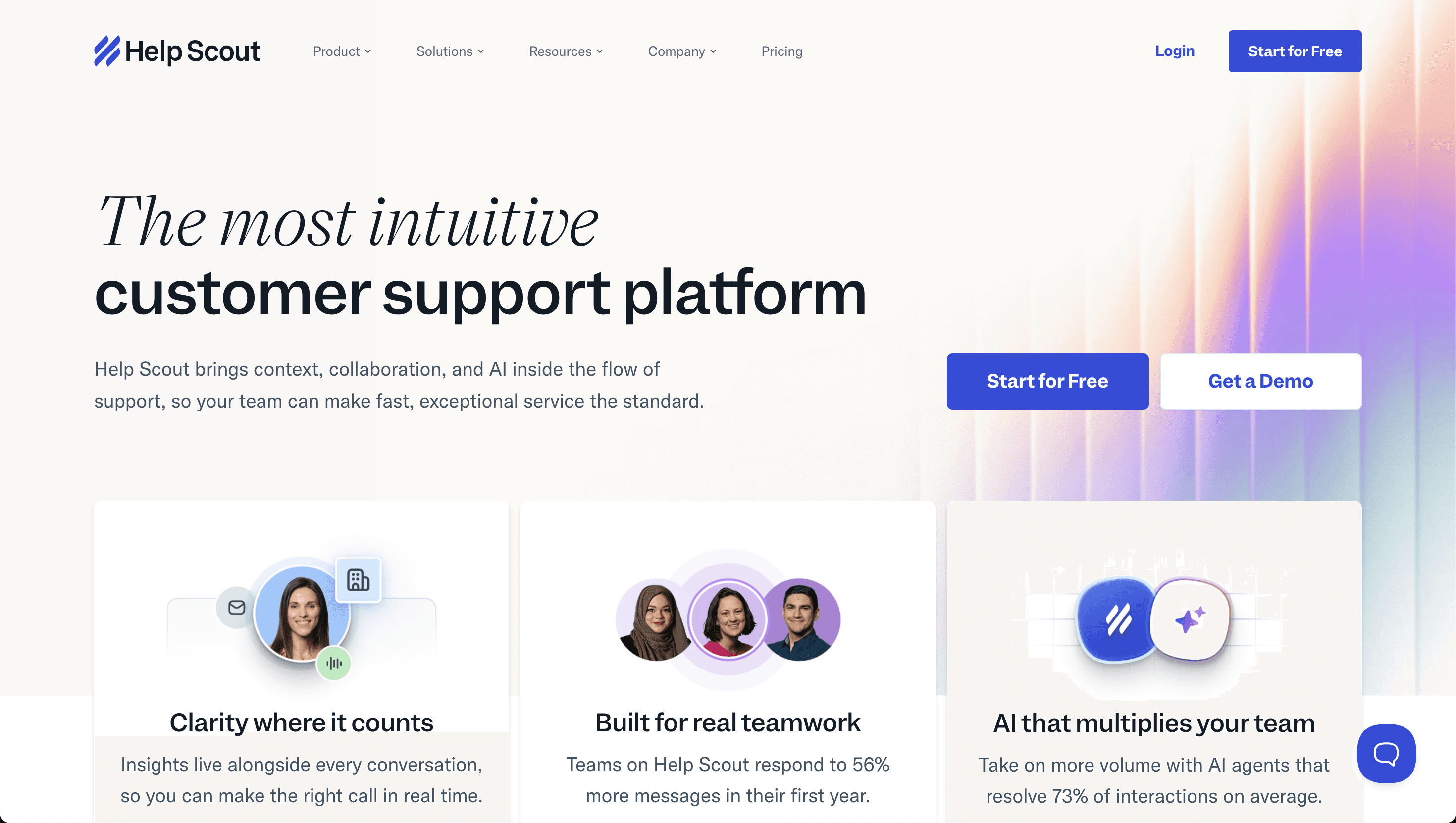
Help Scout is a help desk for small and mid-size teams that puts email, live chat, messaging and a help center into one shared inbox. An AI agent, AI Answers, replies to common questions from your knowledge base, and WhatsApp and SMS sit next to email in the same view.
For a restaurant group, it fits a guest relations team that handles catering requests, gift card questions and complaints by email and chat. In 2026, Help Scout added WhatsApp in its Winter release and native two-way SMS in August.
Key features
Shared inbox: Your team sees who is replying to what, assigns conversations and leaves private notes, so two people never answer the same guest.
Beacon live chat: A website widget offers chat and suggests help articles before a visitor sends a message.
AI Answers: Responds to common questions from your Docs knowledge base and hands the conversation to a person when it can't help.
WhatsApp and SMS: WhatsApp messages and texts through your Twilio number arrive in the same inbox as email.
AI drafts and summaries: On Plus and Pro, AI suggests replies and condenses long threads before you jump in.
Pros
Free plan: Up to 5 users can share one inbox and one Docs site at no cost.
Pay-per-result AI: AI Answers is billed only when it resolves a conversation, and you can set a monthly spending cap.
Easy trial: Standard and Plus come with a 15-day free trial and no credit card.
Well reviewed: Help Scout holds 4.4 out of 5 on G2 across 428 reviews.
Cons
AI drafts need a higher plan: Standard includes only the AI Inbox assistant; AI drafts start on Plus.
Extra AI fees: Each AI Answers resolution costs $0.75 on top of your seats.
User caps: Standard stops at 25 users and Plus at 50, while Pro requires at least 10 users and a demo.
Bring your own Twilio: SMS runs through a Twilio account you connect, and phone calls need the Aircall add-on.
Price and plans
Help Scout has a free plan for up to 5 users and a 15-day free trial on Standard and Plus. Prices below are per user, per month, billed annually; monthly billing costs about 16% more.
Standard: $25 per user, per month.
Plus: $45 per user, per month.
Pro: $75 per user, per month (minimum 10 users).
AI Answers: $0.75 per resolution, as an add-on.
10. Zoho Desk
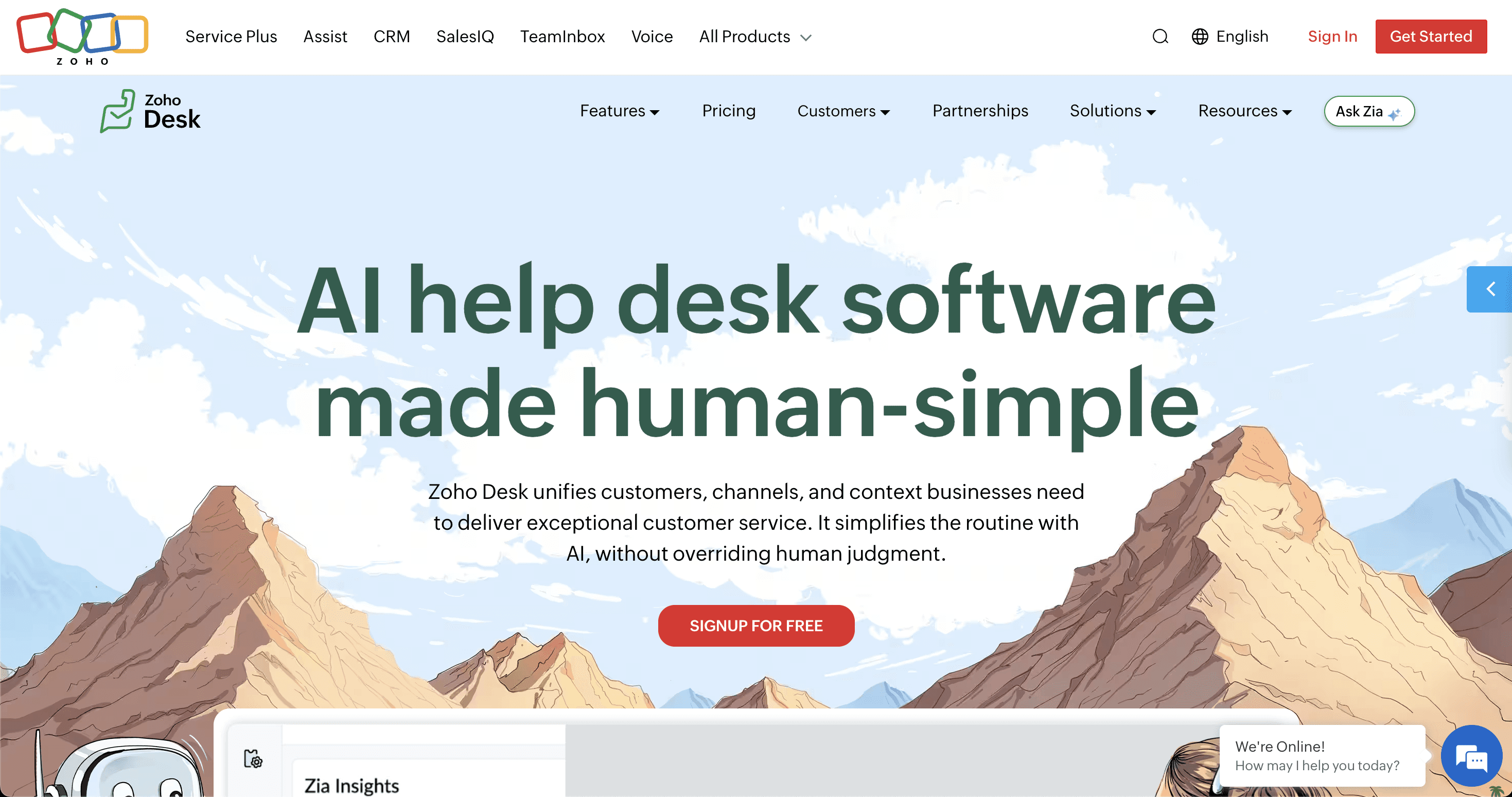
Zoho Desk is the help desk in Zoho's business software suite. It turns emails, social messages, web forms, phone calls and chats into tickets in one view, and adds self-service portals, automation and Zia, Zoho's AI assistant.
For a restaurant group, Zoho Desk makes most sense if you already run Zoho CRM or other Zoho apps, or if you want a low-cost desk for guest questions about orders, bookings and gift cards. In July 2026, Zoho extended Zia features such as sentiment analysis and auto tags to every paid edition from Standard up.
Key features
Multichannel tickets: Email, web forms, phone, social media and live chat requests arrive in a single queue, and Standard adds WhatsApp, Instagram and Facebook Messenger.
Zia AI: The assistant reads the tone of each message, tags tickets, suggests replies and flags unusual spikes in volume.
Self-service: A knowledge base, community forum and Answer Bot help guests find answers before they open a ticket.
Automation: Assignment rules, SLAs, multi-level escalations and Blueprint workflows move each ticket through the right steps.
Service reports: Customer happiness ratings and custom dashboards show how quickly and how well your team answers.
Zoho integrations: Ticket data connects with Zoho CRM and Zoho Analytics, so guest history and reporting stay in one suite.
Pros
Low cost: A free plan covers 3 users, and paid plans start at $7 per user, per month, billed annually.
Strong user rating: Zoho Desk has a 4.4 out of 5 rating on G2.
Zoho fit: Teams on Zoho CRM get tickets and customer records in the same system.
Many channels: Messaging apps such as WhatsApp and Instagram sit next to email and phone in one ticket view.
Cons
Limited free plan: The free edition covers 3 users and email ticketing with limited capabilities.
Key tools on Professional: Blueprints, telephony, multi-department support and the full Zia set start at $23 per user, per month, billed annually.
Monthly billing costs more: Standard is $20 per user on monthly billing, against $14 billed annually.
General help desk: Replying to reviews across locations and other restaurant-specific work need a separate tool.
Price and plans
Zoho Desk has a free plan for up to 3 users and a 15-day free trial of any paid plan. Annual billing prices are as follows; monthly billing costs more.
Express: $7 per user, per month.
Standard: $14 per user, per month.
Professional: $23 per user, per month.
Enterprise: $40 per user, per month.
11. LiveAgent
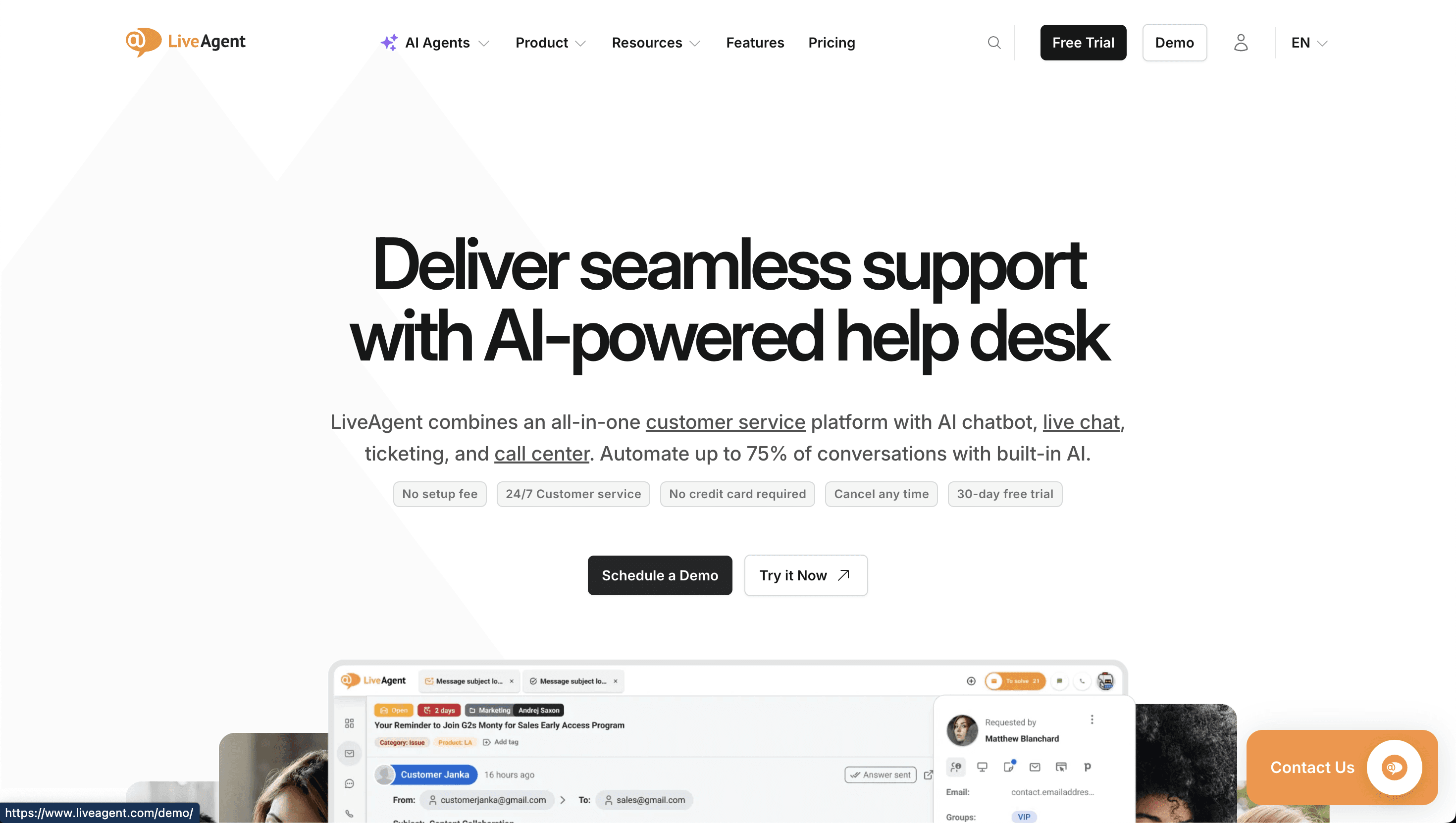
LiveAgent is an all-in-one help desk made by Quality Unit for small and growing support teams. Live chat, email tickets, phone calls and social messages share one inbox, and an AI chatbot answers routine questions before a person steps in.
Its prices are low for a tool with a built-in call center, which suits a restaurant group that wants reservation and catering calls in the same queue as website chats. Huawei and Slido are among its customers.
Key features
Universal inbox: Email, chat, calls and messages from Facebook, Instagram, WhatsApp and other channels land in one queue.
Call center: IVR menus, call routing and call recording run inside the help desk, with no separate phone system.
AI chatbot: Rolled out in early 2025, it works from your existing chat button, answers from your content in the customer's language and hands off to an agent.
AI help for agents: The AI Answer Assistant drafts replies from the ticket and your help articles, and AI summaries shorten long threads.
Rules and reports: Automation rules, ticket distribution and SLAs assign work, and real-time reports track agent performance.
Pros
Affordable entry: Starter is $15 per agent, per month on annual billing.
Phone in the same inbox: From the Team plan, calls sit next to chats and emails.
AI without a markup: AI comes on every plan, and LiveAgent adds no fee on top of your AI provider's price.
Strong ratings: LiveAgent has a 4.5/5 rating on G2 from more than 1,500 reviews.
Cons
No free plan: After the trial, you need a paid plan.
Starter is limited: Social channels, the call center and reporting start on Team.
Separate usage bills: AI usage is billed by your OpenAI, Anthropic, Google Gemini or FlowHunt account, and calls by your phone provider.
General help desk: There are no restaurant-specific tools such as review replies or loyalty offers.
Price and plans
LiveAgent has a 30-day free trial with no credit card. These are regular prices billed annually (monthly billing costs more); lower offer prices apply to trials started by November 22, 2026.
Starter: $15 per agent, per month, for up to 5 agents.
Team: $29 per agent, per month, for up to 15 agents.
Business: $49 per agent, per month.
Enterprise: $3,199 per month with 80 agents included.
12. Tidio
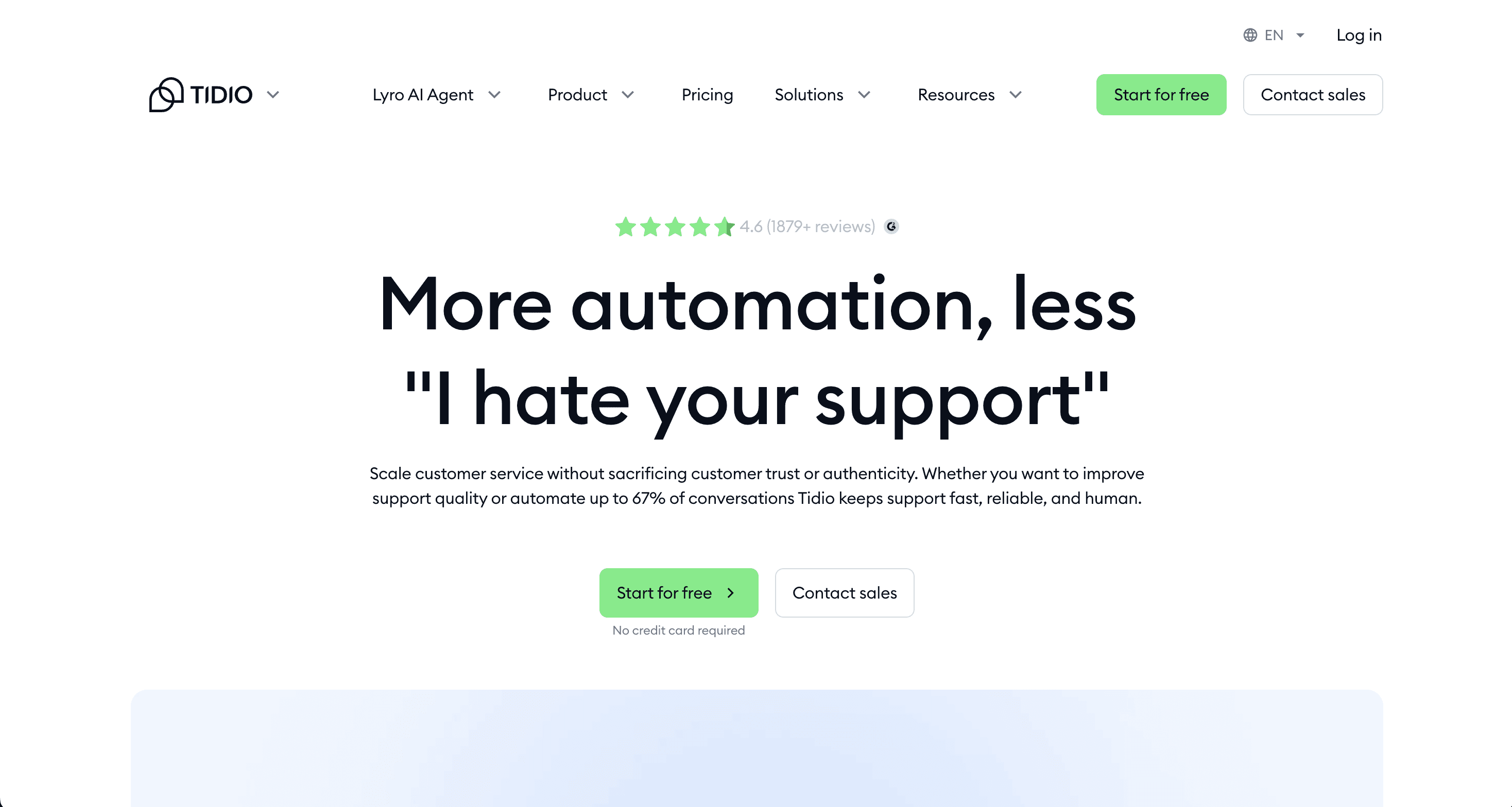
Tidio is a customer service platform for small and midsize businesses that combines a website chat widget, the Lyro AI agent, no-code Flows automations and an email help desk. For a restaurant, a bot on your site can answer questions about hours, menus or bookings while staff handle the rest from the same inbox.
In October 2026, Tidio reported that Lyro ranked first in the default view of G2's AI CX Agent Evaluations, passing 40 of 46 tasks with the highest policy-compliance score (92%) among nine agents.
Key features
Live chat widget: Install it on your website and reply to guests from a browser or the mobile and desktop apps while you're on the floor.
Lyro AI agent: It learns from your website and FAQ content, then answers questions about opening hours, menus or availability.
Handoff to staff: When a guest needs a person, Lyro passes the chat on with the conversation so far.
Flows: Drag blocks to set up greetings, lead capture or booking prompts without code.
Email help desk: Email tickets sit next to chats, and Lyro can answer those too.
Pros
Free to start: The free plan includes 10 seats, 50 billable conversations a month and 50 Lyro conversations for life.
No developer needed: Setup is guided, so a manager can launch a chat bot alone.
Low paid entry: Starter costs $24.17 a month on annual billing.
Well reviewed: Tidio holds 4.6/5 on G2 from 1,879 reviews.
Cons
Lyro is an add-on: After the first 50 free conversations, Lyro starts at $32.50 a month for 50 Lyro conversations.
Conversation caps: Plans are metered by billable conversations, with 50 a month on Free and 100 on Starter.
Limited Flows reach: Automations reach 100 visitors a month on Free and Starter; more needs the Flows add-on.
Price and plans
Tidio has a free plan and a 7-day free trial of its paid plans and add-ons, with no credit card. Prices below are per month, billed annually (2 months free).
Free: $0, with 50 billable conversations a month.
Starter: $24.17 per month, with 100 billable conversations.
Growth: From $49.17 per month, from 250 billable conversations.
Plus: From $300 per month, plus usage.
Premium: Price on request.
Lyro AI Agent add-on: From $32.50 per month for 50 Lyro conversations.
13. Ada
Ada is an AI customer service platform whose agent answers customers across chat, messaging, email and voice. Brands use it to resolve routine questions automatically and hand the rest to people through the helpdesk they already run.
Ada's 2026 releases center on one agent for every channel: the Unified Reasoning Engine arrived in February, and a July update added native AI generation in 60 languages and images in automated conversations. Customers named on its site include Cebu Pacific, monday.com and Barnes & Noble.
Key features
Unified Reasoning Engine: One intelligence layer runs the agent on voice, email, chat, WhatsApp, SMS, Instagram and in-app messages, so answers stay consistent.
Playbooks: Structured workflows guide the agent through multi-step requests on voice as well as chat and messaging.
Multilingual answers: Native generation in 60 languages lets one agent serve customers in different regions without separate scripts.
APIs and MCP: Open APIs, SDKs and MCP support connect the agent to your business systems, so it can look things up and complete tasks.
Human handoff: Integrations with Zendesk, Salesforce, Dixa and other helpdesks pass a conversation to your agents when someone needs a person.
Audit logging: Enterprise audit logs support security and compliance reviews.
Pros
Focused on the AI agent: Ada concentrates on automated service, and the same agent works across text and voice.
Fits your stack: It connects to Zendesk, Salesforce, ServiceNow, Genesys and other contact-center tools.
Compliance coverage: Ada lists SOC 2, HIPAA, GDPR and PCI DSS among its certifications.
Rated well: Ada scores 4.6 out of 5 on G2.
Cons
No public prices: Pricing comes after a 30-minute call with Ada's team.
Volume-based cost: The default model charges for every conversation, so the bill grows with traffic.
Handoff through your helpdesk: When a guest needs a person, Ada passes the chat to a helpdesk you connect, such as Zendesk or Salesforce.
Enterprise scale: Ada is built for brands with high support volume, so a smaller restaurant group may not have enough conversations to justify it.
Price and plans
Ada doesn't publish prices. Most customers pay per conversation, and a resolution-based model is available for some enterprises; you get a quote after a demo.
14. Aircall
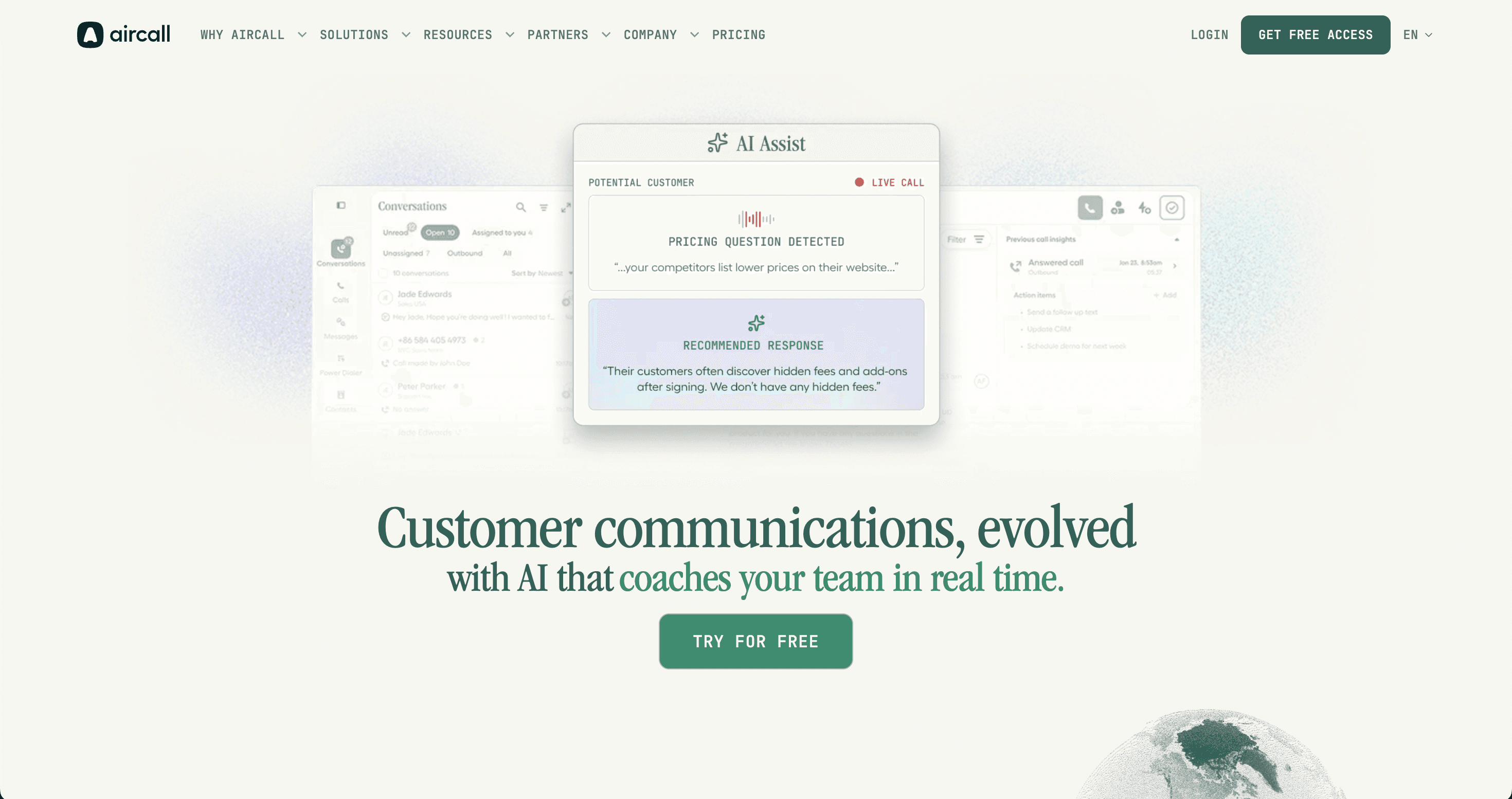
Aircall is a cloud phone system for sales and support teams, now positioned as an AI-powered communications platform. Besides business numbers, routing and call recording, it offers an AI Voice Agent for routine calls and AI Assist to transcribe and summarize conversations. Aircall says more than 22,000 businesses use it.
Restaurant support teams still take calls about hours, bookings, catering and order problems, and Aircall connects those calls to the helpdesk or CRM that holds the rest of the conversation. In May 2026 it bought Vogent, a San Francisco voice AI company, to improve how its agent handles live calls.
Key features
Numbers and call flows: Local, toll-free and international numbers, with IVR menus, queues, routing and business hours.
AI Voice Agent: Answers routine questions such as opening hours or directions from your FAQs, day and night, and since September 2026 it can also run outbound call campaigns.
AI Assist: Produces call transcripts, summaries, action items and sentiment, and syncs them to your CRM.
Supervisor controls: Managers can listen in live, whisper to an agent, join a call and review recordings.
Messaging: Text guests by SMS or MMS from a shared inbox, with WhatsApp available too.
Integrations: 250+ connections, including Salesforce, HubSpot, Zendesk and Intercom, put the caller's history on screen.
Pros
Works with your helpdesk: Calls and texts sync into the CRM or helpdesk your team already uses.
After-hours coverage: Every plan includes 50 minutes of AI Voice Agent calls each month.
Clear entry price: Published plans start at $30 per license per month.
Well rated: G2 reviewers rate Aircall 4.4/5, based on 1,682 reviews.
Cons
Three-license minimum: Essentials and Professional need at least 3 licenses, and Enterprise starts at 25.
Summaries cost more on Essentials: AI call summaries are included in Professional; on Essentials they need the AI Assist add-on.
Usage-based AI minutes: Voice agent calls beyond the included minutes cost $0.29 a minute pay as you go, or come in bundles.
Phone-first: Email tickets and live chat need a separate helpdesk, which Aircall connects to.
Price and plans
Aircall has a 7-day free trial. Plans are priced per license, per month, billed annually (annual billing saves 25%), with a minimum of 3 licenses.
Essentials: $30 per license, per month.
Professional: $50 per license, per month.
Enterprise: Custom pricing, from 25 licenses.
15. Re:amaze
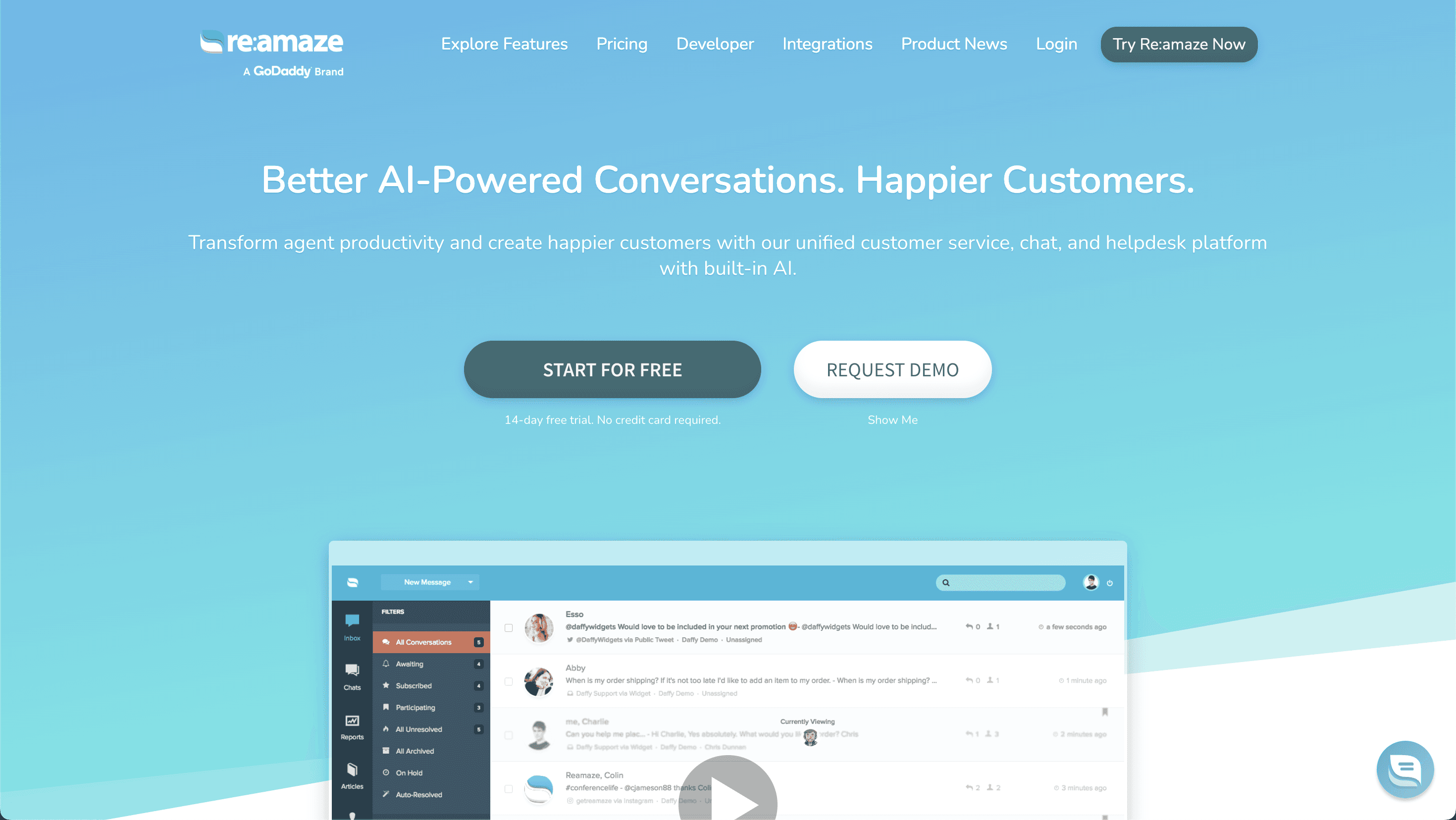
Re:amaze is a helpdesk and AI customer service platform for ecommerce and online businesses, sold as Re:amaze by GoDaddy. It brings email, live chat, social, SMS and voice into one shared inbox, adds chatbots and an AI agent, and lets you run several brands from a single account.
It fits food and drink brands that sell online, where most support questions are about orders. In 2025, Re:amaze moved its message sorting (Intents) onto AI and extended the same AI context to response templates, quick replies and its shopper and FAQ bots.
Key features
Shared inbox: Email, live chat, social media, SMS, VoIP and video calls land in one queue your whole team can see.
AI Agent: Still in beta, it learns from your help content and answers questions on chat, email and SMS.
Order context: Shopify and BigCommerce order details appear inside each conversation.
Cues and chatbots: Proactive chat messages fire when a visitor meets a rule you set, and bots handle routine questions.
Multi-brand support: Each brand keeps its own inbox, help center and look under one login.
Pros
Faster order answers: Agents see purchase details in the conversation, so delivery and refund questions need fewer lookups.
Several storefronts, one team: Pro and Plus include unlimited brands.
Flexible published pricing: Per-user plans sit beside a flat-rate Starter plan with unlimited team members.
Easy to try: The 14-day trial includes every Plus feature and needs no credit card.
Well rated: Re:amaze averages 4.6 out of 5 in G2 reviews.
Cons
AI limits: The AI Agent is still in beta, and each user gets 5, 10 or 20 AI resolutions a month, depending on the plan.
Basic is single-brand: Running more than one brand requires Pro or Plus.
Ecommerce focus: Its integrations center on online stores, so a restaurant group that needs POS or reservation data in support may need another tool.
Price and plans
Re:amaze offers a 14-day free trial with all Plus features and no credit card. Prices are per team member, per month on monthly billing; annual billing costs less.
Basic: $29 per team member, per month ($26.10 billed annually); one brand.
Pro: $49 per team member, per month ($44.10 billed annually); unlimited brands.
Plus: $69 per team member, per month ($62.10 billed annually); unlimited brands.
Starter: $59 per month, flat, for unlimited team members and up to 500 responded conversations a month.
16. Front
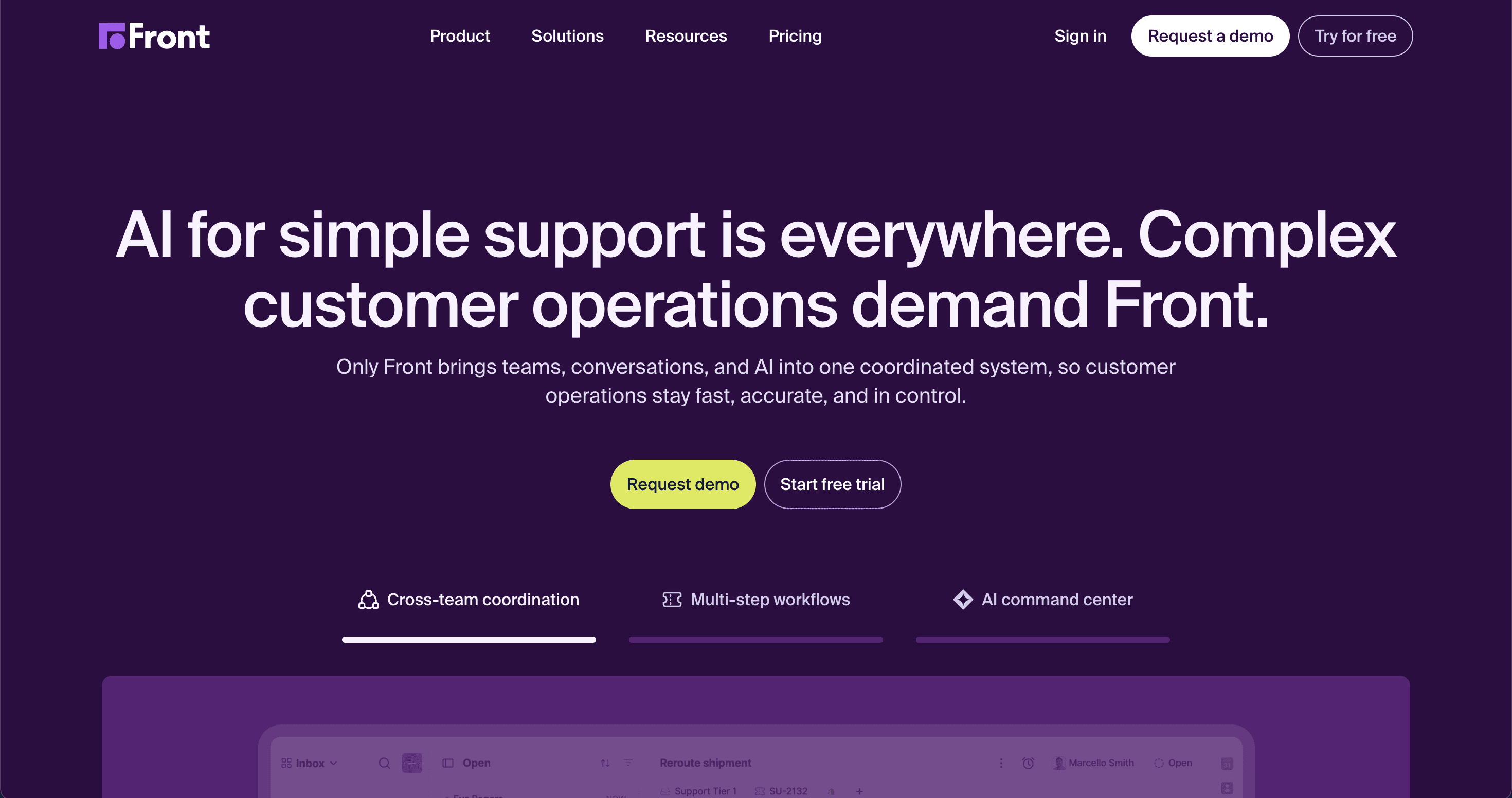
Front is a customer operations platform that looks like email and works like a helpdesk. Shared inboxes bring together email, SMS, chat and social messages, each conversation gets an owner, and AI agents can take on routine requests.
It suits a restaurant group whose guest relations team handles catering inquiries, event bookings and supplier threads by email as much as by chat. Front launched its Autopilot AI agent in September 2025, and in June 2026 it opened a beta that lets outside AI agents work inside Front as teammates.
Key features
Shared inboxes: A catering email, a text from a regular and a website chat can sit in one view, with a clear owner for each.
Internal comments: Teammates discuss a conversation with comments and @mentions that the guest never sees.
Rules and SLAs: Route messages by location or topic, schedule follow-ups and escalate anything close to missing its SLA.
Autopilot and Copilot: Autopilot resolves common requests on its own, and Copilot drafts replies and suggests next steps for agents.
AI Topics and analytics: See the most common reasons guests get in touch, along with response times and workload by person or inbox.
Knowledge base: Publish answers to frequent questions, such as allergen policies or catering minimums.
Pros
Familiar workflow: Teams used to email get assignment, SLAs and AI without moving to a rigid ticket queue.
Flexible AI: Use Front's own agents or connect outside agents built with tools such as Claude or Sierra.
Free trial without a card: The 14-day trial includes every Professional feature.
Highly rated: Front has a 4.7/5 rating on G2.
Cons
One channel on Starter: Support across email, SMS, social and chat starts on Professional at $65 per seat each month.
AI add-ons: Below Enterprise, Copilot is $20 per seat per month, and Autopilot is billed per conversation on every plan.
Seat-based cost: Every agent needs a paid seat, so a growing team raises the bill.
Onboarding fee for large contracts: Front requires an onboarding package for contracts over $25k.
Price and plans
You can try Front's Professional features free for 14 days without a credit card. Annual prices per seat are below.
Starter: $25 per seat, per month, up to 10 seats.
Professional: $65 per seat, per month, up to 50 seats.
Enterprise: $105 per seat, per month.
Autopilot: From $0.05 per conversation, as an add-on.
17. Gladly
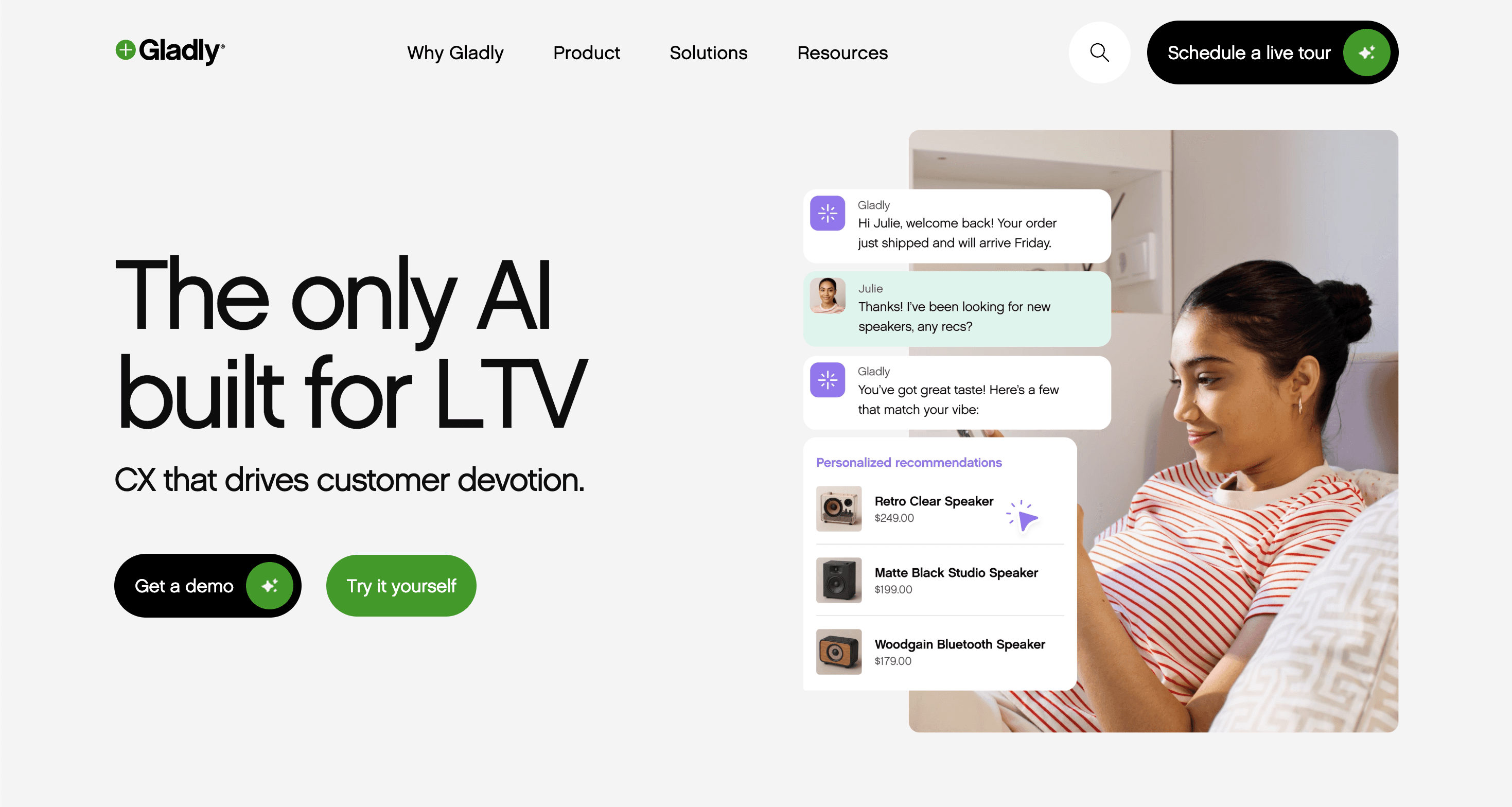
Gladly is a customer service platform organized around the customer: each person has one lifelong conversation that spans voice, email, chat, SMS and social. It now calls itself an agentic commerce platform, with Gladly AI resolving requests and Team Assist helping human agents.
Most of its named customers are retailers, such as Ulta Beauty, Rothy's and Nordstrom, and Breeze Airways is its reference in travel and hospitality. In May 2026, at Gladly Connect Live, it announced agentic commerce features that let one AI handle buying questions and service requests such as exchanges.
Key features
Lifelong conversation: Calls, emails, chats, texts and social messages from one person appear as a single thread.
Customer profile: Agents see past interactions and order data beside the conversation.
Gladly AI: AI answers and resolves common requests on every channel, then hands off to a person with the context attached.
Team Assist: Human agents get AI help with context and replies during live conversations.
People-based routing: Conversations go to agents based on who the customer is and their history.
Service reporting: Managers track team performance and customer satisfaction.
Pros
History follows the guest: A regular who calls one week and texts the next reaches an agent who can see both.
Shared record for AI and staff: Handoffs from AI to a person keep the conversation intact.
Hospitality use cases: Its travel and hospitality offering covers booking changes, cancellations and service based on loyalty status.
Highly rated: G2 users give Gladly an average of 4.7 out of 5, from 1,113 reviews.
Cons
Retail focus: Its homepage pitches a "retail-trained" AI commerce solution, and its hospitality page names no restaurants.
No trial or price list: The pricing page leads to a demo and a sales conversation.
Enterprise scale: It's built for mid-market and enterprise consumer brands, so a small restaurant group may need less.
Price and plans
Gladly doesn't publish prices or offer a listed free trial; you book a demo and get a quote from its sales team.
18. Sprinklr Service
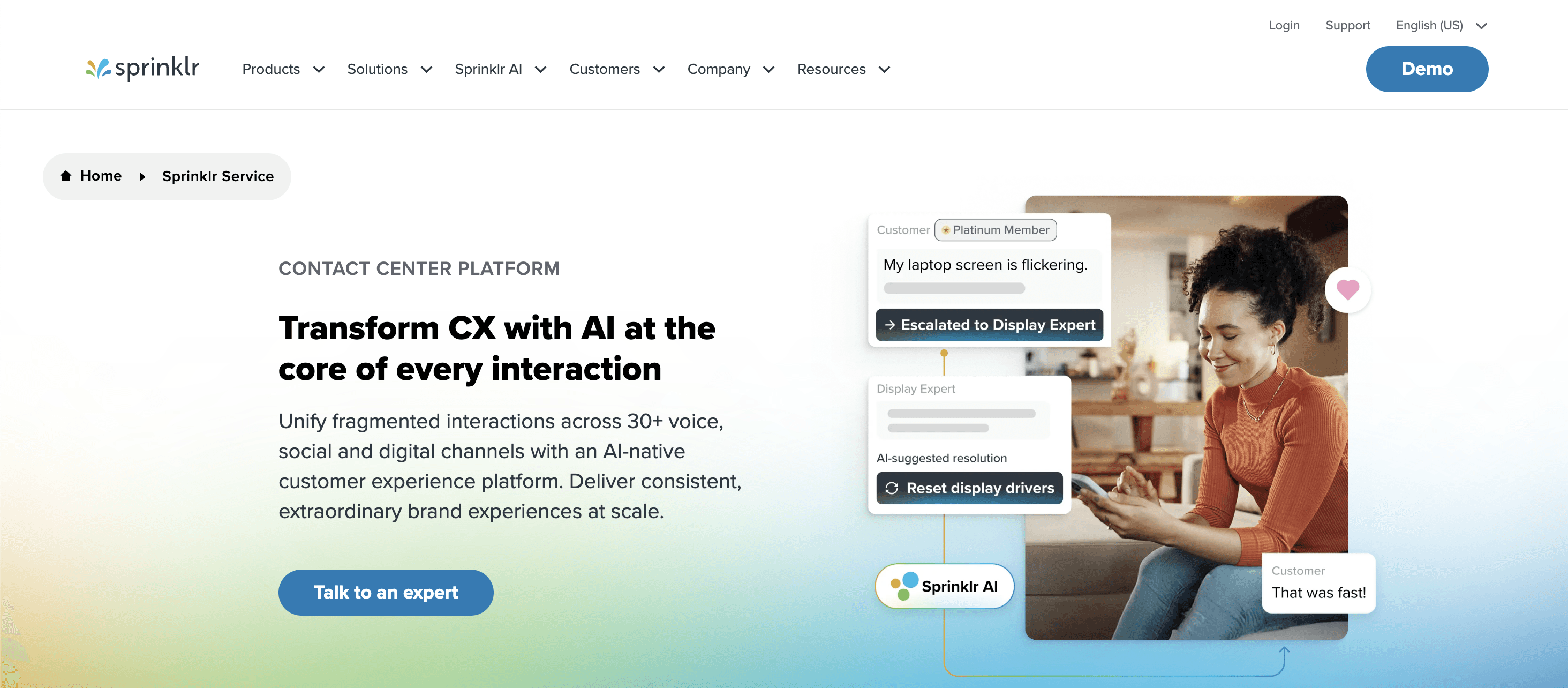
Sprinklr Service is the AI contact center product in Sprinklr's customer experience suite. It brings voice, social, messaging, email and chat, which Sprinklr counts as 30+ channels, into one agent console with AI agents, an agent copilot and quality tools.
Its customers include Deutsche Telekom, 3M, Telefonica and Gulf Bank. That's the scale it's built for: global brands with large contact centers, including international restaurant and hospitality chains that handle service across social, messaging and voice.
Key features
One console for every channel: Calls, WhatsApp, LINE, WeChat, social comments, review sites, email and chat reach agents in the same place, with the customer's history attached.
Routing by intent and sentiment: AI routing matches each case to an agent by skill and capacity, and sentiment analysis helps upset customers reach someone sooner.
AI agents and voice bots: Customer-facing AI agents handle routine requests and FAQs in your brand voice.
Agent Copilot: Suggests responses, pulls relevant articles and summarizes each conversation; the April 2026 release added proactive nudges during live conversations.
AI+ Studio: Build AI agents and test them against simulated conversations before launch, then keep scoring them once live.
Contact center operations: Workforce management, quality management and analytics on 100% of conversations are part of the suite.
Pros
Broad channel coverage: Social care across 25+ social channels runs next to voice and messaging, on one set of customer data.
AI tested before launch: Autonomous Evaluation puts AI agents through simulated scenarios before customers ever see them.
Feedback built in: Omnichannel surveys and AI-predicted CSAT bring customer feedback into the service data.
G2 rating: Sprinklr Service scores 4.3 out of 5 on G2 from 774 reviews.
Cons
Custom pricing only: Sprinklr doesn't publish prices, and you get a quote after a demo.
Enterprise scope: It's sized for large, multi-country contact centers, so a restaurant group with a small guest relations team may need far less.
Learning curve: G2 reviewers most often name the learning curve and cost as drawbacks.
Price and plans
Sprinklr doesn't publish prices for Sprinklr Service; you get a custom quote after a demo.
Customer Support Software: FAQ
What is customer support software?
Customer support software brings customer conversations from channels like email, chat, phone, social media and SMS into one place so your team can answer them. Most tools add ticket routing, automated replies to common questions, a self-service help center and reports on team performance. Many now include AI that drafts responses or resolves simple questions on its own.
Does a restaurant need customer support software?
A single small location can usually keep up with guest messages by hand. Once you run several locations or a franchise, questions and reviews arrive across many channels and stores, and fast, consistent replies get much harder. Software helps you see everything in one inbox and respond quickly wherever guests reach out.
What's the difference between a helpdesk and a chatbot?
A helpdesk organizes conversations into an inbox or tickets so your human team can assign, track and answer them. A chatbot answers common questions automatically, such as opening hours, menu questions or reservation availability, and hands the guest to a person when needed. Many platforms combine both, so the bot handles routine questions and your team takes the rest.
How much does customer support software cost?
Many helpdesks charge per agent or per seat each month, and several offer a free plan for small teams. Enterprise platforms and specialized sales chat tools usually cost much more, and some only share pricing on request. Count how many people will use the tool and which channels you need before comparing quotes.
How do I choose customer support software for my business?
Start with where your customers contact you and pick a tool that covers those channels in one inbox. Then check how well it fits your industry, since many popular helpdesks are built for SaaS or e-commerce workflows like order lookups and refunds. Integrations with your existing CRM or POS, ease of setup and AI features that cut repetitive work matter next.
Which customer support tool is built for restaurants?
Momos was built only for restaurants and helps enterprise brands scale customer support across their locations. Its AI agent, Alfie, reads guest emotion from the review wording, visit history and preferences, then writes an on-brand, personalized reply within minutes. It can also issue points, coupons and offers from your loyalty platform.


 AIエージェントが、貴店の全店舗におけるすべてのお客様対応を年中無休・24時間体制で自動化します。


" transform="translate(3.219 19.212)" width="152.45224485148515px"/><path d="M 0 11.619 C 7.071 11.39 33.491 21.738 40.35 21.268 C 38.499 18.19 37.116 14.915 35.507 11.625 C 33.7 7.867 32.587 3.926 31.702 0" fill="transparent" height="21.28391189647101px" id="I9fuJaf7q" stroke-dasharray="" stroke-linecap="round" stroke-linejoin="round" stroke-width="4.97" stroke="rgb(0, 0, 0)" transform="translate(139.727 55.754)" width="40.34950693069311px"/></svg>)